
Key Statistics at a Glance
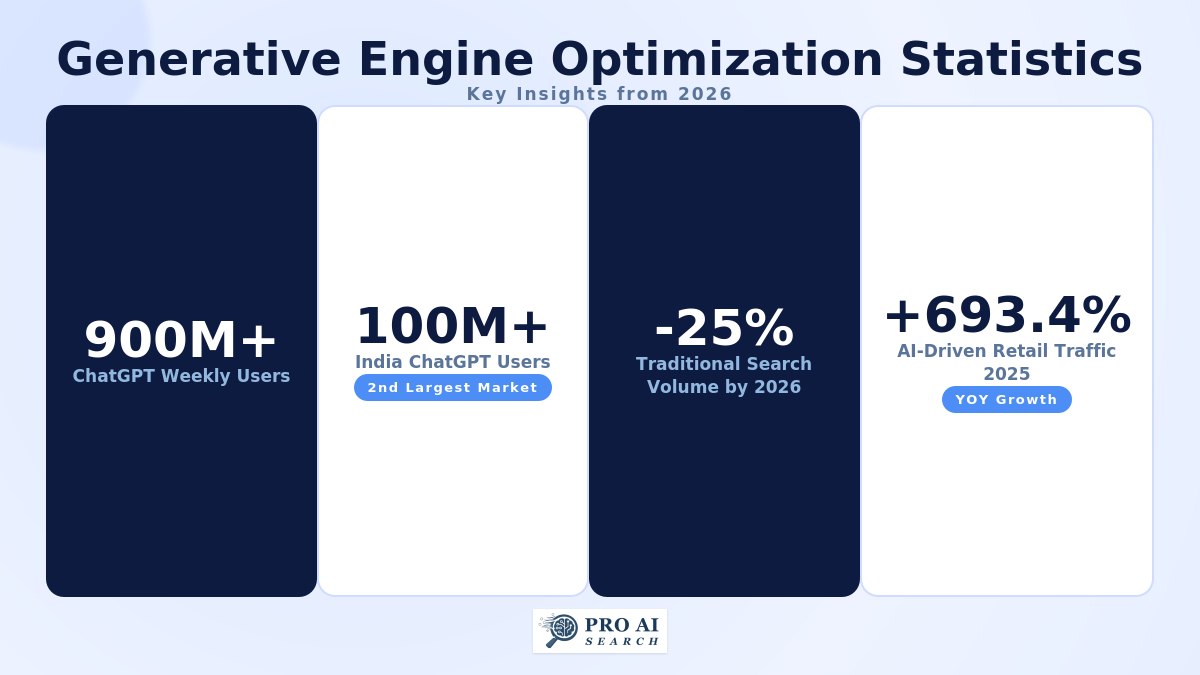
- ChatGPT has reached 900 million weekly active users globally as of February 2026
- India is OpenAI’s second-largest market with more than 100 million weekly users
- Traditional search engine volume will drop 25% by 2026 due to AI chatbots and virtual agents
- AI-driven referral traffic to US retail sites increased 693.4% year over year during the 2025 holiday season
- Google AI Overviews triggered for 15.69% of queries in November 2025, down from a peak of 25% in July
- Zero-click rate for keywords with AI Overviews has slowly declined since January 2025
The generative engine optimization statistics from 2026 show a fundamental shift in how people search for information online. I first saw this happening in late 2024 while managing search strategy for VEGA AI at LearnQ India. We were tracking organic traffic the usual way when I noticed something unexpected: referral traffic from chatgpt.com and perplexity.ai kept growing, even though we had done nothing specific to optimize for those platforms.
At the time, I did not have a name for what was happening. We just knew that some pages were performing better in AI search results than others. Now we have data that confirms what many of us suspected: AI search is not coming, it is already here.
The numbers tell a story that goes beyond simple statistics. They reveal how businesses need to think about content, citations, and visibility in an AI-first world.
How Big Has AI Search Actually Become?
ChatGPT has reached 900 million weekly active users according to TechCrunch’s February 2026 report. To put that in perspective, that is more weekly active users than Instagram had when it was acquired by Facebook. This is not a niche tool anymore.
For a complete breakdown of AI search adoption data, see our AI Search Statistics 2026 guide.
Think of it this way: if ChatGPT were a country, it would be the third most populous nation on Earth. Every week, 900 million people are asking it questions instead of typing those same questions into Google.
The growth rate is staggering. OpenAI added 200 million users in just five months. That is faster adoption than any consumer technology we have seen, including smartphones and social media.
For anyone running a business, this shift matters. Your potential customers are increasingly starting their research in ChatGPT or Perplexity instead of Google. If your content is not showing up in those AI responses, you are invisible to a rapidly growing segment of your audience.
I saw this firsthand at Pro AI Search. We started tracking AI citations in mid-2024, and the percentage of our traffic coming from AI sources has grown every single month since then.
Why India Leads in AI Search Adoption
India is OpenAI’s second-largest market with more than 100 million weekly users, according to TechCrunch’s analysis of OpenAI’s global reach. That means roughly one in every nine ChatGPT users globally is in India. Only the United States has more users.
This is not an accident. India’s digital-first population, combined with high mobile penetration and English literacy, makes it the perfect market for AI search adoption. Students in Pune are using ChatGPT to research college applications. Manufacturers in Ahmedabad are asking Perplexity how to reach international buyers. SMBs in Indore are getting marketing advice from Claude.
The India numbers also reveal something counterintuitive: AI search is not just for tech-savvy early adopters anymore. According to OpenAI’s data, 18 to 24 year olds account for nearly 50% of ChatGPT usage in India. These are college students, young professionals, and entrepreneurs who have no memory of a time when you had to scroll through 10 blue links to find an answer.
For Indian businesses, this creates both an opportunity and a risk. The opportunity is that AI search is democratizing access to information in ways that favor quality content over big marketing budgets. A small business in Bangalore with genuinely helpful content can get cited in ChatGPT responses alongside multinational competitors.
The risk is that if you are still optimizing only for Google, you are missing where your audience has already moved. I talk to business owners every week who are still focused entirely on traditional SEO while their competitors are quietly building visibility in AI search results.
How Traditional Search Volume Is Declining
Traditional search engine volume will drop 25% by 2026 due to AI chatbots and other virtual agents, according to Gartner’s February 2024 prediction. We are now in 2026, and that prediction is proving accurate.
This does not mean SEO is dead. It means the nature of search optimization is evolving. Think of it like the shift from desktop to mobile. Companies that adapted early to mobile-first design thrived. Those that waited struggled to catch up.
The 25% decline is not evenly distributed across all queries. Informational queries (how to, what is, best practices) are moving to AI search faster than transactional queries (buy, near me, discount codes). This makes sense. AI is excellent at synthesizing information and explaining concepts. It is less good at helping you complete a purchase, at least for now.
What surprises most people is that this decline is not killing traditional SEO. It is forcing it to get better. The pages that still rank well in Google are also the ones getting cited in ChatGPT and Perplexity. Good content practices work across both traditional and AI search.
I learned this the hard way. At VEGA AI, we had some pages that ranked well in Google but never got AI citations. They were keyword-stuffed, long, and structured for search engines rather than humans. When we rewrote them to answer questions directly in the first two paragraphs, they started appearing in AI responses within weeks.
The pattern was obvious in hindsight: AI search rewards the same content qualities that human readers appreciate. Clear answers. Credible sources. No jargon. No fluff.
What AI-Driven Referral Traffic Reveals About Purchase Intent
AI-driven referral traffic to US retail sites increased 693.4% year over year during the 2025 holiday season, according to Adobe’s analysis of digital commerce trends. That is not a typo. Nearly seven times more referral traffic from AI sources in one year.
This statistic matters because referral traffic from AI is different from traditional search traffic. When someone clicks through from a ChatGPT response, they are not browsing. They have already done their research. The AI has pre-qualified them.
Think about how you use AI search versus Google. On Google, you might search “best running shoes,” scroll through several results, read reviews, compare prices, then search again with more specific criteria. On ChatGPT, you ask “what are the best running shoes for flat feet under $150,” get a detailed answer with specific recommendations, then click through to buy.
The user journey is compressed. The AI has already done the comparison work. This means AI referral traffic often has higher conversion rates than traditional organic search traffic.
For Indian e-commerce businesses, this creates a massive opportunity. Imagine a small furniture maker in Jodhpur who creates detailed product pages with specifications, materials, and use cases. When someone asks ChatGPT “what is the best solid wood study table under Rs 15,000,” that business can get cited and receive highly qualified traffic.
The 693.4% growth in AI referral traffic is not evenly distributed. It is concentrated among businesses that have optimized their content for AI citations. The gap between businesses that understand generative engine optimization and those that do not is widening rapidly.
How Google AI Overviews Are Evolving
AI Overviews triggered for 6.49% of queries in January 2025, rose to 25% in July, then settled at 15.69% in November 2025, according to Semrush’s comprehensive AI Overviews study. The fluctuation tells us something important: Google is still figuring this out.
The spike to 25% in July was Google being aggressive with AI Overviews, probably too aggressive. Users complained that AI summaries appeared for queries where they wanted to see multiple sources and perspectives. Google pulled back.
The current 15.69% trigger rate suggests Google has found a balance. AI Overviews appear for informational queries where a summarized answer is genuinely helpful. They do not appear for queries where users want to browse options or see diverse viewpoints.
This matters for content strategy. If you are creating content that answers specific factual questions (how to fix a leaking tap, what documents are needed for a passport, how does compound interest work), you should optimize for AI Overviews. If you are creating content where opinion and perspective matter (best neighborhoods in Mumbai, should I invest in crypto, is freelancing better than a job), traditional search results are still dominant.
I track AI Overview triggers for Pro AI Search content every week. Our how-to guides and technical explainers trigger AI Overviews about 40% of the time. Our opinion pieces and case studies almost never do. This aligns with what Semrush found across millions of queries.
Why Zero-Click Rates Are Declining for AI Overviews
Zero-click rate for keywords with AI Overviews has slowly declined since January 2025, according to the same Semrush study. This is the opposite of what most people expected.
The conventional wisdom was that AI Overviews would kill click-through rates. If Google gives you the answer right at the top, why would you click? But the data shows something more nuanced.
Users are clicking through from AI Overviews because the summary creates interest rather than satisfying it completely. Think of it like a movie trailer. A good trailer does not give away the whole plot. It gives you enough to make you want to watch the film.
AI Overviews work the same way. They answer the basic question but often leave details, context, or related information that makes users click through to learn more. This is especially true for complex topics where a three-paragraph summary cannot cover everything.
For content creators, this is actually good news. It means AI Overviews are driving traffic, not stealing it. But only if your content deserves the click. If your article just repeats what the AI Overview already said, users have no reason to visit. If your article goes deeper, adds context, or provides specific examples, they will click.
I have seen this pattern in Pro AI Search’s traffic data. Articles that get featured in AI Overviews actually see traffic increases, not decreases. But only if the full article delivers more value than the summary.
What These Statistics Mean for Content Strategy in 2026
The generative engine optimization statistics from 2026 point to three clear strategies that work:
First, answer the question in the first two paragraphs. AI engines prioritize content that gets to the point quickly. If your answer is buried in paragraph seven, the AI will cite someone else who answered it in paragraph one.
Second, cite your sources. AI engines give more weight to content that links to credible external sources. This is counterintuitive for traditional SEO, where external links were often seen as sending authority away from your site. In AI search, external links signal that you have done your research.
Third, structure for scannability. Use clear H2 and H3 headings formatted as questions. Use short paragraphs. Use bullet points for lists. AI engines parse structured content more easily than long blocks of text.
To understand how GEO differs from traditional optimization, read our guide on GEO vs SEO.
These are not tricks or hacks. They are good content practices that have always existed but are now being rewarded by AI algorithms in the same way Google’s algorithm rewards them.
For Indian businesses specifically, there is a fourth strategy: include local context. When writing about business topics, use Indian examples. When discussing pricing, use rupees. When citing data, prioritize Indian sources where available. AI engines are getting better at understanding geographic context and serving locally relevant answers.
How AI Search Will Continue Evolving Through 2026
The statistics we have seen so far are from early 2026. AI search is still in its first inning. Based on current trends, here is what I expect for the rest of 2026:
ChatGPT’s user base will likely hit 1 billion weekly active users by Q4 2026. The growth rate has been consistent, and there are no signs of it slowing down. India will probably account for 150 million of those users by year end.
Google AI Overviews will stabilize around 20-25% of total queries. Google has found the sweet spot where AI summaries add value without frustrating users who want traditional results. Expect more AI Overview features like inline citations and related questions.
AI-driven referral traffic will continue growing triple digits year over year. As more businesses realize that AI search drives high-intent traffic, competition for AI citations will increase. Getting cited will become harder, which makes starting now even more important.
Traditional search volume will continue declining, but not disappearing. Google is still the dominant search engine and will be for years. But the mix is shifting. In 2023, maybe 5% of our search behavior went through AI. In 2026, it is closer to 25-30%. By 2027, it will probably be 40%.
The businesses that thrive in this environment will be those that optimize for both traditional and AI search simultaneously. The good news is that the tactics overlap more than they diverge. Clear writing, credible sources, direct answers, and structured content work everywhere.
For the technical side of AI search optimization, our LLM SEO guide covers how large language models process and rank content.
Why Most Businesses Are Still Missing the AI Search Opportunity
Despite all these statistics, most businesses I talk to are still not actively optimizing for AI search. They know it is important. They plan to get to it eventually. But it stays on the someday list.
I understand the hesitation. Traditional SEO is familiar. The tactics are well-documented. The results are measurable. AI search feels newer and less certain.
But that uncertainty is temporary. In 12 months, generative engine optimization will be as standard as traditional SEO is today. The businesses that moved early will have established citation patterns and domain authority in AI search results. The businesses that waited will be playing catch-up.
The opportunity right now is that competition is still relatively low. When I check AI search results for most business queries, I see the same 3-5 sources getting cited repeatedly. That means there is space for new entrants who create genuinely helpful content.
This is not theoretical. I have seen it work for Pro AI Search’s own content, for clients we advise, and for businesses in India that have taken AI search seriously in the past six months. The results are measurable and the timeline is faster than traditional SEO.
How to Start Optimizing for AI Search Today
If you want to start benefiting from the AI search opportunity these statistics reveal, here is the simplest starting point:
Take your five most important pages. Usually these are your service pages, product pages, or key blog posts. Read them with fresh eyes and ask: does this page answer its main question in the first two paragraphs? If someone asked ChatGPT this question, would the AI cite this page?
Most pages fail this test. They have long introductions, they bury the answer, or they are written to sound impressive rather than to be helpful. Rewrite the opening of each page to answer the core question directly and clearly.
That alone will put you ahead of 80% of businesses. From there, you can layer in the other tactics: FAQ sections, structured data, external citations, clear heading hierarchy, and content depth.
Our Answer Engine Optimization guide covers the tactical implementation in detail.
For Indian businesses specifically, also ask: does this page include India-specific context, examples, or data? If your page about digital marketing just regurgitates generic advice from US blogs, you are leaving opportunity on the table. Indian AI search users want and respond to content that understands their market.
Frequently Asked Questions
What exactly is generative engine optimization?
Generative engine optimization (GEO) is the practice of optimizing content to appear in AI-generated search results from platforms like ChatGPT, Perplexity, Google AI Overviews, and Claude. Unlike traditional SEO that focuses on ranking in standard search engine results pages, GEO focuses on getting your content cited by AI systems when they answer user queries. The core tactics include direct answers in opening paragraphs, structured content with clear headings, credible external citations, and comprehensive topic coverage. For a platform-specific look at how Claude decides what to cite, our Claude AI citation guide breaks down the retrieval logic that sets Claude apart from ChatGPT and Perplexity.
How do AI chatbots decide which sources to cite?
AI chatbots select sources through a multi-step process that starts with retrieval-augmented generation (RAG). When you ask a question, the AI runs multiple searches simultaneously (often 6-10 queries) to find relevant sources. It then evaluates those sources based on relevance, authority, recency, content structure, and how directly they answer the question. Sources that answer questions clearly in the first few paragraphs, cite their own sources, include publication dates and author information, and cover topics comprehensively are more likely to be cited. See our detailed guide on how to rank in ChatGPT.
Why has India become such a large market for AI search?
India’s large AI search adoption is driven by several factors: high English literacy rates (over 125 million English speakers), widespread mobile internet access (over 700 million internet users), a young demographic comfortable with new technology (median age 28), and a cultural preference for direct answers over browsing multiple sources. The fact that 18-24 year olds account for nearly 50% of ChatGPT usage in India shows that the demographic most likely to be digital decision-makers in the next decade is already AI-first in their search behavior.
Will AI search completely replace traditional search engines like Google?
AI search will not completely replace traditional search engines, but it will significantly reduce their volume and change their role. Gartner predicts a 25% decline in traditional search volume by 2026, which we are now seeing. Certain query types (informational, how-to, educational) are moving faster to AI search, while others (transactional, local, comparison shopping) remain better suited to traditional search results. The likely outcome is a hybrid model where users choose the search type based on their need: AI for direct answers, traditional search for browsing and discovery.
How can small businesses in India compete with larger companies in AI search?
Small businesses actually have advantages in AI search that they did not have in traditional SEO. AI engines prioritize content quality and relevance over domain authority and backlink counts. A small furniture maker in Rajasthan with detailed, specific product descriptions can get cited in ChatGPT responses alongside national retailers. The key is creating genuinely helpful content that answers questions directly, includes local context, and demonstrates actual expertise. This democratizes visibility in ways that favor quality content over marketing budgets.
How long does it take to see results from generative engine optimization?
Results from GEO can appear faster than traditional SEO. While traditional SEO often takes 3-6 months to show ranking improvements, GEO can show citation impact in 2-4 weeks for well-optimized content on topics where competition is not yet intense. This is because AI engines are less focused on historical domain authority and more focused on current content quality and relevance. However, building consistent citation patterns across multiple queries and topics still requires sustained effort over several months.
What is the difference between zero-click results in Google and AI-generated answers?
Zero-click results in traditional Google search occur when the search engine result page answers the question directly in a featured snippet, knowledge panel, or other rich result, so users do not need to click through. AI-generated answers take this further by synthesizing information from multiple sources into a comprehensive response with inline citations. The key difference is that Google’s zero-click results typically show one source prominently, while AI answers blend multiple sources. Interestingly, zero-click rates for AI Overviews have been declining because users often want more depth than the summary provides.
Should businesses stop investing in traditional SEO and focus only on GEO?
Businesses should not abandon traditional SEO. The strategic approach is to optimize simultaneously for both traditional and AI search, which is easier than it sounds because the tactics overlap significantly. Content that ranks well in Google (clear structure, authoritative backlinks, technical optimization, mobile-friendly design) often also gets cited by AI engines. The main additions for GEO are: answer questions more directly in opening paragraphs, include more external citations to credible sources, structure content with question-format headings, and ensure comprehensive topic coverage. Most businesses can implement GEO by refining their existing content rather than creating entirely new content.