
Key Takeaways
- 37% of consumers now start their searches with AI tools instead of Google, according to a January 2026 study by Eight Oh Two Marketing cited by Search Engine Land.
- AI search optimization covers four distinct disciplines: LLM SEO (technical access), GEO (content strategy), AEO (content structure), and AI SEO (authority and rankings). Each requires a different approach.
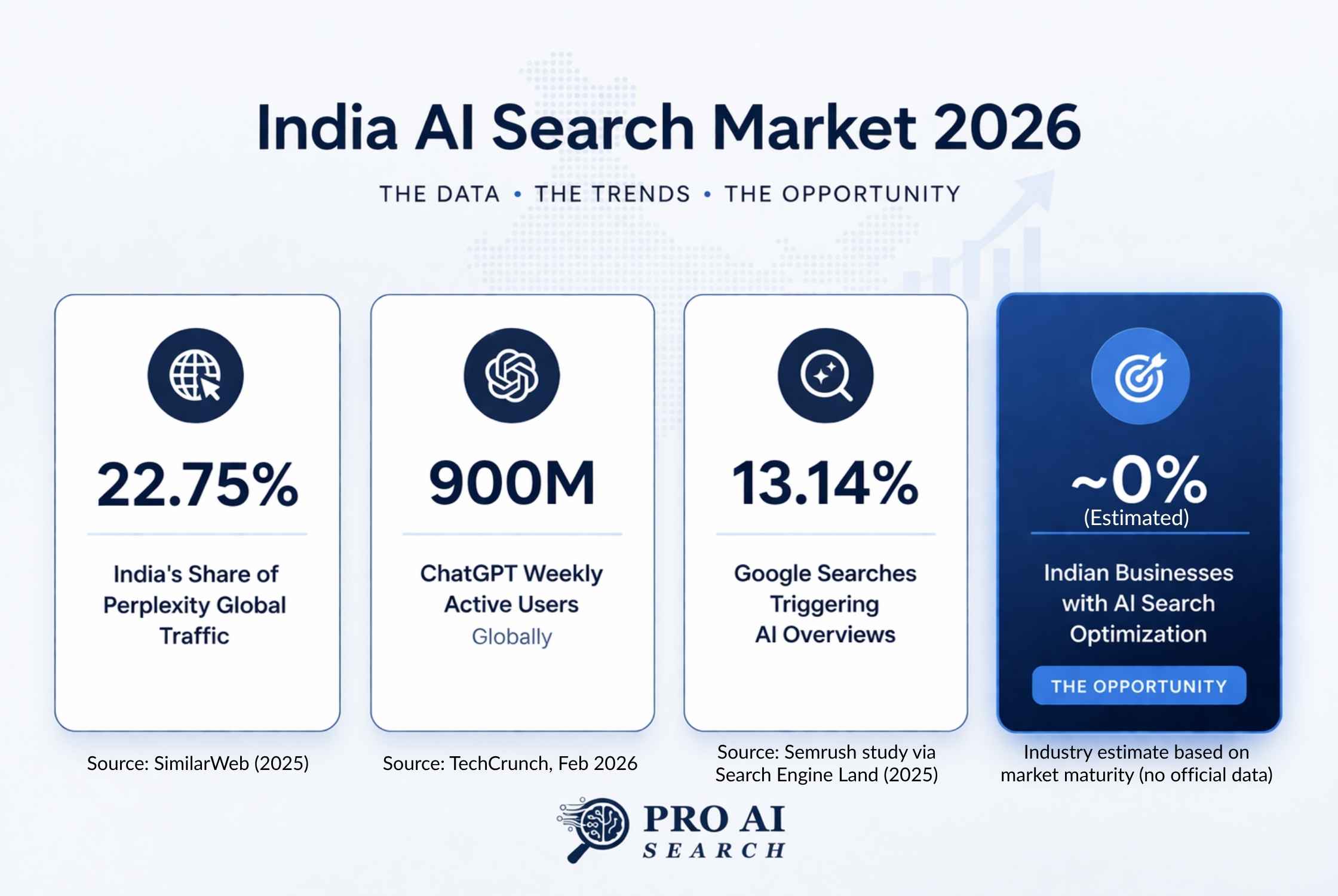
- India is one of the fastest-growing AI search markets globally. India accounts for 22.75% of all Perplexity traffic and saw 640% growth in Perplexity users in Q2 2025 alone after the Airtel partnership. See the full data in our AI search statistics 2026 roundup.
- A Princeton University study published at ACM KDD 2024 found that structured content optimization can boost visibility in AI-generated responses by up to 40%.
- 85% of AI brand mentions come from third-party sources, not brand websites. Off-site presence on Reddit, YourStory, Inc42, and review platforms matters as much as on-page optimization.
- AI search converts at 14.2% compared to Google’s 2.8%, making AI referral traffic approximately five times more valuable per session.
- The window for first-mover advantage in Indian AI search is 2026. Most Indian business websites have not implemented a single AI search optimization technique.
AI search optimization is the practice of making your business discoverable, credible, and citable across AI-powered search platforms including ChatGPT, Perplexity, Google AI Overviews, and Gemini. It covers four interconnected disciplines: the technical infrastructure that lets AI crawlers access your site (LLM SEO), the content strategy that earns AI citations (GEO), the writing structure that wins direct answer slots (AEO), and the authority signals that make AI systems trust and recommend your brand (AI SEO).
Why AI Search Optimization Cannot Wait
When I started building Pro AI Search and tracking AI visibility for content across VEGA AI and LearnQ.ai, the pattern was impossible to ignore. Businesses that had invested years in Google SEO were invisible in Perplexity and ChatGPT responses. Newer sites with less domain authority but better-structured content were getting cited. The rules of search had changed, and most Indian businesses had not noticed yet.
The data confirms what I was seeing on the ground.
The scale of the shift in 2026:
37% of consumers now start their search journeys with AI tools rather than traditional search engines, up from near zero three years ago. A further 60% say AI delivers clearer, better answers than traditional search.
ChatGPT has reached 900 million weekly active users as of February 2026, more than doubling from 400 million a year earlier.
18% of all Google searches triggered an AI Overview in March 2025 according to a Pew Research study, with users clicking traditional results in only 8% of those sessions.
Gartner predicts traditional search engine volume will drop 25% by 2026 as AI chatbots become the primary answer source for users.
AI search traffic converts at 14.2% compared to Google organic’s 2.8%, making each AI-referred visitor approximately five times more valuable per session.
For Indian businesses specifically, the opportunity is compounding. India and Southeast Asia are seeing 190 to 210% year-over-year growth in AI search adoption as of Q1 2026, the fastest of any region globally. The businesses that build AI search visibility in 2026 will be nearly impossible to displace by 2028 when competition intensifies.
What Is AI Search Optimization?
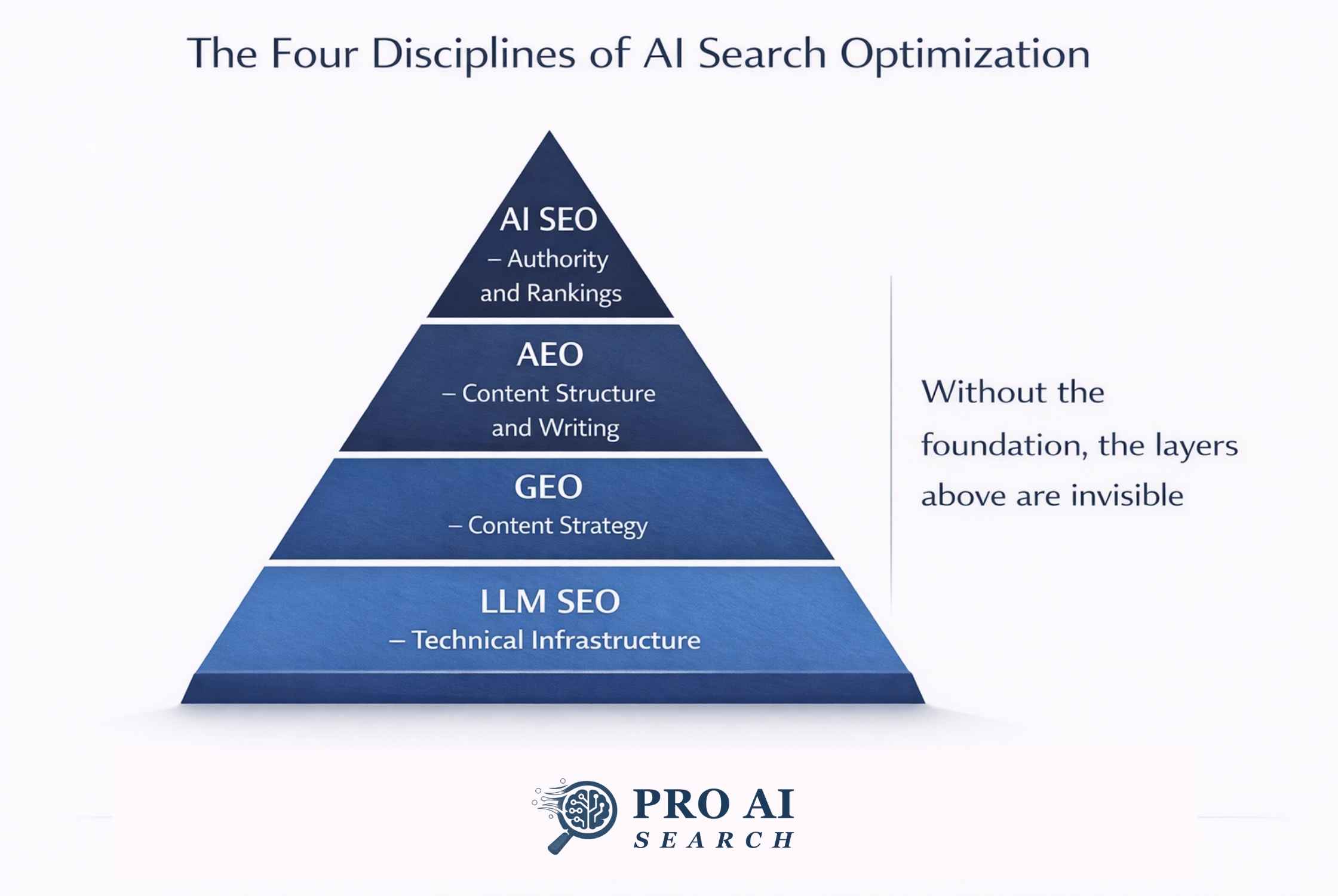
AI search optimization is not a single technique. It is a discipline with four distinct layers, each addressing a different part of how AI systems discover, evaluate, and cite content. Most guides treat it as one thing. It is not. Understanding the four layers is the difference between a strategy that works and one that does not.
Layer 1: LLM SEO
Technical infrastructure. Makes your site accessible to AI crawlers through robots.txt, llms.txt, Cloudflare configuration, schema markup, and page speed. Without this layer, no AI system can reach your content.
Layer 2: GEO
Content strategy. What topics to cover, how deep to go, which questions to answer, and how to build topical authority that AI systems recognize as genuine expertise.
Layer 3: AEO
Content structure. How to write content so AI engines extract and cite it: inverted pyramid method, question-format headings, FAQ schema, and answer-block formatting.
Layer 4: AI SEO
Authority and rankings. Building the E-E-A-T signals, topical authority clusters, and brand mentions that make AI systems consistently recommend your business over competitors.
The relationship between the four layers: LLM SEO is the door. GEO is the blueprint for what you build. AEO is the quality of what you say. AI SEO is the reputation that makes AI systems trust you. Skipping any layer leaves a gap that limits the effectiveness of the other three.
How AI Search Optimization Differs From Traditional SEO
| Factor | Traditional SEO | AI Search Optimization |
|---|---|---|
| Primary goal | Rank in Google’s list of results | Be cited inside AI-generated answers |
| Success metric | Keyword rankings, organic clicks | AI citation rate, share of voice, AI referral traffic |
| Content requirement | Keyword-targeted, long-form, builds to the answer | Answer-first, question-format headings, structured for extraction |
| Authority signals | Backlinks, domain authority score | E-E-A-T, brand mentions, third-party citations, entity recognition |
| Technical focus | Core Web Vitals, crawlability, sitemaps | AI crawler access, llms.txt, schema markup, server-side rendering |
| Traffic type | Click-through to your website | Brand mention (often no click), but 5x higher conversion when clicks occur |
| India opportunity | Competitive, established players dominate most niches | Early mover advantage, most Indian sites have zero AI optimization |
The most important distinction: traditional SEO success does not automatically translate to AI search visibility. 80% of AI-cited sources do not appear in Google’s top 10 organic results, according to Superlines’ March 2026 analysis. Ranking first on Google for a keyword does not mean AI engines will cite you. The content structure, technical access, and authority signals required for AI citations are meaningfully different from what earns Google rankings.
The Four Disciplines of AI Search Optimization
Each discipline below has its own dedicated guide on this site covering full implementation. What follows is a summary of what each covers and why it matters, so you can understand how they fit together before diving into any one of them.
LLM SEO: Technical AI Search Infrastructure
LLM SEO is the technical foundation that makes AI search optimization possible. It covers everything AI crawlers need to access, read, and understand your website: the llms.txt file that tells AI systems what your site covers, the robots.txt configuration that ensures AI crawler user-agents (ChatGPT-User, PerplexityBot, ClaudeBot, Google-Extended) are not accidentally blocked, the Cloudflare settings that prevent your firewall from silently blocking AI traffic, and the schema markup that helps AI systems understand your content structure.
For Indian websites, the most common and most damaging LLM SEO failure is Cloudflare’s Bot Fight Mode being enabled by default. It blocks legitimate AI crawlers without any notification. If your site has been live for months with no AI citations despite good content, this is almost certainly why.
The Princeton University GEO study published at ACM KDD 2024 found that optimized content structure can boost AI visibility by up to 40%. But that study assumes AI crawlers can access the content in the first place. LLM SEO is what ensures they can.
Read the LLM SEO GuideGEO: Generative Engine Optimization
GEO is the content strategy layer. It covers how to build a content architecture that AI systems recognize as authoritative, what topics to cover and in what depth, how to write content that AI engines retrieve and cite in their responses, and how to build the brand authority that makes AI systems consistently recommend you over competitors with similar content.
The core GEO insight from the Princeton research: content with statistics, citations, and specific data points earns up to 40% higher AI visibility than opinion-only content covering the same topic. Data-backed writing is not just better for readers. It is structurally more citable by AI systems.
For Indian businesses, GEO means becoming the authoritative source for India-specific versions of your category’s most important questions. There is almost no well-structured, India-specific content competing for AI citations in most Indian business categories. That is the opportunity.
Not sure how GEO compares to traditional SEO? Read our GEO vs SEO breakdown for Indian businesses.
Read the GEO GuideAEO: Answer Engine Optimization
AEO is the content structure and writing technique layer. It covers the inverted pyramid method (answer first, context second, detail third), question-format heading architecture, FAQ schema implementation, and the specific formatting patterns that cause AI engines to extract and cite your content as a direct answer.
The fundamental AEO principle: AI engines extract the opening of each content section when building responses. The first sentence under every heading is your highest-value real estate for AI citation. If that sentence does not directly answer the question implied by the heading, the section will not be cited regardless of how good the rest of the content is.
85% of AI brand mentions come from third-party sources (AirOps 2026 State of AI Search report), not brand websites. This makes AEO’s off-site component, earning mentions on YourStory, Inc42, Reddit, and Economic Times, as important as on-page optimization for Indian businesses.
Read the AEO GuideAI SEO: Ranking in AI-Powered Search Results
AI SEO is the authority and ranking layer. It covers how each major AI platform (Google AI Overviews, Perplexity, ChatGPT, Gemini) selects and ranks its sources differently, how to build topical authority clusters that AI systems recognize as comprehensive expertise, how E-E-A-T (Experience, Expertise, Authoritativeness, Trustworthiness) applies differently to AI citation decisions than to traditional ranking algorithms, and how to audit existing content for AI citation readiness.
The platform-specific breakdown is where most AI SEO guides fall short. Google AI Overviews pull from Google’s own index. Perplexity runs live web retrieval. ChatGPT web search is Bing-powered. Gemini draws from Google’s Knowledge Graph. A single strategy optimized only for one platform will miss citations on the other three entirely.
Read the AI SEO GuideHow the Four Disciplines Work Together
The four disciplines are not parallel tracks. They are sequential layers where each one enables the next.
LLM SEO is the prerequisite. If AI crawlers cannot access your site, GEO content strategy produces no citations, AEO writing techniques produce no citations, and AI SEO authority building produces no citations. Technical access is the gate. Everything else is irrelevant if the gate is closed.
GEO strategy determines what you build. It sets the content architecture: which topics to cover, how to organize them into clusters, which questions to prioritize, and how to build topical depth that AI systems recognize as genuine expertise. GEO without LLM SEO produces content that cannot be found. GEO without AEO produces content that is found but not cited.
AEO execution determines how content gets cited. It is the difference between a page that AI systems retrieve and one that AI systems actually quote in their responses. Without AEO-structured writing, even high-quality content with good technical access earns far fewer citations than its quality merits.
AI SEO builds cumulative authority. Over time, the combination of technical access, strategic content, and structured writing earns brand mentions across the web, builds entity recognition in AI knowledge graphs, and creates the kind of consistent presence that makes AI systems default to recommending your brand. This is where results compound.
Where Should Indian Businesses Start?
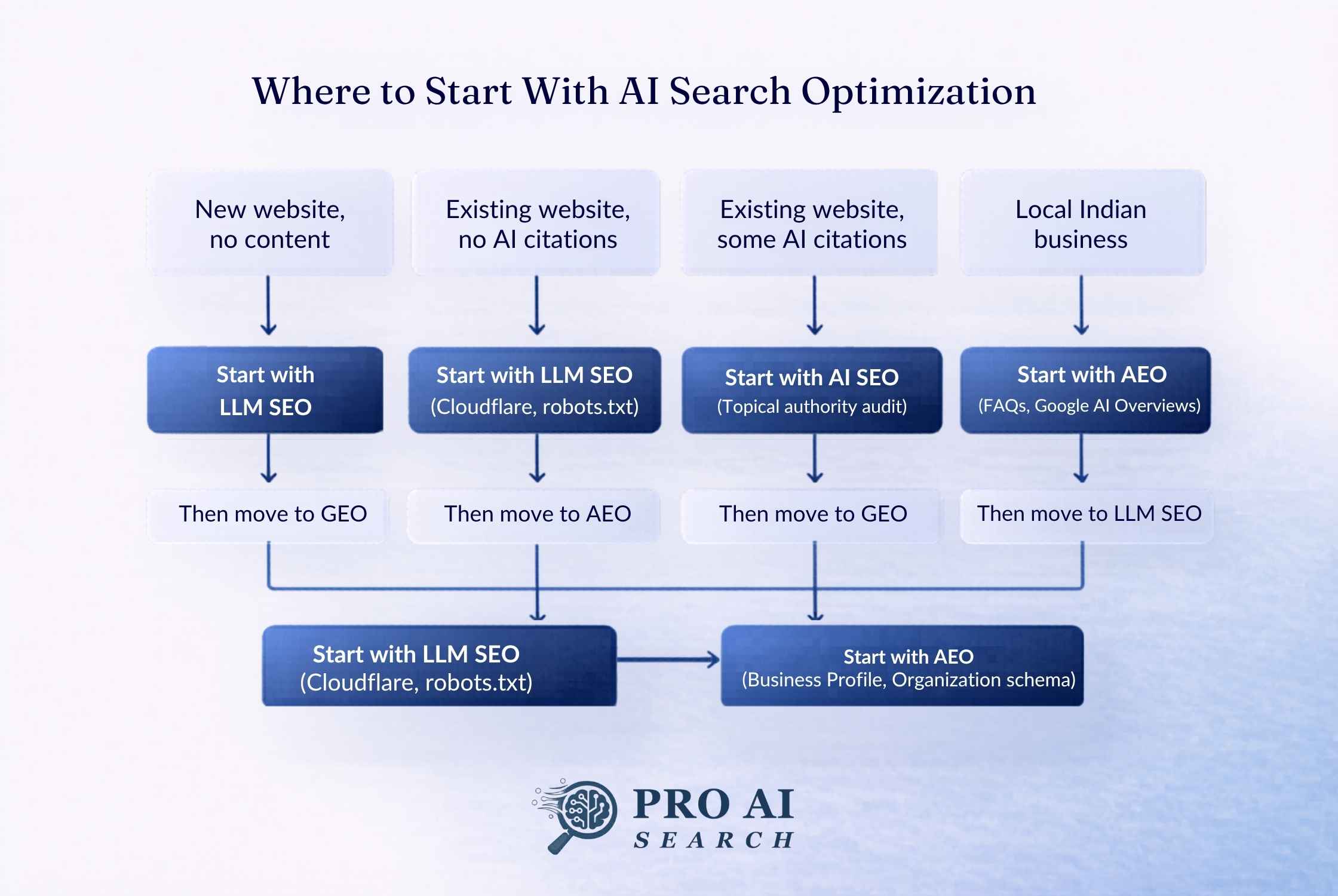
New website with no content yet
Start with LLM SEO first. Set up llms.txt, configure robots.txt, turn off Cloudflare Bot Fight Mode, and add Organization schema to the homepage. This takes less than two hours and ensures that every piece of content you publish afterward is accessible to AI crawlers from day one. Then move to GEO to build your content architecture before writing your first article.
Existing website with content but no AI citations
Start with LLM SEO immediately. Check Cloudflare Bot Fight Mode status. Check that AI crawler user-agents are not blocked in robots.txt. Verify llms.txt is live. These technical fixes take under an hour and can unlock AI citations from content you have already published. Then apply AEO’s inverted pyramid method to your top 10 existing pages: rewrite the first sentence under every H2 to lead with a direct answer.
Existing website with some AI citations but want more
Start with AI SEO. Run the AI Citation Readiness Scorecard on your top 20 pages. Identify which pages are close to earning consistent citations and which have structural gaps. Build out your topic cluster to cover related questions comprehensively. Topical authority compounds: covering eight related questions deeply earns more citations than publishing eight isolated articles on unrelated topics.
Local Indian business or service provider
Start with AEO and LLM SEO simultaneously. FAQ schema implementation on your services pages (free with Rank Math and Schema & Structured Data for WP) directly targets Google AI Overviews for local service queries. Simultaneously, verify your Google Business Profile is complete and accurate: Gemini draws from Google’s Knowledge Graph, and Business Profile data feeds directly into it. Then build content covering the specific questions your customers ask AI engines about your service category in your city.
The India AI Search Opportunity in 2026
India’s position in global AI search is extraordinary. The data tells a clear story about where the opportunity is and why it is time-sensitive.
India accounts for 22.75% of all Perplexity traffic globally, making it the platform’s largest market by web visits according to SimilarWeb data. After Airtel offered free Perplexity Pro access to its subscribers, India saw 640% year-over-year growth in Perplexity users in Q2 2025 alone. Perplexity has committed $400 million in planned India investment for 2026, signaling that this market is central to its long-term growth, not a temporary effect of one promotion.
ChatGPT reached 900 million weekly active users globally as of February 2026, with India among its largest markets. Google AI Overviews dominate Indian search, where Google commands over 95% of the search market. India and Southeast Asia are seeing 190 to 210% year-over-year growth in AI search adoption, the fastest adoption rate globally.
Yet the supply side of this market is almost completely empty. Most Indian business websites have not implemented a single AI search optimization technique. There is almost no well-structured, India-specific content competing for AI citations in categories like income tax advice, business law, HR software, EdTech, fintech, or professional services. The queries exist. The AI engines are ready to cite sources. The sources simply do not exist yet for most India-specific topics.
The first-mover window: Gartner predicts traditional search volume will drop 25% by 2026 as AI answers absorb more queries. Businesses that establish AI search authority now will be entrenched by the time that decline accelerates. Those that wait will compete in a market where the established players are already well-cited, which is a much harder position to overcome. The cost of implementing AI search optimization today is a few hours of work per page. The cost of not implementing it is compounding invisibility as AI search adoption accelerates.
Your Complete AI Search Optimization Resource Library
Each guide below covers one discipline of AI search optimization in full detail, with step-by-step implementation instructions specific to Indian businesses using WordPress and Rank Math. They are designed to be read in the order shown for the fastest results, but each stands alone if you have a specific gap to address.
GEO: Generative Engine Optimization
The content strategy guide. What to write, how to structure it, how to build topical authority, and how to earn AI citations on Perplexity, ChatGPT, and Google AI Overviews. Includes the Two-Pathway Model and an 8-step GEO framework for Indian businesses.
Content StructureAEO: Answer Engine Optimization
The writing technique guide. The inverted pyramid method, question-format headings, FAQ schema implementation, and the six factors that drive ChatGPT recommendations based on Neil Patel’s research across 80+ variables.
Technical SetupLLM SEO: Technical AI Infrastructure
The technical implementation guide. llms.txt, robots.txt AI crawler configuration, Cloudflare Bot Fight Mode, schema markup, and the complete 12-point technical audit checklist. Start here if you have existing content getting zero AI citations.
Authority BuildingAI SEO: Ranking in AI Search
The authority and platform-specific ranking guide. How Google AI Overviews, Perplexity, ChatGPT, and Gemini rank content differently, topical authority clusters, E-E-A-T for AI search, and the AI Citation Readiness Scorecard.
For terminology reference, the AI Search Glossary covers 75+ terms used across these guides with plain-language definitions written for business owners, not technical specialists.
Frequently Asked Questions About AI Search Optimization
What is AI search optimization?
AI search optimization is the practice of making your business discoverable and citable across AI-powered search platforms including ChatGPT, Perplexity, Google AI Overviews, and Gemini. It covers four disciplines: LLM SEO (technical infrastructure for AI crawler access), GEO (content strategy for earning citations), AEO (content structure for winning direct answer slots), and AI SEO (authority building for consistent AI recommendations). It is the next evolution of SEO, not a replacement for it.
How is AI search optimization different from traditional SEO?
Traditional SEO optimizes for ranked positions in a list of Google results. AI search optimization earns citations inside AI-generated responses where there is no ranked list, only sources the AI chooses to cite. Traditional SEO measures success in keyword rankings and clicks. AI search optimization measures success in citation rate, AI share of voice, and AI referral traffic. The technical and content foundations overlap significantly, but AI search optimization adds four layers that traditional SEO does not address: llms.txt, AI crawler configuration, answer-first writing structure, and entity-level authority signals.
Which AI platform should Indian businesses optimize for first?
Priority order for Indian businesses: (1) Google AI Overviews, because Google dominates Indian search at over 95% market share and AI Overviews appear on 18% of all queries, (2) Perplexity, because India is its largest global traffic market at 22.75% of total visits and results appear faster for new content than Google AI Overviews, (3) ChatGPT, because India is among its largest markets and ChatGPT web search is Bing-powered, making Bing Webmaster Tools submission a specific action Indian businesses can take immediately. Gemini is fourth priority but becomes more important as India-specific voice search grows.
How long does AI search optimization take to show results?
The technical fixes (LLM SEO layer) can unlock existing content for AI citation within 24 to 48 hours of implementation. Perplexity citations for new content typically appear within 2 to 4 weeks of publishing on a technically accessible site. Google AI Overview citations take 6 to 12 weeks for new content because they require first ranking in Google’s top 10. ChatGPT citations follow Bing ranking timelines of 4 to 8 weeks. Building consistent AI share of voice across multiple queries takes 3 to 6 months of sustained optimization.
Can small Indian businesses compete with large brands in AI search?
Yes, more effectively than in traditional SEO. AI systems weight content quality, structure, and topical specificity more heavily than domain authority. A small CA firm with well-structured, question-answering content about income tax in Maharashtra can earn AI citations that a large national portal with thin, generic tax content does not. The Princeton GEO study demonstrated up to 40% visibility improvement from content structure optimization alone, independent of domain authority. Indian SMBs with genuine expertise in specific niches are particularly well-positioned to earn AI citations that larger, more generic competitors miss.
Is AI search optimization just GEO by another name?
GEO (Generative Engine Optimization) is one of the four disciplines within AI search optimization, not the complete picture. GEO covers content strategy and earning citations in AI responses. It does not cover the technical infrastructure (LLM SEO), the specific writing techniques for direct answer slots (AEO), or the platform-specific ranking mechanics and authority building (AI SEO). Many guides use GEO and AI search optimization interchangeably, which creates confusion about what implementation actually requires. This site treats them as distinct but interconnected disciplines for clarity and practical implementation.

About the Author
Amit Kumar
Founder, Pro AI Search | Growth Manager, VEGA AI at LearnQ India
Amit is a growth and SEO specialist based in Bengaluru with 7+ years of experience in SEO and growth marketing. He currently leads SEO and growth strategy for two EdTech brands, VEGA AI and LearnQ.ai, both under LearnQ India. Previously he managed SEO campaigns at PageTraffic and has built marketing funnels for startups across EdTech and fintech. He founded Pro AI Search to document what actually works for Indian businesses in AI search, before most competitors have figured it out.