
This guide is part of our complete AI Search Optimization resource for Indian businesses.
Generative Engine Optimization (GEO) is the practice of optimizing your content so AI search engines like ChatGPT, Perplexity, Google AI Overviews, and Gemini cite your business in their generated responses. This guide covers what GEO is, how AI engines decide what to cite, and a step-by-step implementation framework for Indian businesses.
What GEO Looks Like in Practice
Before getting into strategy, let me make this concrete. Here is what GEO actually looks like when it is working.
A student in Pune opens Perplexity and types: “which AI-powered learning app is best for NEET 2026 preparation?” Perplexity runs several web searches, pulls content from multiple sources, synthesizes a response, and lists two or three platforms by name, with citations. The student reads the answer, sees a platform’s name, and either searches for it directly or asks a follow-up question. They may never click the citation link at all. But the brand is now in their consideration set.
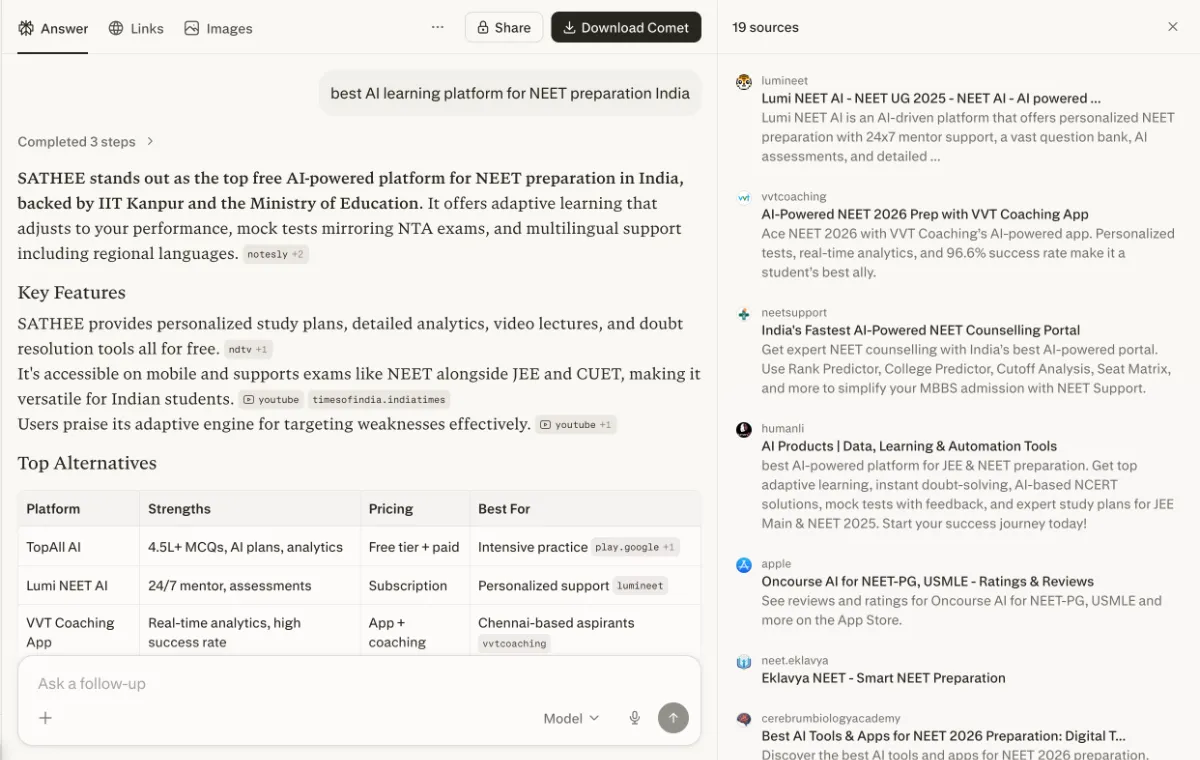
That is GEO working. The platform that appears in that response did not get there by ranking #1 on Google. It got there because its content was structured to be found, extracted, and cited by an AI system.
This shift is already measurable. Bootstrapped form builder Tally reported that ChatGPT became their #1 referral source, ahead of all organic and paid channels. They are not alone. Across SaaS, EdTech, fintech, and services, AI referral traffic is appearing in GA4 dashboards where it did not exist 18 months ago.
The shift in one sentence: In traditional search, you compete for clicks. In AI search, you compete to be part of the answer. The businesses that understand this early have a significant first-mover advantage.
Why I Started Paying Attention to GEO
I first noticed the shift while working on search strategy for VEGA AI at LearnQ India. We were tracking organic traffic the usual way, watching keyword rankings, checking Google Search Console, doing the standard SEO work. Then I started noticing something odd: a handful of pages were getting referral traffic from chatgpt.com and perplexity.ai even though we had done nothing specifically to optimise for those platforms.
When I went back and looked at what those pages had in common, the pattern was obvious in hindsight. They all answered specific questions directly in the first few paragraphs. They had clear headings structured as questions. They cited external data sources. They had author information and publication dates. None of this was accidental GEO strategy, it was just good content practice. But it was getting results in AI search that our other, longer, more keyword-stuffed pages were not.
That is when I started researching GEO properly. What I found changed how I think about content entirely, and it is why I built Pro AI Search: to document what actually works for Indian businesses in this new search environment before everyone else figures it out.
What Is Generative Engine Optimization (GEO)?
Generative Engine Optimization, or GEO, is the process of optimizing your website’s content to increase how often AI-powered search engines cite your business in their generated responses.
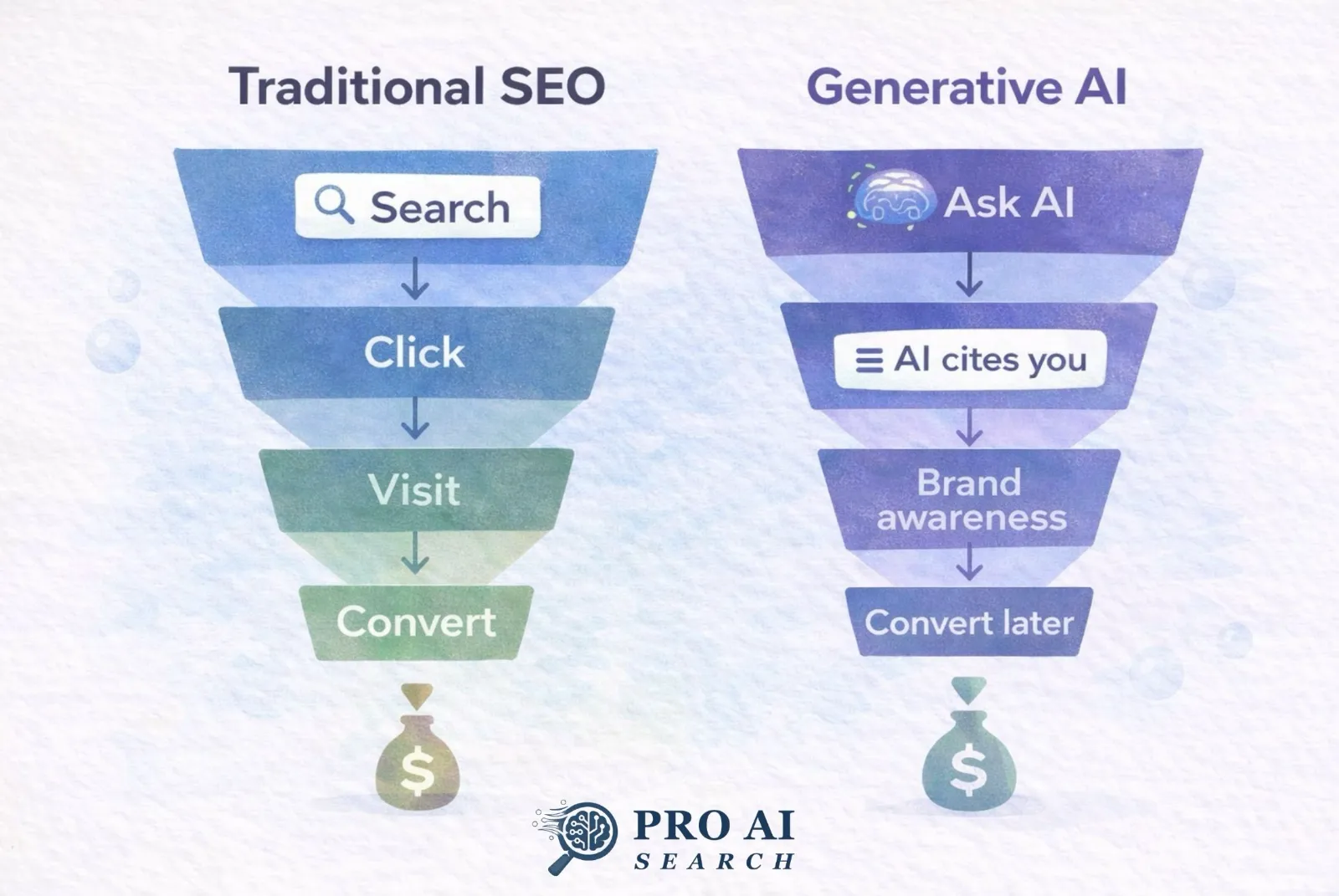
Where traditional SEO gets your page onto Google’s first page so users click through to your site, GEO gets your content quoted directly inside the AI’s answer. The user may never visit your site. But they read your name, your data, your opinion, in the AI’s response. That is a different kind of visibility, and for many businesses it converts better than a traditional click. Curious how GEO stacks up against traditional SEO? Read our detailed GEO vs SEO breakdown for Indian businesses.
The term was formally defined in a 2024 research paper by researchers from Princeton University, Georgia Tech, The Allen Institute for AI, and IIT Delhi. The paper, titled GEO: Generative Engine Optimization, studied how different content strategies affect citation rates in AI-generated responses. Their findings confirmed what practitioners were already starting to observe: specific, measurable content attributes significantly increase the probability of being cited by AI engines.
The one-line version: GEO is how you get AI engines to say your name when your customers ask questions about your industry.
How AI Search Engines Actually Work
To understand GEO you first need to understand how AI search engines generate their answers. They do not work like Google. Google crawls the web, indexes pages, and ranks them based on relevance and authority signals. AI search engines do something fundamentally different.
Retrieval Augmented Generation (RAG)
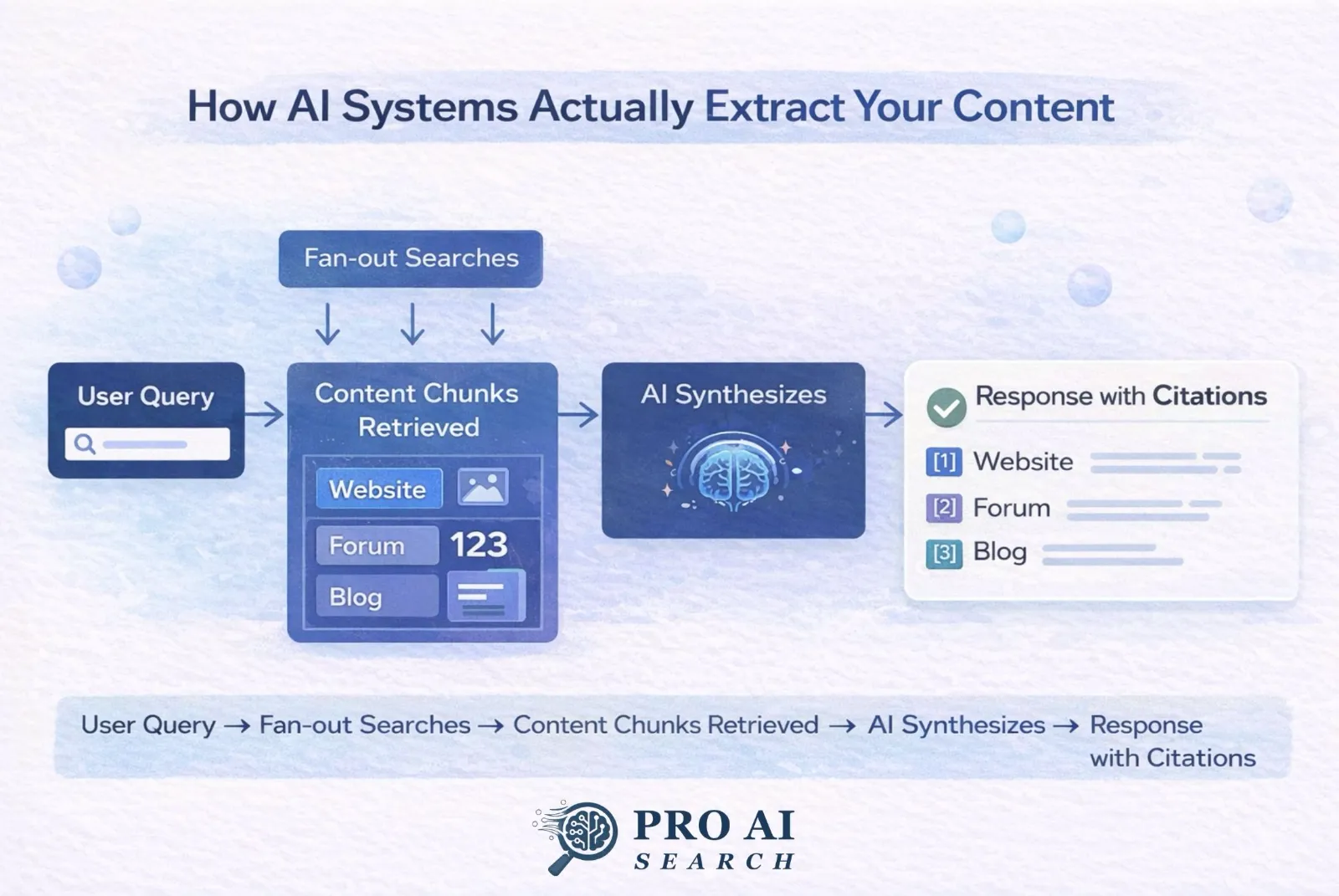
When you ask a question on Perplexity or ChatGPT with web search enabled, the AI runs a process called Retrieval Augmented Generation, or RAG. Here is what happens:
- Fan-out queries: Your question gets broken into multiple sub-queries that run simultaneously. A single question like “which AI-powered learning platform should I use for my team in India” might trigger 6 to 10 separate web searches.
- Source retrieval: The AI pulls the top results for each sub-query, extracting snippets, summaries, and structured data from multiple pages.
- Content evaluation: The AI evaluates each source for relevance, structure, and credibility. Pages that answer questions directly, cite data, and have clear author credentials score higher at this stage.
- Response synthesis: The AI writes a response, weaving together information from the sources it trusted most.
- Citation: The sources used get cited in the response. If your page was one of them, your URL appears alongside the answer your customer just read.
How AI Systems Actually Extract Your Content
Here is something most GEO guides skip: AI systems do not read your article the way a human does. They split your content into chunks, convert each chunk into a numerical representation called an embedding or vector, and retrieve the most relevant chunks when assembling a response. Your article’s narrative structure largely disappears in this process.
This has a direct implication for how you should write. Paragraphs that reference earlier content (“as mentioned above,” “this is why,” “building on that”) lose meaning when extracted out of context. The AI retrieves the chunk but not the setup. The result is a citation that sounds incomplete or confusing.
Paragraphs that work as standalone units, each expressing one complete idea with its own context, are far more likely to be retrieved and cited accurately. Think of each paragraph as a potential citation unit. If it cannot stand alone, rewrite it until it can.
I saw this play out directly with content I worked on for LearnQ.ai. Pages that structured content around specific exam-related questions, with direct answers in the opening paragraph and data cited from official sources, started appearing as Perplexity citations within weeks of going live. Pages that were written primarily for keyword density did not.
Key research finding: 44.2% of all LLM citations come from content in the first 30% of an article. If your most important answer is buried in paragraph 8, it will not get cited. Lead with the answer.
What AI Engines Use to Decide What to Cite
The Princeton GEO paper and follow-on research identifies these as the primary citation-probability factors:
- Statistics and data: Content with specific numbers and cited data is cited up to 40% more often than opinion-only content. “AI referral traffic converts 25x higher than organic” beats “AI traffic converts really well.” For a full data picture, see our AI search statistics 2026 roundup.
- Direct answer structure: Content that answers the question in the first paragraph before elaborating is cited significantly more often than content that builds context before answering.
- Author credibility signals: Named authors with credentials, publication dates, and professional affiliations increase citation probability. Anonymous content is treated as lower trust.
- Clear heading structure: Question-format H2 and H3 headings map directly to user queries. “What is GEO?” as a heading is more citable than “Overview.”
- Comprehensive coverage: Longer, thorough content gets cited more often because the AI can extract more useful information from a single trusted source rather than piecing together five thin ones.
GEO vs SEO: What Actually Changes
This is the question I get most often. GEO and SEO are not competing strategies. GEO builds on your SEO foundation. But there are real differences in how you measure success and what you optimise for.
| Factor | Traditional SEO | GEO |
|---|---|---|
| Goal | Rank on page 1 of Google | Get cited in AI-generated answers |
| Success metric | Keyword rankings, organic traffic | AI citations, AI share of voice |
| Primary signal | Backlinks, on-page keywords | Content structure, statistics, authority |
| User journey | User clicks, visits your site | AI quotes you, user may or may not visit |
| Content format | Keyword-optimized articles | Direct-answer, question-structured content |
| Overlap | High. E-E-A-T, backlinks, and technical SEO all feed GEO performance. Good SEO is the foundation. | |
Something most people miss: Research shows only 10% of Google AI Mode citations overlap with Google’s top organic results. Ranking #1 on Google does not mean you will be cited by AI. You need a specific GEO strategy, not just strong traditional SEO.
GEO vs AEO vs LLM SEO: How the Pieces Fit Together
When I first started researching this space in 2024, the terminology was a mess. GEO, AEO, LLM SEO, AI SEO, LLMO — everyone seemed to have their own term. Here is how I think about it after spending a year in the weeds:
- GEO (Generative Engine Optimization): The umbrella strategy. Getting your content cited in AI-generated responses across all platforms. This is the goal.
- AEO (Answer Engine Optimization): The content layer of GEO. Structuring content specifically to win direct answer slots: question-format headings, inverted pyramid writing, FAQ schema, featured snippet optimization. See the complete AEO guide.
- LLM SEO: The technical layer. Making your website readable and crawlable by AI systems: llms.txt, robots.txt configuration, schema markup, structured data. See the LLM SEO guide.
- AI SEO: Often used interchangeably with GEO. Refers broadly to optimizing for AI-powered search results including Google AI Overviews. See the AI SEO guide.
GEO is the strategy. AEO is how you structure content within that strategy. LLM SEO is the technical foundation that makes it work. You need all three, but GEO is where you start.
The India GEO Opportunity (And Why It Will Not Last Forever)
I want to be direct about this because it is the reason I built this site: the window for Indian businesses to establish GEO authority is open right now, and it will not stay open much longer.
The India AI search numbers:
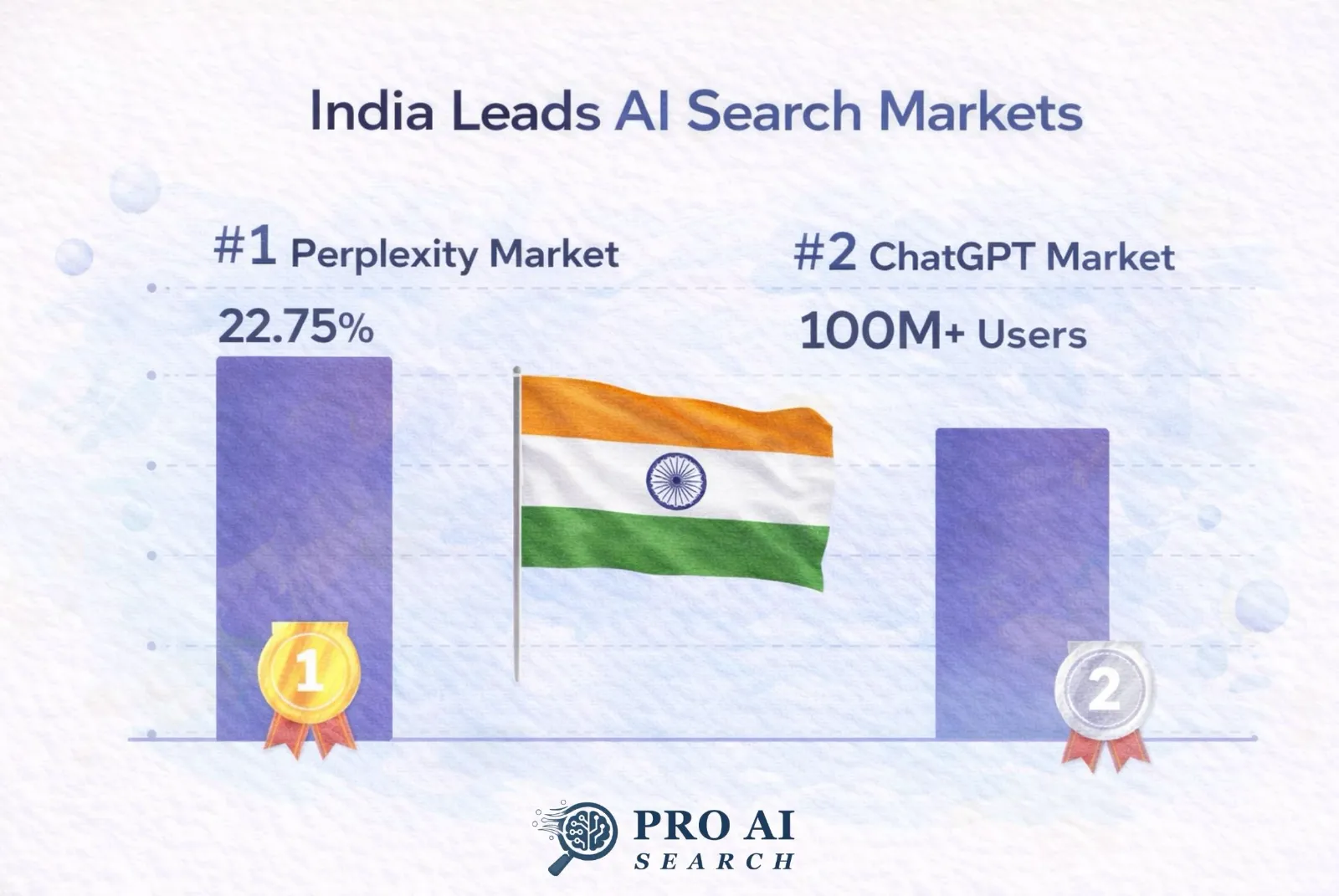
ChatGPT has reached 900 million weekly active users globally as of February 2026, with India among its largest markets.
India accounts for 22.75% of Perplexity’s total global traffic, making it the single largest market by country.
Google AI Overviews are now fully live in India across Google Search.
92% of Indian office workers use AI tools regularly, according to Microsoft’s Work Trend Index.
75 million Indian SMBs are digitally underserved, with most having zero GEO strategy.
Here is what makes this remarkable: despite India being one of the largest AI search markets in the world, almost zero India-specific GEO resources exist. Every major guide is written for US or European enterprise budgets, with tools costing $300 to $2,000 per month and examples from Fortune 500 companies. Indian startups, SMBs, and growing businesses are completely unaddressed.
GEO keyword difficulty averages 15 to 20 on most tools, compared to 45 to 60 for equivalent traditional SEO terms. The Google Trends classification for “generative engine optimization” is “Breakout,” meaning growth above 5,000%. Any Indian business or publisher that builds genuine GEO authority in the next 12 months will be extremely hard to displace once the space matures. I am building Pro AI Search to be that resource. But the same logic applies to any Indian business in any category.
How to Implement GEO: A Step-by-Step Framework
This is the practical part. Based on what I have observed from working on AI search visibility for VEGA AI, FinLecture.in, and this site, here is a framework that works for Indian businesses starting from scratch.
Step 1: Audit Your Current AI Visibility
Before optimising anything, establish your baseline. Open Perplexity, ChatGPT, and Google AI Overviews. Search for the 10 to 15 questions your customers most likely ask before buying or contacting you. Write down which businesses are being cited in each response. Note whether your business or website appears anywhere. This takes 30 minutes and is the most important thing you can do before any other GEO work. Without a baseline, you cannot measure progress.
Step 2: Map Your Citation-Worthy Questions
Make a list of every question a customer might ask in the research phase before contacting you. For an EdTech platform like VEGA AI, these are questions like “which AI learning platform is best for NEET preparation” or “how does adaptive testing work in online learning.” For a fintech content site like FinLecture, they are questions like “what is the difference between old and new tax regime” or “how to claim HRA exemption in India.” These are the questions your content must answer directly and completely.
Step 3: Rewrite Your Content Around Direct Answers
For each target question, make sure your page answers it in the first paragraph, before any context or background. Use the inverted pyramid: answer first, explanation second, detail third. This is the single biggest structural change most Indian websites need to make. Most content buries the answer deep in the article after a long introduction. AI engines will not wait for it.
Step 4: Add FAQ Schema to Key Pages
FAQ schema tells AI engines explicitly what questions your page answers and what the direct answers are. This is implemented through structured data markup, which Rank Math SEO handles cleanly. Add FAQ schema to your homepage, service or product pages, and any content page that targets informational queries. It is one of the highest-impact technical GEO actions with very low implementation cost.
Step 5: Strengthen Your E-E-A-T Signals
Experience, Expertise, Authoritativeness, and Trustworthiness signals feed directly into AI citation decisions. Named authors with real credentials, external citations to reputable sources, a clear About page, and mentions on other websites all improve your E-E-A-T profile. Anonymous content is a significant handicap in AI search. Every piece of content on your site should have a named author with visible credentials and a link to their professional profile.
Step 6: Set Up Your llms.txt File
An llms.txt file sits at the root of your website and tells AI crawlers what your site covers and which pages matter most. It is similar to a sitemap but designed specifically for large language models. If you use Rank Math SEO, this is generated automatically. Check yours is live at yourdomain.com/llms.txt and that it accurately represents your content. Ours at proaisearch.com/llms.txt was one of the first things I configured when building this site.
Step 7: Check Your robots.txt and Cloudflare Settings
Many Indian websites are accidentally blocking AI crawlers. Two common culprits: an overly restrictive robots.txt that blocks all bots by default, and Cloudflare’s Bot Fight Mode, which blocks AI crawlers alongside malicious bots. Check your robots.txt explicitly allows ChatGPT-User, PerplexityBot, ClaudeBot, Google-Extended, and bingbot. If you use Cloudflare, turn Bot Fight Mode off. Your content cannot be cited if AI cannot read it.
Step 8: Track Your AI Citations Weekly
Run your 20 target questions through Perplexity, ChatGPT, and Google AI Overviews every week. Track which queries now cite your site that did not before. This manual tracking is free and gives you the clearest picture of what is working. Your primary KPI is AI share of voice: out of your 20 target queries, how many AI responses mention your business? Start at zero, aim for 25% by month 3, 50% by month 6.
What GEO Cannot Guarantee
I want to be straight about the limitations here, because most GEO content oversells certainty.
- Citations are probabilistic, not guaranteed. You can follow every best practice and still not be cited for a given query. AI systems make probabilistic decisions based on hundreds of signals. There is no equivalent of “rank #1 if you do X.” What you can do is consistently increase your citation probability across a large number of relevant queries.
- AI systems change without notice. Perplexity, ChatGPT, and Google AI Overviews update their retrieval and ranking behavior regularly. What works today may need adjustment in six months. GEO is not a set-and-forget strategy. It requires ongoing monitoring and iteration.
- Attribution is genuinely hard. When an AI response mentions your brand, the user may close the app, think about it for three days, then search your brand name on Google and convert. Your analytics will record a direct or branded organic visit, not an AI citation. This “dark funnel” attribution gap means AI’s contribution to your business is almost certainly larger than your GA4 data shows. Build GEO for brand authority, not just trackable clicks.
- AI engines have different behavior. A strategy that gets you cited on Perplexity may not work identically on ChatGPT or Google AI Overviews. Each platform has its own retrieval logic. Monitor all three separately rather than assuming results transfer.
My honest take: GEO is not a silver bullet and anyone who tells you otherwise is selling something. It is a genuine long-term authority building strategy, and for Indian businesses right now, the upside of being early is significant. Just go in with realistic expectations about what you can measure and when.
GEO Content Strategy: What to Write and How
Content strategy is where most Indian websites can gain the fastest GEO traction. The competition in India-specific AI search content is almost non-existent right now.
Content Types That Get Cited Most
- Definitive guides: Comprehensive 3,000 to 8,000 word guides that cover a topic completely. AI engines prefer one authoritative source over five thin ones.
- Statistics roundups: Pages that compile data on a topic are among the most-cited content types. Original research is even more valuable. This is why the India AI Search Research Report I am building for June 2026 is a core part of the Pro AI Search strategy.
- Comparison articles: “GEO vs SEO,” “old vs new tax regime,” “ChatGPT vs Perplexity for business” articles answer comparison queries directly and get cited heavily in AI responses.
- How-to guides: Step-by-step instructional content with numbered steps is in exactly the format AI engines prefer to extract and cite.
- FAQ pages: Dedicated FAQ content with question-format headings and direct answer paragraphs is among the easiest content to get into AI responses.
Writing Principles That Increase Citation Rate
- Answer in the first sentence. Never make the reader search for your point.
- Use specific numbers. Every claim you can back with data becomes more citable.
- Use question-format headings. “What is GEO?” outperforms “Introduction to GEO” for AI citations every time.
- Write short paragraphs. Three to four sentences maximum. AI engines extract paragraphs as citation units.
- Cite your sources with links. External citations to credible sources increase your own content’s perceived authority.
GEO for Indian Tech and Internet Businesses
I am going to be honest about my experience here. My direct work has been in EdTech, fintech content, and digital marketing, not manufacturing or logistics. So I will write about what I actually know from the sectors I have worked in, and cover other verticals in dedicated guides as this site grows.
EdTech and Online Learning
This is the space I know best from VEGA AI and LearnQ.ai. The AI search queries that matter most for EdTech are comparison and recommendation queries: “best NEET preparation app India,” “which online learning platform for JEE,” “adaptive learning vs traditional coaching.” The businesses winning AI citations in this space are those with detailed, data-backed comparison content and genuine student outcome data. Generic course description pages get zero AI citations. Specific, outcome-focused content with real numbers gets cited regularly.
Fintech and Personal Finance
From the work on FinLecture.in, I can say that personal finance is one of the highest-volume GEO opportunity spaces in India right now. Questions like “how to save tax in India 2026,” “which ITR form to fill,” and “is NPS better than PPF” are being asked on AI platforms millions of times. The businesses and content creators who answer these questions with clear, accurate, well-structured content are getting significant AI referral traffic. The key is accuracy: wrong tax information gets you removed from AI citations fast.
SaaS and Digital Tools
Indian SaaS companies have a specific GEO opportunity: most are competing globally in crowded categories but have a defensible niche in India-specific use cases. Instead of competing on “project management software,” a Bengaluru-based SaaS company should build authority on “project management for Indian IT services companies” or “GST-compliant invoicing software for Indian freelancers.” The India-specific angle is where the GEO competition is thinnest and the intent is highest.
Digital Marketing and SEO Agencies
If you run a digital marketing agency in India, GEO is both a service opportunity and a personal credibility play. Your potential clients are asking AI “which digital marketing agency in Bengaluru should I hire” right now. If your agency’s website has no structured content answering questions about your capabilities, process, and results, you will not appear. Building a genuine GEO-optimized case studies and services section is one of the fastest ways to differentiate from competitors who are all still focused purely on traditional SEO.
Measuring GEO Performance
This is where GEO gets genuinely difficult compared to traditional SEO. In search, the attribution path is clear: user searches, clicks, lands on your site, converts or doesn’t. You can tie that session directly to a keyword and a page.
AI search breaks that path. A user asks Perplexity which EdTech platform to use, reads a response that mentions VEGA AI, closes the app, and signs up three days later via direct traffic. Your analytics show a direct conversion. The AI citation that started the journey is invisible.
This does not mean you should not measure. It means you need to measure differently, and with honest expectations about what the numbers will and will not show you.
The Metrics That Matter
| Metric | What It Measures | How to Track (Free) | Target by Month 6 |
|---|---|---|---|
| Citation Frequency | How often AI platforms mention your brand for target queries | Manual weekly queries across Perplexity, ChatGPT, Google AI Overviews | Cited in 6+ of 20 target queries |
| AI Share of Voice | Your citation rate vs competitors for the same queries | Track which competitor is cited when you are not, for each query | Cited more than any single competitor in your category |
| Sentiment | Whether AI mentions are positive, neutral, or negative | Read the full AI response, not just whether you appear | 100% neutral or positive mentions |
| Citation Context | Which questions trigger mentions of your brand | Note the exact query that produced each citation | Citations appearing for 5+ distinct query types |
| AI Referral Traffic | Direct clicks from AI platforms to your site | GA4: referral traffic from chatgpt.com, perplexity.ai | 50+ monthly sessions from AI sources |
| Branded Search Lift | Indirect AI impact via brand searches | Google Search Console: track branded keyword impressions over time | 20%+ increase in branded impressions vs baseline |
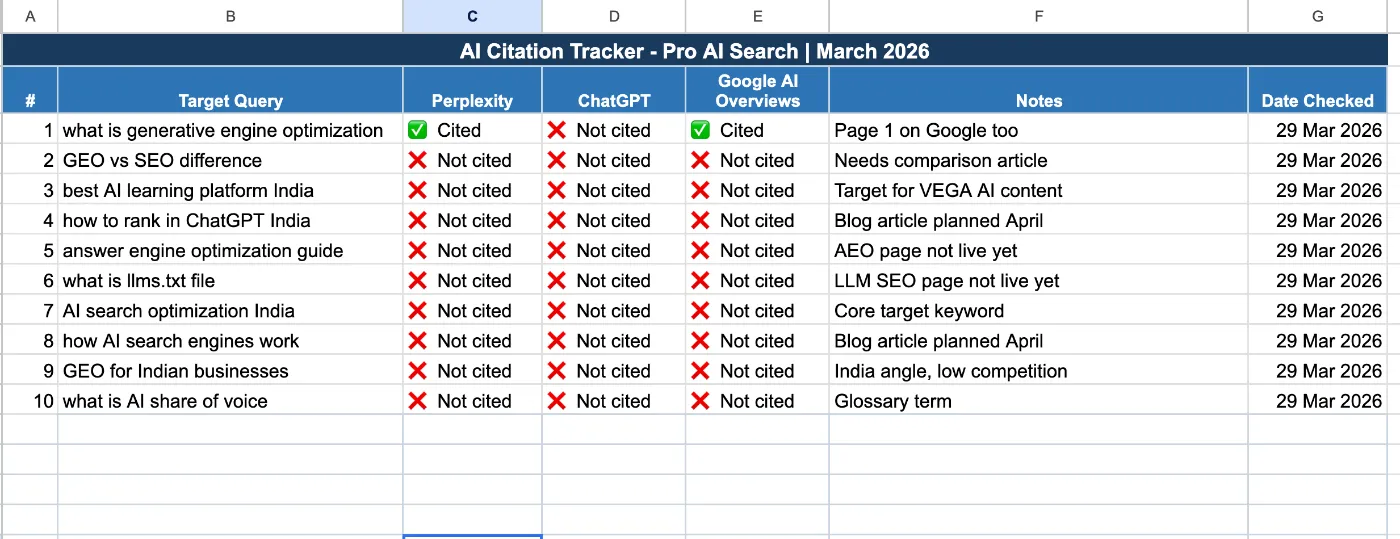
The branded search lift signal: When AI mentions your brand consistently, branded search volume on Google tends to increase even without direct click-through. Tracking this in Google Search Console gives you a partial proxy for AI influence that GA4 cannot capture on its own.
A Go Fish Digital case study found AI referral traffic converts 25x higher than organic search traffic. Even a small number of direct AI clicks can have disproportionate business impact.
Common GEO Mistakes I See Indian Websites Making
After auditing content across several Indian websites, the same mistakes come up repeatedly.
- Blocking AI crawlers without knowing it. Cloudflare Bot Fight Mode is enabled by default on many Indian hosting setups. It blocks PerplexityBot, ClaudeBot, and other AI crawlers alongside malicious bots. Turn it off.
- Writing for keywords instead of questions. A page optimised for “tax consultant Bengaluru” does not answer “which tax consultant should I hire in Bengaluru.” The phrasing matters. Reframe all content around questions.
- No statistics or data. Generic claims without numbers are almost never cited. “Most businesses see good results” gets ignored. “Businesses implementing GEO see AI referral traffic convert 25x higher” gets cited.
- Thin service pages. A 150-word service page with a contact form will never appear in an AI citation. Service pages need 800 to 1,200 words of structured, question-answering content to compete.
- No author attribution. Anonymous content has significantly lower E-E-A-T scores. Every page should have a named author with visible credentials.
- Waiting for the market to mature. The businesses building GEO authority in India right now will be nearly impossible to displace in 18 months. The cost of waiting is compounding every week.
Frequently Asked Questions About GEO
What is the difference between GEO and SEO?
SEO gets your page onto Google’s results page so users click through to your site. GEO gets your content cited inside the AI’s generated answer. SEO success is measured by keyword rankings and traffic. GEO success is measured by AI citations and share of voice. They are not competing strategies: strong SEO foundation, including backlinks, E-E-A-T, and technical health, feeds directly into GEO performance. But ranking on Google does not automatically mean you will be cited by AI. Research shows only 10% of AI citations overlap with Google’s top organic results.
How long does GEO take to show results?
In my experience, the first AI citations usually appear within 4 to 8 weeks of publishing well-structured content. This is faster than traditional SEO because AI engines re-evaluate content more frequently than Google’s crawl cycle. Citations first tend to appear in Perplexity, then ChatGPT, then Google AI Overviews. Meaningful brand recognition across AI platforms typically builds over 3 to 6 months as your content volume and authority grows.
Does GEO work for new Indian websites with low domain authority?
Yes, and this is one of GEO’s biggest advantages over traditional SEO. AI engines weight content quality, structure, and relevance more heavily than raw domain authority. A well-structured, data-backed article on a new site can outperform a thin article on a high-DA site in AI citations. I have seen this first-hand with new content on lower-authority domains getting Perplexity citations within weeks. The key is content quality and structure, not legacy authority.
Which AI search engines should Indian businesses prioritise?
In order of priority for India: (1) Google AI Overviews, because Google is still the dominant search platform in India and AI Overviews appear on most commercial queries, (2) Perplexity, because India is its largest global market and it is growing fast among educated professional and student users, (3) ChatGPT, because India is the second-largest market globally. Gemini and Grok are worth monitoring but are secondary priorities for now.
Is GEO just another name for AEO?
No. GEO is the broader strategy covering all AI search optimization. AEO (Answer Engine Optimization) is specifically about structuring content to win direct answer slots: question-format headings, inverted pyramid writing, FAQ schema, and featured snippet optimization. AEO is one important component of GEO. GEO also includes technical implementation (LLM SEO), brand authority building, and platform-specific strategies. Think of AEO as the content discipline within the broader GEO strategy.
Do I need separate content for GEO and SEO?
No. Good GEO content also ranks on Google. The same article that answers questions directly, uses clear headings, cites data, and demonstrates expertise will perform well in both traditional and AI search. The main adjustment is structural: lead with answers, use question-format headings, and keep paragraphs short. These changes improve both Google rankings and AI citation probability at the same time.
Can a new website with zero backlinks get AI citations?
Yes. I have seen it happen. AI citation probability is more influenced by content structure and quality than by the backlink profile of your domain. A brand new site with one well-structured, data-backed, question-answering article can get cited by Perplexity before it ranks on Google’s first page. That said, backlinks and domain authority still matter for the underlying web search results that AI engines pull from. GEO and SEO work together, not independently.
Does GEO work in Hindi or regional Indian languages?
This is an emerging area and the honest answer is: the research is thin. AI engines like Perplexity and ChatGPT do process Hindi and regional language queries, but their citation behavior for non-English content appears less consistent based on what I have observed. My recommendation for now: build your primary GEO content in English, then expand to Hindi for specific high-volume queries once you have English citation authority established. This is an area I will cover in more depth as the data matures.
What free tools can I use to track GEO in India?
Start with manual tracking: run your 20 most important queries through Perplexity, ChatGPT, and Google AI Overviews weekly and record which cite you. This is free and gives you the clearest signal. For traffic measurement, Google Analytics 4 tracks referrals from chatgpt.com and perplexity.ai at no cost. For paid options, Profound (from $99/month) and AthenaHQ (from $295/month) offer automated AI citation tracking, but both are priced above most Indian SMB budgets. Start free, upgrade when the volume justifies it.
How does GEO apply to B2B Indian businesses?
B2B buyers in India are increasingly using AI search during vendor research. A procurement manager might ask Perplexity “which cloud infrastructure provider is best for Indian startups” before calling anyone. For B2B businesses, GEO means having structured content that answers procurement-stage questions: capabilities, pricing models, client case studies, certifications, and geographic coverage. This type of detailed, structured content is almost completely absent from Indian B2B websites today, which makes the opportunity significant for businesses willing to invest in building it.

About the Author
Amit Kumar
Founder, Pro AI Search | Growth Manager, VEGA AI at LearnQ India
Amit is a growth and SEO specialist based in Bengaluru with 7+ years of experience in SEO and growth marketing. He currently leads SEO and growth strategy for two EdTech brands, VEGA AI and LearnQ.ai, both under LearnQ India. Previously he managed SEO campaigns at PageTraffic and has built marketing funnels for startups across EdTech and fintech. He founded Pro AI Search to document what actually works for Indian businesses in AI search, before most competitors have figured it out.