
GEO vs SEO: What’s the Difference and Which Do You Need in 2026?
GEO (Generative Engine Optimization) is the practice of optimizing content to be cited in AI-generated responses. SEO (Search Engine Optimization) is the practice of ranking in traditional search engine results pages. They are not competing strategies, GEO builds on SEO foundations. But they have meaningfully different goals, signals, and success metrics. This article ‘GEO vs SEO’ breaks down exactly what separates them, what they share, and which you should prioritize first as part of your broader AI search optimization strategy.
Why I Started Tracking Both at the Same Time
When I was working on content strategy for VEGA AI & LearnQ.ai at LearnQ India, I started noticing something in the data that traditional SEO reporting completely missed. Certain pages were ranking in Google’s top five for their target keywords and getting consistent organic traffic. The same pages were getting zero citations in Perplexity or ChatGPT responses for identical queries. Meanwhile, newer pages that hadn’t cracked page one yet were getting cited by ChatGPT within weeks of publishing.
The difference wasn’t domain authority or backlinks. It was content structure. The pages getting AI citations answered the question directly in the first paragraph, used question-format headings, and cited external data sources. The pages ranking on Google but invisible to AI were optimized for keyword density and traditional ranking signals that AI systems evaluate very differently.
That observation changed how I approach every piece of content I work on, and it’s the reason I built Pro AI Search. GEO and SEO are not the same discipline, even though they share the same foundation.
What Is the Core Difference Between GEO and SEO?
SEO gets your page onto a list. GEO gets your content into the answer.
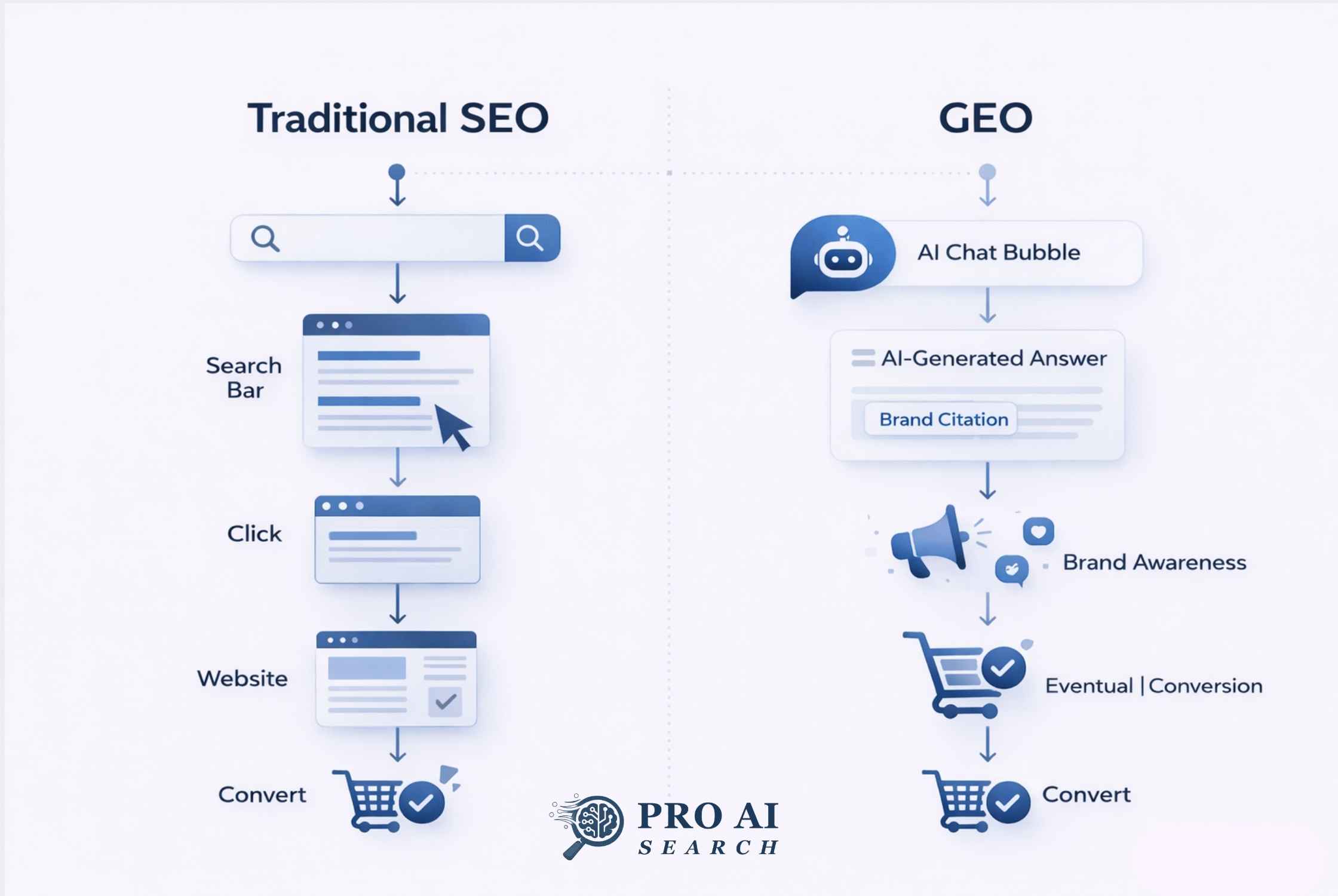
Traditional SEO optimizes your website to rank on Google’s results page so users see your link and click through to your site. The user journey is: search → list of results → click → visit site → convert. You measure success by keyword rankings, organic traffic, and click-through rates.
GEO optimizes your content to be cited inside AI-generated responses from platforms like ChatGPT, Perplexity, Google AI Overviews, and Gemini. The user journey is: ask AI a question → AI generates an answer → your brand is cited as a source → user may or may not click through → brand authority is established. You measure success by citation rate, AI share of voice, and brand mentions in AI responses.
The Princeton University GEO research paper, published at ACM KDD 2024 by researchers from Princeton, Georgia Tech, The Allen Institute for AI, and IIT Delhi, was the first to formally define GEO and measure what content attributes increase AI citation probability. Their finding: structured optimization can boost AI visibility by up to 40% compared to unoptimized content covering identical topics. That 40% difference is not from better backlinks or higher domain authority. It is entirely from content structure. For the broader data picture on AI search growth, see our AI search statistics 2026 roundup.
GEO vs SEO: Side-by-Side Comparison
| Factor | Traditional SEO | GEO |
|---|---|---|
| Primary goal | Rank on Google’s results page | Get cited in AI-generated responses |
| Success metric | Keyword rankings, organic clicks | Citation rate, AI share of voice |
| Primary signals | Backlinks, keyword relevance, page authority | Content structure, E-E-A-T, direct answers, statistics |
| Content format | Keyword-targeted, builds to the answer | Answer-first, question-format headings, structured for extraction |
| User journey | Search → click → visit site | Ask AI → AI cites you → brand awareness → eventual conversion |
| Tools | Google Search Console, Ahrefs, Semrush | Manual citation tracking, GA4 AI referral segments, Profound |
| Timeline | 3 to 6 months for new content | 4 to 8 weeks for first citations on new content |
| India opportunity | Competitive, established players dominate | Early mover advantage, most Indian sites not optimized |
| Traffic type | Direct clicks | Brand mentions, occasional direct clicks |
| Conversion quality | Standard organic conversion rate | ChatGPT traffic grows 3.26x, higher intent per session |
The 12% Overlap Problem: Why SEO Rankings Don’t Guarantee AI Citations
This is the most important data point in this entire article, and the one most businesses miss completely.
Ahrefs analyzed 15,000 prompts across ChatGPT, Gemini, and Copilot and found that on average only 12% of URLs cited by AI assistants also rank in Google’s top 10 for the same query. For ChatGPT specifically, the overlap is even lower at 6.82%. A separate Search Engine Journal analysis of 863,000 keywords found that only 38% of Google AI Overview citations came from pages in the top 10, and that number had dropped from 76% just six months earlier as Google switched to Gemini 3 as its AI Overview backbone.
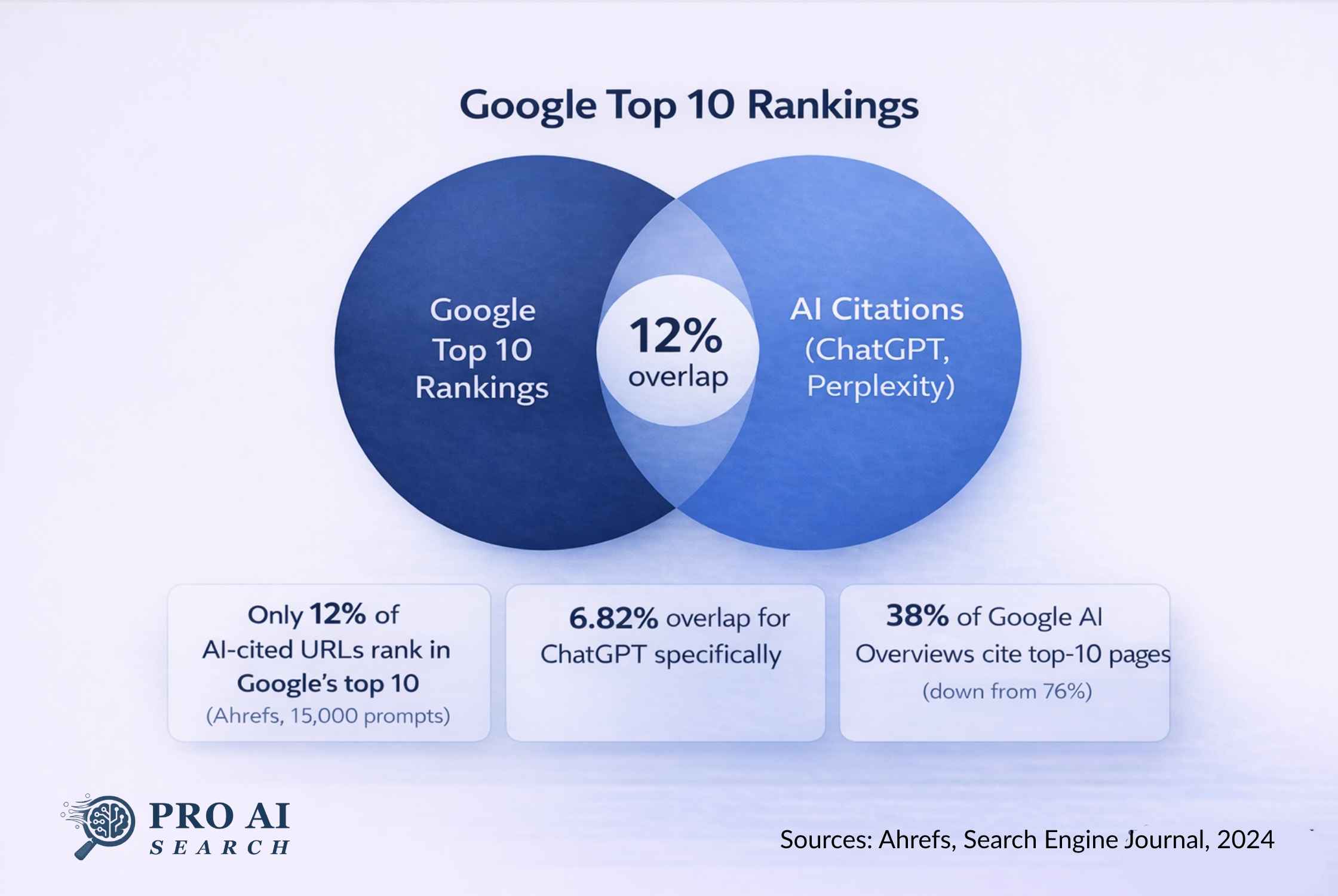
What this means practically: you can rank first on Google for a keyword and still get zero AI citations for that same query. The reverse is also true, a page outside Google’s top 100 can still get cited by Perplexity or ChatGPT if its content is structured correctly. GEO is a distinct discipline from SEO. Doing one does not automatically deliver the other.
I saw this directly with content I worked on at LearnQ India. Pages optimized purely for Google rankings were invisible in Perplexity responses for identical queries. Once we restructured those pages, leading with direct answers, adding question-format H2s, citing external data sources, Perplexity citations started appearing within four to six weeks, independent of the Google ranking position.
What GEO and SEO Share: The 80% Foundation
Before treating GEO and SEO as entirely separate disciplines, it is worth being honest about how much they overlap. The foundation that makes a page rank well on Google also makes it more likely to get cited by AI systems.
The shared foundation includes content structure techniques like those covered in AEO (Answer Engine Optimization), question-format headings, direct answers, FAQ schema, plus technical accessibility(AI crawlers need the same basic access as Googlebot), E-E-A-T signals (experience, expertise, authoritativeness, trustworthiness matter for AI citation selection as much as Google rankings), page speed (slow pages are skipped by both Googlebot and AI crawlers), backlinks and domain authority (these build the credibility signals that AI systems use alongside content quality), and structured data markup (schema helps both Google and AI understand your content).
The key insight from the Princeton GEO paper is that the content attributes that increase AI citation probability, statistics, citations, direct answers, authoritative writing are also the attributes that improve Google’s E-E-A-T evaluation. Writing better content for GEO makes your SEO better simultaneously. The workflows do not need to be separate.
Where India Changes the Calculation
Every GEO vs SEO comparison article I have read is written for US or European audiences. None of them account for India’s specific position in the global AI search market, which changes the priority order significantly.
India is Perplexity’s single largest global market, accounting for 22.75% of total traffic according to SimilarWeb data. India is among ChatGPT’s top markets globally. At the same time, Google commands over 95% of India’s search market. This means Indian businesses need to optimize for both traditional search and AI search simultaneously, but the AI opportunity is concentrated in different platforms than in the US.
For Indian businesses, the priority order is: Google AI Overviews first (because Google dominates Indian search and AI Overviews appear on a growing percentage of queries), Perplexity second (because India is its largest market and citations tend to appear faster for new content than Google AI Overviews), and ChatGPT third. This is different from the US, where ChatGPT commands a larger share of the AI search attention.
The competitive gap is also different in India. Gartner predicts traditional search volume will drop 25% by 2026 as AI tools absorb more queries. Most Indian businesses have not started GEO at all, while the US and European markets are already becoming competitive. The window for first-mover advantage in Indian AI search is 2026.
Which Should You Prioritize: GEO vs SEO
The honest answer is: it depends on where you are starting from. Here is the framework I use when advising Indian businesses on where to begin.
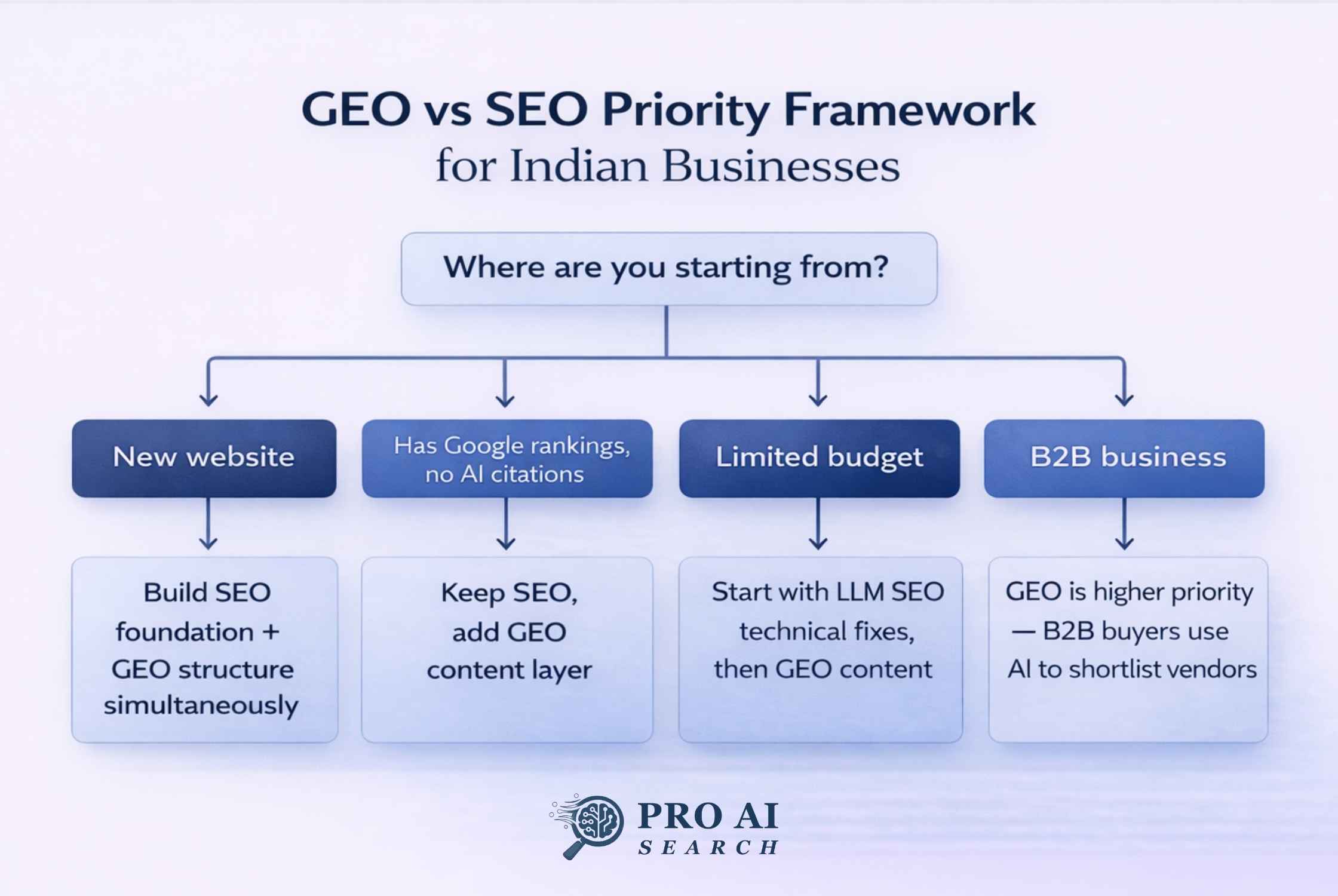
New website with no content yet
Build your SEO technical foundation first, robots.txt, sitemap, schema markup, Google Search Console setup, and write every piece of content with GEO structure from day one. Since GEO-optimized content also improves Google rankings (direct answers, question-format headings, statistics), you are not choosing between the two. You are doing both simultaneously from the start.
Existing website with Google rankings but no AI citations
Your SEO foundation is working. The problem is content structure. Apply the GEO layer on top: rewrite the first paragraph of each H2 section to lead with a direct answer, add FAQ schema to key pages, and verify that AI crawlers can access your site (check Cloudflare Bot Fight Mode and robots.txt). These changes can be applied to existing pages without rebuilding anything.
Limited budget and time
Start with technical LLM SEO, check that AI crawlers can access your site, add llms.txt, configure robots.txt. This takes under two hours and costs nothing. Then write every new piece of content with inverted pyramid structure: answer first, context second, detail third. You are doing GEO and SEO simultaneously with no extra work.
B2B Indian business
GEO is the higher priority. Procurement managers and business decision-makers use ChatGPT and Perplexity to research vendors before making contact. A B2B buyer might ask Perplexity “which logistics company in Bengaluru should I use” before ever visiting your website. If you are not in that answer, you are not in the shortlist. B2B buyers are earlier AI search adopters than consumers, making GEO more commercially urgent for B2B than for B2C.
How to Do GEO and SEO Simultaneously
The most efficient approach is a unified content workflow that serves both Google rankings and AI citations from the same piece of content. Here is what that looks like in practice.
Write the direct answer in the first 40 to 60 words of every H2 section. This is the most important single change you can make. AI engines extract the opening of each content section. Google rewards content that answers search intent directly. Both benefit from the same structural change.
Use question-format H2 and H3 headings. “What is the difference between GEO and SEO?” maps directly to a user query pattern and gets extracted by AI sub-query matching. “Overview” or “Introduction” does not map to anything. Every heading rewrite that improves AI citation probability also improves Google’s understanding of your content structure.
Cite specific data points with linked external sources. The Princeton GEO research found that content with statistics earns up to 40% higher AI visibility than opinion-only content. Google’s E-E-A-T framework rewards the same behaviour. Adding one cited data point per section improves both simultaneously.
Add FAQ schema to every page with a FAQ section. This is free via Rank Math or the Schema & Structured Data for WP plugin, takes ten minutes per page, and directly signals to both Google’s rich results and AI engines what questions your content answers.
Frequently Asked Questions About GEO vs SEO
Is GEO replacing SEO?
No. GEO builds on SEO foundations. Strong technical SEO, backlinks, and E-E-A-T signals all contribute to AI citation probability. GEO adds a content structure layer on top of SEO, it does not replace it. The businesses that will lose visibility are those who optimize only for traditional Google rankings and ignore AI search entirely, not those who do both.
Can the same content rank on Google and get AI citations?
Yes. Content that answers questions directly, uses clear headings, cites data, and demonstrates expertise performs well in both traditional search and AI search. The main adjustment is structural: lead with answers, use question-format headings, keep paragraphs short. These changes improve Google rankings and AI citation probability simultaneously. You do not need separate content strategies.
Which is more important for Indian businesses in 2026?
Both are necessary, but GEO represents the larger untapped opportunity for Indian businesses right now. Most Indian websites have strong enough traditional SEO foundations to rank on Google. Very few have implemented any GEO optimization. Given that India is Perplexity’s largest global market and among ChatGPT’s largest, the upside from early GEO investment is disproportionately large compared to incremental gains in traditional SEO.
How long does GEO take vs SEO to show results?
GEO results appear faster. First Perplexity citations for new content typically appear within 2 to 4 weeks on a technically accessible site. ChatGPT citations follow 4 to 8 weeks after Bing indexes the content. Google AI Overview citations take longer because they require first ranking in Google’s top results, typically 6 to 12 weeks for competitive queries. Traditional SEO for new content on a new domain typically takes 3 to 6 months to show meaningful ranking movement.
Do I need separate tools for GEO and SEO?
Not at the start. Google Search Console and GA4 handle both traditional and AI referral tracking for free. GA4 tracks referral traffic from chatgpt.com, perplexity.ai, and gemini.google.com directly. Manual weekly citation tracking, running your 20 target queries through Perplexity, ChatGPT, and Google AI Overviews costs nothing and gives you the clearest performance signal. Paid tools like Profound (from $99/month) and AthenaHQ (from $295/month) are useful at scale but not necessary for Indian businesses starting out.
What is the biggest mistake businesses make when comparing GEO and SEO?
Treating them as competing priorities and choosing one. The businesses that lose in 2026 are those optimizing only for Google rankings while ignoring AI search. The businesses that also lose are those chasing AI citations without the technical and content foundation that makes citations possible. The correct approach is to build both simultaneously, since 80% of the work is identical. Start with the technical foundation, write every piece of content with GEO structure, and measure both Google rankings and AI citations from day one.
