
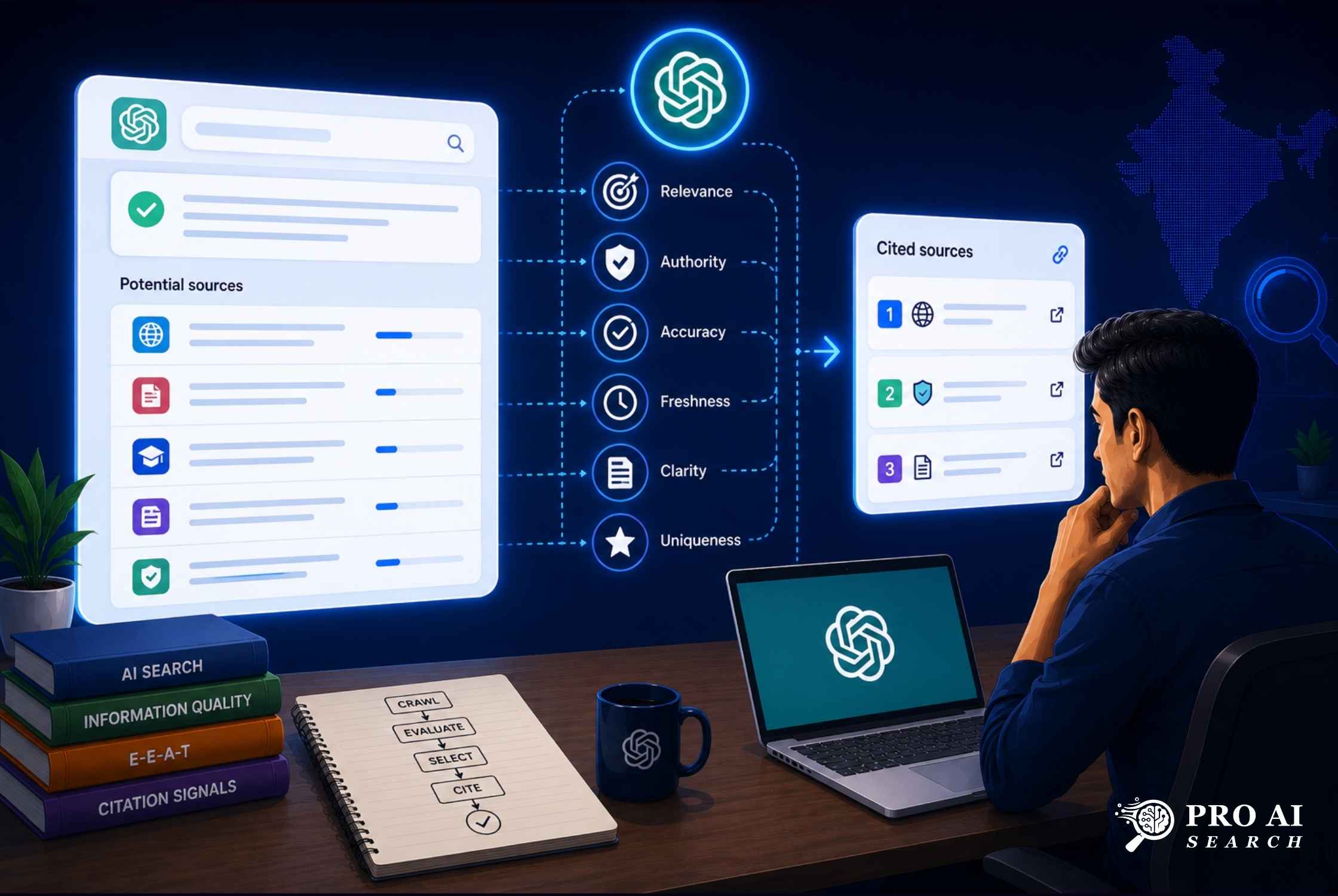
How ChatGPT chooses sources to cite is one of the most practically important questions in AI search optimization right now, and most explanations get it wrong by treating ChatGPT as a single system. It is not. ChatGPT operates through two completely different mechanisms, and the one you are optimising for determines whether your strategy has any chance of working.
This guide breaks down exactly how each mechanism works, what the research shows about citation signals, and what Indian websites can do right now regardless of domain authority.
How Does ChatGPT Actually Choose Which Sources to Cite? (It Has Two Completely Different Systems)
ChatGPT chooses sources through two entirely separate mechanisms depending on which mode is active. In its default mode, it generates answers from training data without accessing any live sources and produces no citations at all. In browsing mode, it searches the web via Bing and selects 3 to 6 sources to cite per response based on domain authority, content quality, and platform trust signals.
Most businesses optimising for ChatGPT citations are optimising for browsing mode, which is correct. But the confusion between modes explains why many businesses see their brand mentioned in ChatGPT answers without ever receiving a clickable citation. Mentions come from training data. Citations only come from browsing mode. These are different outcomes requiring different strategies.
According to ZipTie.dev’s citation research, browsing mode evaluates sources using three weighted factors: domain authority at approximately 40%, content quality at approximately 35%, and platform trust at approximately 25%. Understanding each factor is the foundation of any citation strategy. Our guide on how AI search engines work covers how this retrieval process differs across ChatGPT, Gemini, and Perplexity.
What Is the Difference Between ChatGPT Mentioning Your Brand and Actually Citing You?
ChatGPT mentions brands approximately 3 times more often than it actually cites them with a clickable source link. This distinction matters enormously for strategy because mentions and citations require completely different approaches to earn.
A mention looks like this: “Popular CRM options include Salesforce, HubSpot, and Pipedrive.” No link. No source attribution. The answer comes from training data and your brand appears because it was present in the training corpus frequently enough to be statistically associated with the topic. You cannot directly control training data mentions except by building widespread presence across the web over time.
A citation looks like this: “According to [your website], the average implementation takes 6 weeks.” There is a clickable link. The answer came from browsing mode where ChatGPT retrieved your specific page and lifted a specific passage from it. Citations are directly optimisable through content structure, freshness, and crawlability improvements. For Indian businesses, citations are the meaningful target because they drive actual referral traffic, not just brand awareness. Our comparison of GEO vs AEO vs LLM SEO covers how each approach targets different parts of this citation process.
What Domain Authority Does a Website Need Before ChatGPT Will Cite It?
Sites with over 32,000 referring domains are 3.5x more likely to be cited by ChatGPT than sites with fewer referring domains, according to SE Ranking research cited in Sudha Solutions’ 2026 citation guide. Researchers describe this as an authority trust cliff, a threshold below which ChatGPT treats content as too risky to surface to users.
However, domain authority works differently in ChatGPT’s system than in Google’s. High domain authority gets your content into the retrieval pool, the initial set of pages ChatGPT considers. Once retrieved, pages in the domain authority range of 40 to 80 show citation rates comparable to higher-authority domains. Getting through the retrieval threshold is the hard part. Once you are retrieved, content quality becomes the deciding factor.
Also worth noting: pages ranking in Position 1 on Google are cited by ChatGPT 3.5x more often than pages outside the top 20. But only 12% of URLs cited by ChatGPT also rank in Google’s top 10, which means strong Google rankings help but are not sufficient on their own. 44% of SaaS brands with strong Google rankings have zero ChatGPT visibility.
What Indian Websites with Low Domain Authority Can Do Instead
Low domain authority is a real barrier to ChatGPT citations but it is not permanent and it is not the only path. Three approaches work specifically well for Indian websites building from a low authority base.
First, target India-specific queries where the citation competition is thin. When someone asks ChatGPT “which Indian B2B software companies specialise in healthcare automation,” the pool of well-structured competing content is small enough that a lower-authority domain with genuinely good content can win. Generic global queries require significant authority. India-specific queries often do not.
Second, build third-party presence on high-authority platforms that ChatGPT already trusts. A well-structured answer on Quora, a detailed Reddit comment in a relevant subreddit, or a LinkedIn article that gets meaningful engagement all contribute to your citation profile because ChatGPT cites these platforms directly. Your brand appears in those citations even when your own domain is not cited. Our guide on how IndiaMART sellers can leverage AI search covers this third-party citation strategy for Indian B2B businesses specifically.
Third, submit your sitemap to Bing Webmaster Tools immediately if you have not done so. ChatGPT’s browsing mode searches via Bing. A site that Bing has not indexed cannot appear in ChatGPT citations regardless of content quality. This is a zero-cost action that removes a technical barrier without requiring any authority building.
Does Content Structure Actually Affect Whether ChatGPT Cites You?
Content structure directly and measurably affects ChatGPT citation rates. According to ZipTie.dev’s research, 44% of all ChatGPT citations come from the first third of a webpage’s content. Content buried in the middle or bottom of a long page rarely gets lifted even when it is the most relevant passage on the page.
Question-format H1 and H2 headings have 7x more citation impact for smaller domains compared to statement-format headings. “How Does X Work?” outperforms “X Overview” significantly because ChatGPT’s query matching favours headings that directly mirror how users phrase questions to the AI. The r/GrowthHacking community put this plainly in a thread auditing 50 SaaS websites: “The sites that get cited consistently seem to make it ridiculously easy for models to understand what the product does.” Comprehension, not keyword density, is the optimisation target.
The practical structural rules that increase citation probability are straightforward. Every H2 section should open with a direct answer in the first sentence, not context or background. Paragraphs should be three sentences maximum so that the answer passage is extractable without ChatGPT having to parse a long block of text. Comparison tables, numbered steps, and definition blocks get cited at higher rates than prose paragraphs because they are structurally easy to lift and attribute. Our technical GEO audit checklist includes a content structure scoring system based on these citation signals.
How Much Does Content Freshness Matter for ChatGPT Citations?
Content freshness is one of the strongest and fastest-acting citation signals. According to data cited in Sudha Solutions’ 2026 guide, content updated within 30 days receives 3.2x more citations than stale content. Pages updated within three months averaged 6 citations in tracked studies versus 3.6 citations for outdated pages, a 67% difference driven purely by recency.
Freshness matters for two reasons. First, ChatGPT’s browsing mode retrieves live web content and its evaluation signals include publication and modification dates. A page with a 2023 date in 2026 signals staleness regardless of how good the content is. Second, ChatGPT is risk-averse about surfacing outdated information to users. Recent content reduces the risk that the cited information is no longer accurate.
The practical implication for Indian businesses is that updating existing strong articles is often faster and more citation-effective than publishing new ones. Add a “Last Updated” date visibly at the top of every article. Revise at least one substantive section with current data every 90 days. This signals freshness to both ChatGPT’s crawlers and to users who see the article.
Why Does ChatGPT Cite Reddit and Wikipedia More Than Most Brand Websites?
ChatGPT gives Reddit and Wikipedia outsized citation weight because platform trust is 25% of its source selection formula, and these two platforms score higher on trust signals than almost any brand-owned domain. Reddit alone has 23.6 million pages cited in AI responses, appearing in 92.8% of all AI search opportunities according to industry analysis from May 2026.
Platform trust is distinct from domain authority. It reflects how consistently a platform has produced reliable, community-validated information over time. Wikipedia’s editorial standards and Reddit’s upvoting system both function as community trust signals that ChatGPT’s training reinforced. Brand websites, regardless of their SEO strength, lack this community validation layer by default.
The practical takeaway from the r/bigcommerce community is directly actionable: “The stores showing up consistently in ChatGPT recommendations weren’t always the ones with the best SEO or the most backlinks. A lot of them just had a serious Trustpilot presence.” Third-party review platforms like Trustpilot, G2, and Clutch function as platform trust proxies for brand websites. ChatGPT cites these review platforms, and your brand appears inside those citations. Building 50 to 100 verified Trustpilot reviews creates citation exposure that a brand website alone cannot achieve. This applies directly to Indian B2B businesses listed on platforms like IndiaMART, TrustRadius India, and Software Suggest.
Authentic Reddit participation in relevant subreddits creates the same effect. A detailed, helpful answer in r/IndianStartups or r/digital_marketing that earns upvotes becomes citable content that ChatGPT can attribute to a specific thread. Your brand appears in the citation even when your own domain is not cited directly. Read our guide on how to rank in Perplexity for the platform-specific community participation strategy that applies across AI search engines.
What Can an Indian Website Do Right Now to Get Cited by ChatGPT?
Indian websites can take four concrete steps right now that directly address the ChatGPT citation factors, without needing to wait for domain authority to build.
Step 1: Submit to Bing Webmaster Tools today. Go to bing.com/webmasters, submit your sitemap, and verify your domain. ChatGPT’s browsing mode uses Bing’s index. A site not in Bing’s index cannot receive ChatGPT citations regardless of content quality. This takes 15 minutes and costs nothing.
Step 2: Check your robots.txt for blocked AI crawlers. Open your domain followed by /robots.txt and verify that GPTBot and ChatGPT-User are not blocked. Many WordPress security plugins block these crawlers by default. Removing that block immediately makes you eligible for ChatGPT’s retrieval pool.
Step 3: Restructure your top 5 pages for answer-first content. Take your five most important pages and rewrite every H2 section so the first sentence is a direct answer to the question the heading asks. Move your best content to the top third of each page. Add a FAQ section at the bottom of every article with at least 5 self-contained question-answer pairs. These structural changes can produce citation results within two to four weeks of Googlebot and Bingbot re-crawling the updated pages.
Step 4: Build third-party presence on platforms ChatGPT already trusts. Get listed on G2, Clutch, or Software Suggest with a complete profile and at least 10 verified reviews. Participate authentically in two to three relevant subreddits with substantive answers. Publish at least one LinkedIn article per month on a specific question in your niche. Each of these actions creates citation surface area on platforms where ChatGPT already has high trust, accelerating your citation timeline without requiring domain authority growth. Our AI search optimization guide for Indian startups covers this four-step sequence with industry-specific examples.
Frequently Asked Questions
Does ChatGPT use Google to find sources?
No. ChatGPT’s browsing mode searches the web via Bing, not Google. This is a critical distinction for Indian businesses because strong Google rankings do not guarantee ChatGPT citations. You need to be indexed by Bing separately, which requires submitting your sitemap to Bing Webmaster Tools. Pages that rank well on Google but are not indexed by Bing are invisible to ChatGPT’s citation system entirely.
Why does ChatGPT mention my brand but never link to my website?
This happens because mentions and citations come from different systems. Mentions come from ChatGPT’s training data, where your brand appeared frequently enough to be statistically associated with your category. Citations come from browsing mode, where ChatGPT retrieves and links to live web pages. To move from being mentioned to being cited, you need to be indexed by Bing, have your content retrieved for relevant queries, and have your content structure make it easy for ChatGPT to lift a specific passage. The gap between mentions and citations is common, ChatGPT mentions brands approximately 3x more often than it actually cites them.
How long does it take for a new Indian website to get its first ChatGPT citation?
For a new Indian website following the correct setup sequence, the realistic timeline is 4 to 6 weeks for the first citation. The sequence matters: Bing indexation first (week 1), robots.txt check (week 1), content restructuring for answer-first format (weeks 1 to 2), then wait for Bingbot to re-crawl updated pages (weeks 2 to 4). Citations for India-specific queries with low competition can arrive within 2 to 3 weeks on well-structured pages. Citations for competitive global queries require domain authority building that takes months.
Does updating old content help get cited by ChatGPT?
Yes, significantly. Content updated within 30 days receives 3.2x more citations than stale content. Updating an existing article with current data, revising the publication date, and improving the answer-first structure in key sections is often faster and more effective than publishing a new article from scratch. Add a visible “Last Updated” date at the top of every article. ChatGPT’s retrieval system treats recently modified pages as lower-risk sources for time-sensitive queries.
Does ChatGPT prefer certain types of content formats?
Yes. ChatGPT lifts specific passages rather than entire pages, so content formats that produce clean, extractable passages perform better. These include: direct definitions at the start of sections, numbered step lists, comparison tables, and FAQ blocks with self-contained answers. Narrative prose buried in long paragraphs rarely gets cited even when the information is accurate and relevant. The format that works best mirrors how ChatGPT itself structures responses, clear, concise, direct answers followed by supporting detail.
How is ChatGPT’s citation behaviour different from Perplexity and Gemini?
The three platforms use fundamentally different source selection signals. ChatGPT via Bing weights domain authority heavily and favours editorial sources like Wikipedia, Reddit, and established publications. Perplexity runs its own crawler and weights recency and answer quality over authority, which is why new websites get Perplexity citations faster than ChatGPT citations. Gemini pulls from Google’s index and favours content that already ranks well in Google Search. For Indian businesses, optimise for Perplexity first (fastest path to first citation), Gemini second (benefits from existing Google SEO work), and ChatGPT third (requires Bing indexation and authority building). Our AEO guide covers the platform-by-platform optimisation strategy in detail.