
The best perplexity ai alternatives in 2026 are ChatGPT with Search, Google Gemini, Microsoft Copilot, Claude.ai, Grok, and You.com. Each one handles cited, real-time web answers differently, and which one is right for you depends on whether you want a free replacement, a tool optimized for India, or a platform that matters most for your content’s AI citation reach.
Perplexity remains the cleanest dedicated AI search engine available today. But its free tier is limited, its Pro plan costs $20/month, and several strong alternatives now match or beat it on specific use cases. This guide covers all six options with India pricing, citation behavior, and the angle most articles miss: which alternatives matter most if you want your own content to appear in AI-generated answers.
What Makes a Good Perplexity Alternative?
Perplexity’s core value is three things in one: a real-time web search, an AI that synthesizes the results, and inline citations for every claim. A true alternative needs to match at least two of these. Tools that only generate text without real-time web access (like base ChatGPT without search) are AI assistants, not AI search engines, and they serve a different purpose.
Four criteria matter when evaluating alternatives: does it cite sources, does it search the live web, is there a usable free tier in India, and does it run on a large enough index to matter for your GEO strategy. We evaluated all six tools against these criteria before ranking them.
The 6 Best Perplexity AI Alternatives in 2026
Here is the full comparison before we go into detail on each tool.
| Tool | Best For | Cites Sources? | Free Plan | India Monthly Cost |
|---|---|---|---|---|
| ChatGPT with Search | Best overall replacement | Yes (numbered) | Yes (limited) | Free / ₹1,670 (Plus) |
| Google Gemini | Google Workspace users | Yes (inline) | Yes | Free / ₹1,950 (Advanced) |
| Microsoft Copilot | Best completely free option | Yes (inline) | Yes (unlimited) | Free |
| Claude.ai | Long-form research & documents | Only with web search | Yes (limited) | Free / ₹1,700 (Pro) |
| Grok | Real-time & trending topics | Yes (web + X) | Yes | Free |
| You.com | Developers & unlimited free searches | Yes (inline) | Yes (unlimited) | Free / ₹1,250 (YouPro) |
1. ChatGPT with Search (Best Overall Perplexity Alternative)
ChatGPT with Search is the strongest overall Perplexity alternative for most users. It combines GPT-4o reasoning with Bing-powered real-time web search and returns numbered citations alongside every sourced claim, which is the behavior most Perplexity users want to replicate. As of early 2026, ChatGPT holds approximately 60.7% of the AI search market, making it the platform your audience is most likely already using.
The free plan allows limited web searches per day. ChatGPT Plus at $20/month (around ₹1,670) removes the cap entirely and adds access to GPT-4o with reasoning. For users switching from Perplexity Pro, the price is identical and the capability set is significantly broader because ChatGPT also handles writing, coding, and data analysis alongside search.
The one area where ChatGPT Search still trails Perplexity: Perplexity typically returns more sources per answer and displays them more prominently. ChatGPT’s citations are real but often fewer in number per response. If citation density is your primary requirement, keep Perplexity alongside ChatGPT rather than replacing it entirely. For everything else, ranking in ChatGPT matters more than any other AI search platform right now.
Best for: Users who want one tool for research and creation Not ideal for: Users who need maximum citation density per answer
2. Google Gemini (Best for Google Workspace Users)
Google Gemini is the best Perplexity alternative for anyone already embedded in the Google ecosystem. Gemini’s AI Mode, which rolled out widely in 2025, functions as a full conversational search layer on top of Google’s own index. It cites sources inline and pulls from the same index that powers organic Google search results, which means it has access to more pages than Perplexity’s own crawler indexes.
The free plan on gemini.google.com works on any Google account, including Indian Gmail accounts with no VPN or workaround required. Gemini Advanced costs around ₹1,950/month and includes access to Gemini 1.5 Pro with a 1 million token context window. For users who already pay for Google One or Google Workspace, Gemini Advanced is often bundled in.
Gemini’s biggest advantage over Perplexity is recency on news. Because it pulls from Google’s crawl in near-real-time, it handles breaking news better than Perplexity’s crawler. Its gap is depth of academic and technical research, where Perplexity’s focused indexing tends to surface better primary sources. Gemini held approximately 15% of the AI search market as of January 2026, making it the second most important platform for answer engine optimization after ChatGPT.
Best for: Google Workspace users, news research, India users wanting a free option Not ideal for: Deep academic or technical research
3. Microsoft Copilot (Best Completely Free Option)
Microsoft Copilot is the best completely free Perplexity alternative, with no daily search limit and no account required on copilot.microsoft.com. It runs on Bing’s index and uses GPT-4o under the hood, delivering a Perplexity-style cited answer experience at zero cost. For Indian users who find Perplexity’s free tier too restrictive, Copilot is the practical first alternative to try. For a detailed head-to-head on citation quality, pricing, and which to prioritize for your business, our Perplexity vs Copilot comparison covers both platforms in full.
Copilot’s key advantage is the Bing Multiplier: because Copilot and ChatGPT Search both run on Bing’s index, a single Bing optimization effort reaches both platforms simultaneously. You also pick up DuckDuckGo, Yahoo, Ecosia, and Windows 11 search as additional surfaces. That means Copilot is not just a standalone alternative to Perplexity but part of a broader AI citation ecosystem driven by one index.
Where Copilot falls behind Perplexity: it does not have Perplexity’s “Spaces” feature for collaborative research, and its source presentation is less granular. The citations appear but with less visual hierarchy than Perplexity’s numbered system. For everyday research and factual queries, Copilot covers 80% of what Perplexity offers at no cost. For context on how to appear in Copilot’s answers, our LLM SEO guide covers Bing-based optimization in full. For the step-by-step Copilot citation strategy, our complete guide to ranking in Microsoft Copilot covers the specific Bing signals that differ from ChatGPT Search.
Best for: Users who want unlimited free AI search with source citations Not ideal for: Collaborative research projects or multi-step workflows
4. Claude.ai (Best for Long-Form Research Tasks)
Claude.ai is the best Perplexity alternative when the task is analyzing large documents rather than searching the live web. Claude is not a dedicated AI search engine in the way Perplexity is: its free plan does not include web search, so it cannot retrieve real-time information by default. What it does exceptionally well is process long inputs, maintain context across complex multi-step research, and synthesize material you give it directly.
For Indian users, Claude.ai is free on any browser with a Google or email login. Claude Pro at $20/month (around ₹1,700) adds web search capability and higher usage limits. With web search enabled on Pro, Claude does cite sources. Without it, it answers from training data only, which is a meaningful distinction if you are using it as a Perplexity replacement for current events.
The use case where Claude clearly beats Perplexity is document-heavy research: analyzing uploaded PDFs, comparing long reports, synthesizing research papers. Perplexity is faster for web-based Q&A; Claude is better for “here is a 50-page document, explain it to me.” Our guide on getting cited by Claude AI covers how Claude selects sources when web search is active, which is a different mechanism from Perplexity’s crawler.
Best for: Document analysis, long-form research, complex reasoning tasks Not ideal for: Real-time web search on the free plan
5. Grok (Best for Real-Time and Trending Topics)
Grok is the best Perplexity alternative when the research topic is breaking news, trending on X (Twitter), or tied to real-time social signals. Built by xAI and accessible free at grok.com, Grok searches both the live web and the full X post archive, giving it access to information that traditional search indices often miss: expert opinions posted minutes ago, real-time sentiment on market events, and niche technical discussions happening in X threads.
The free tier on grok.com is genuinely unlimited for basic queries, which makes it one of the most accessible alternatives for Indian users. There is no VPN requirement, and the interface is clean and familiar if you use the X platform already. Grok also runs on Grok 3, xAI’s latest model, which is competitive on reasoning benchmarks as of 2026.
Where Grok is weaker than Perplexity: academic and scientific research. X data skews conversational and opinionated, which is great for trending topics but less reliable for precise factual queries that require peer-reviewed sourcing. Perplexity pulls from PubMed, academic databases, and government sources more consistently. For current events and social signal research, Grok is excellent. For everything else, verify its answers with a secondary source. Your GEO vs SEO strategy should account for Grok separately from Bing-based platforms because it requires different optimization signals. For a step-by-step approach to appearing in Grok’s answers, our Grok AI search optimization guide covers xAI’s unique citation signals.
Best for: Breaking news, social media research, trending topic analysis Not ideal for: Academic, medical, or technical research requiring verified sources
6. You.com (Best Free Option for Developers)
You.com is the closest structural match to Perplexity among the free alternatives. It is a dedicated AI search engine that returns cited, synthesized answers from the live web, and its free plan has no daily search limit. For developers specifically, You.com has a dedicated “Code Mode” that combines web search with code generation, a combination Perplexity does not offer natively.
YouPro costs $15/month (approximately ₹1,250), making it the most affordable paid upgrade among all six alternatives. The free tier is genuinely functional, not artificially restricted to push upgrades. Indian users can sign up directly with a Google account, and there are no geo-restrictions on the free plan.
The gap between You.com and Perplexity is primarily index depth and brand recognition. Perplexity’s crawler is more aggressive, and its index of academic and technical sources is more comprehensive. You.com is catching up but is not yet at parity for deep research tasks. It is the right choice if the Perplexity free tier feels too limited and you are not ready to pay for Pro. For developers who want cited answers alongside code, it is the best option in this list. Pair it with an understanding of whether AI can read your website to ensure You.com’s crawler can index your content.
Best for: Developers, budget-conscious users, unlimited free AI search Not ideal for: Deep academic research or enterprise workflows
Which Perplexity Alternative Cites Sources Most Like Perplexity Does?
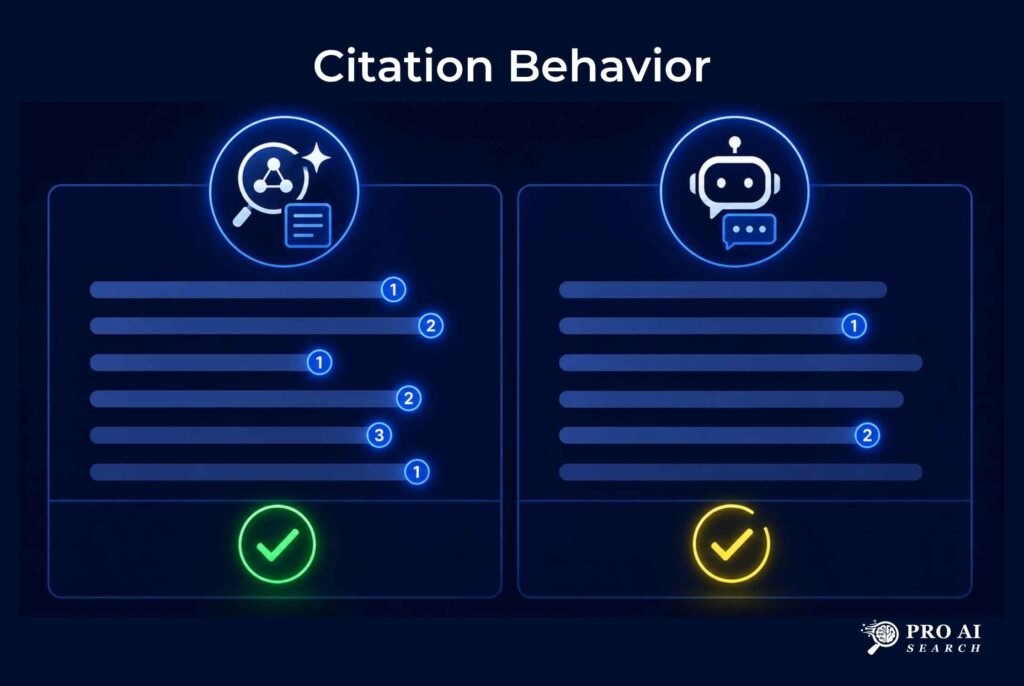
The main reason most users love Perplexity is the citation system. Every claim maps to a numbered source, and you can click through to verify. This is what distinguishes AI search from AI chatbots, and not every alternative on this list replicates it equally well.
Here is the honest breakdown. ChatGPT with Search and Microsoft Copilot both cite sources using inline numbered references, similar to Perplexity’s format, though with fewer citations per answer on average. Google Gemini cites inline but integrates citations more loosely into the prose, making individual claims harder to trace. Grok cites web sources but often mixes them with unattributed X post content, reducing verifiability. You.com matches Perplexity most closely: numbered citations, clickable sources, and a layout that explicitly shows which sentence came from which source. Claude.ai only cites sources when web search is active (Pro plan), and the citation format is less structured than Perplexity’s. For the citation experience closest to Perplexity at no cost, You.com is the winner. For citation experience on a platform with the largest user base, ChatGPT Search is the practical choice.
Which Perplexity Alternative Matters Most for GEO?
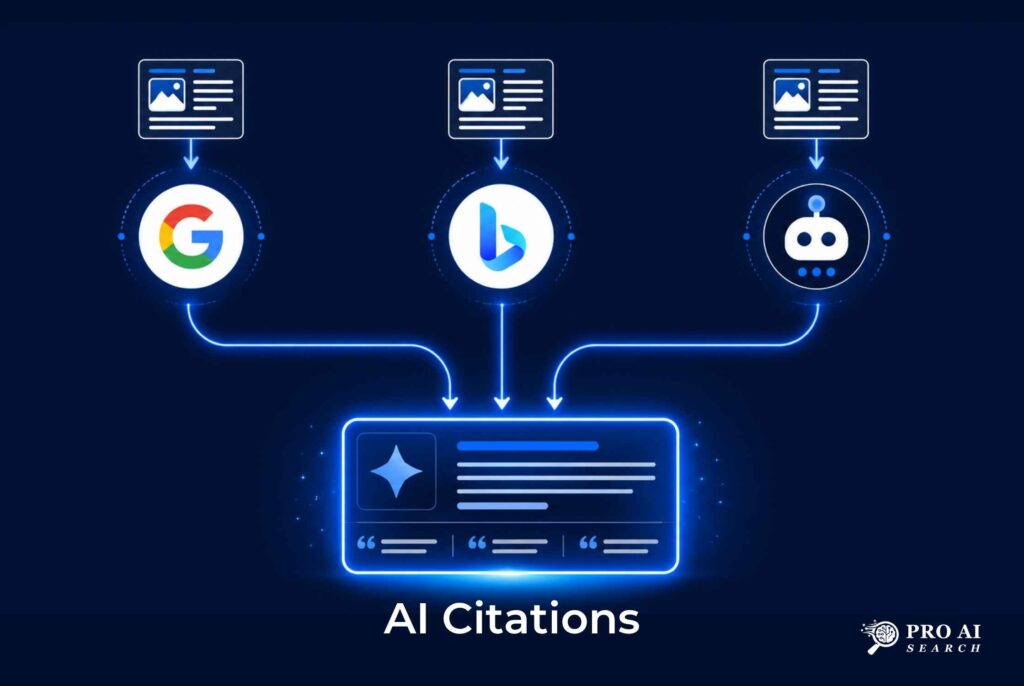
This is the question no other Perplexity alternatives article answers: if you are a content marketer or SEO professional, which of these platforms should you prioritize getting your content cited in? The answer is not necessarily the best tool to use. It is the platform with the most users and the broadest citation reach.
Prioritize in this order for your AI search optimization efforts. First, ChatGPT Search, because 60.7% AI search market share means more users see its citations than any other platform, and Bing optimization covers Copilot simultaneously. Second, Google Gemini, because it draws from the same index that drives Google AI Overviews, so standard on-page SEO and E-E-A-T signals apply directly. Third, Perplexity itself, because it has its own crawler (PerplexityBot) and a dedicated research audience that tends to convert well. The remaining alternatives (Grok, You.com, Claude) have smaller user bases and less consistent citation patterns. They are worth optimizing for over time, but they are not where most businesses should focus first.
The practical implication: getting your site cited in AI search results starts with structured content that answers specific questions directly. Our AI search statistics have the latest market share numbers across platforms, updated for 2026. For technical implementation, the LLM SEO guide covers robots.txt entries, schema markup, and crawl permissions for each platform’s bot. And for India-specific content strategy, starting with ChatGPT rather than Perplexity is the right call: ChatGPT has stronger India penetration and broader access across the income spectrum given its more accessible free tier.
Frequently Asked Questions: Perplexity AI Alternatives
Is there a completely free alternative to Perplexity?
Yes. Microsoft Copilot is the best completely free alternative to Perplexity with no daily search limit, no account required, and inline source citations. You.com is the second best free option and most closely mirrors Perplexity’s interface and citation format. Both are accessible in India without any restrictions or VPN requirement.
Which Perplexity alternative is best for students in India?
Google Gemini is the best option for Indian students because it is completely free on any Google account, handles both English and Hindi queries, and pulls from Google’s comprehensive index. Microsoft Copilot is the second best choice for the same reasons plus unlimited searches. Both are better free options than Perplexity’s restricted free tier for daily student research use.
Does ChatGPT Search actually replace Perplexity?
For most everyday research tasks, yes. ChatGPT with Search returns cited, real-time web answers and is the most capable overall alternative. The one area where Perplexity still leads is citation density: Perplexity typically returns more numbered sources per answer and makes individual claims easier to trace. If citation-heavy academic or technical research is your primary use case, running both tools in parallel gives better results than replacing Perplexity entirely.
Which AI search engine is most accurate for citations?
You.com and Perplexity are the most accurate for citations among AI search tools, because both were built specifically as citation-first AI search engines. ChatGPT Search and Copilot are reliable for most queries but occasionally produce fewer citations per answer. Grok mixes verified web sources with X post content, which can reduce traceability. Google Gemini is strong but integrates citations more loosely into prose compared to Perplexity’s numbered system.
Can I use multiple perplexity ai alternatives together?
Yes, and it is the approach most serious researchers use. The most efficient combination for Indian users is ChatGPT Search or Copilot (Bing-powered, broad coverage) plus Gemini (Google index) for comprehensive AI search coverage. Add You.com if you want a dedicated AI search interface similar to Perplexity’s. Running three tools covers the three major AI search indices: Bing, Google, and dedicated AI-first crawlers, which also means your content that appears in one is more likely to appear in all three if you optimize for Perplexity and optimize for ChatGPT simultaneously.