
If you want to know how to get cited by Claude AI, start with the one fact most businesses miss: Claude does not use Google or Bing to find sources. It runs on Brave Search, and that single difference changes your entire optimization strategy.
I have been running experiments on proaisearch.com since launch, tracking which types of content get pulled into Claude responses and which get ignored. The patterns are consistent enough to build a repeatable strategy around. Here is exactly what works.
How Claude AI Decides Which Sources to Cite
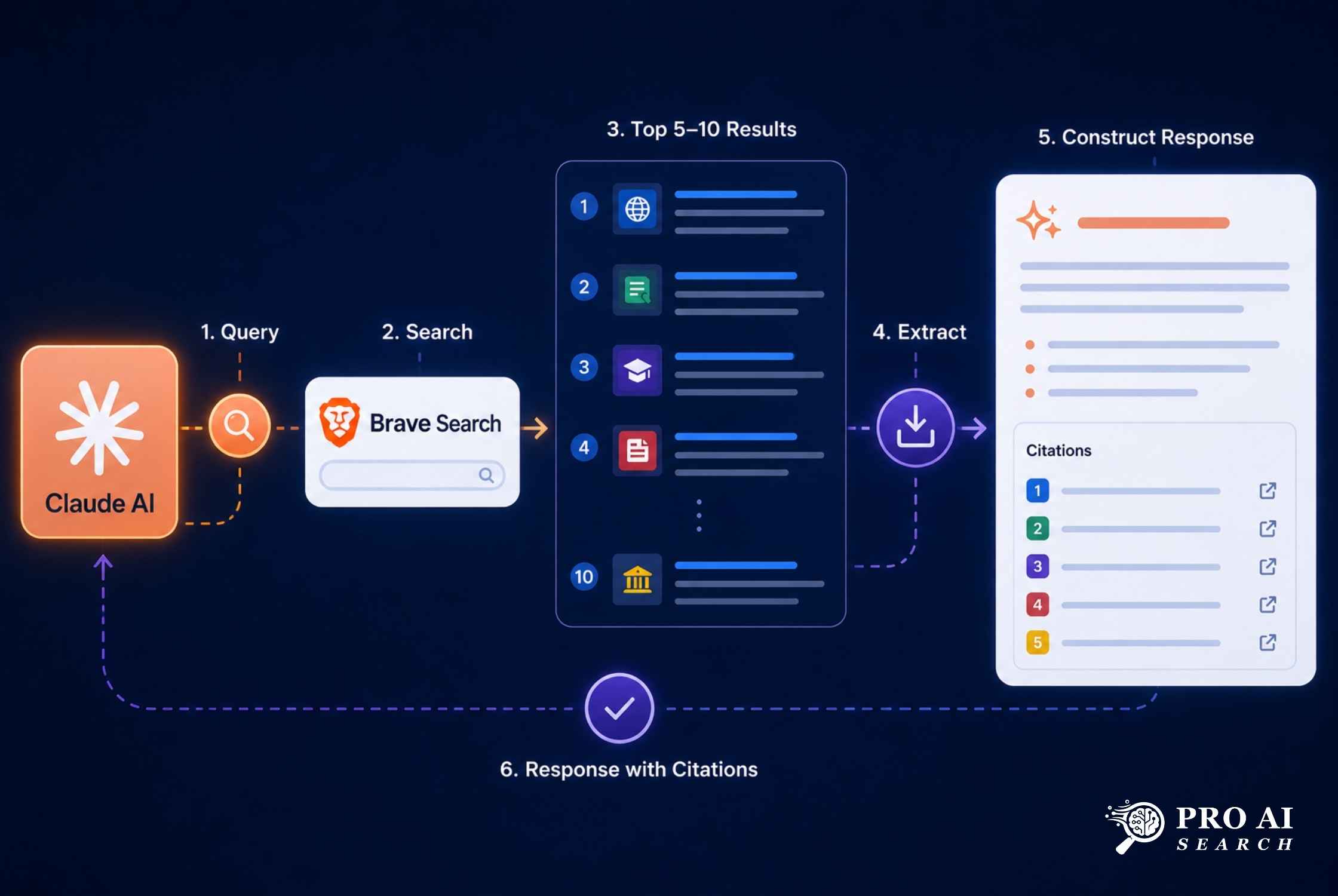
Claude selects sources by querying Brave Search, scanning the top 5-10 results, and picking pages it can extract a clean, quotable answer from. Research from Profound (reported by Luca Tagliaferro, 2025) found an 86.7% citation overlap between Claude responses and Brave Search’s top organic results, which means Brave Search visibility is the primary gating factor.
Claude does not passively crawl the web on its own. When a user asks a question that needs current information, Claude runs a live search through Brave, evaluates results against the query, and selects the page that answers it most directly. Anthropic confirms this directly in their support documentation: Claude Research uses live web results powered by Brave Search to deliver answers with citations.
Three conditions determine whether your page gets selected: the page appears in Brave Search’s top results for the query, the content contains a directly extractable answer sentence, and the page signals freshness and credibility. Miss any one of these and your page gets passed over regardless of how good the content is.
Understanding how AI search engines work at the technical level helps clarify why the retrieval mechanism matters so much. Each platform has a different data pipeline, and Brave’s is smaller and more selective than Google’s or Bing’s.
Step 1: Get Visible on Brave Search (The Step Most Businesses Skip)
Getting into Brave Search is your first checkpoint. You cannot get cited by Claude if Brave has not indexed your content.
Brave operates an independent web index. It is not a reskin of Google or Bing results. Sites that dominate Google rankings do not automatically carry that visibility into Brave, which is why I regularly see strong-authority sites completely absent from Claude responses.
The first action is to submit your site to Brave Webmaster Tools directly at search.brave.com/webmaster. It is free and takes under five minutes. After submission, test your visibility by searching your target queries on brave.com before testing them in Claude. If your content does not appear in Brave results, it will not appear in Claude citations either.
Step 2: Structure Your Content So Claude Can Extract It
Claude favors pages that look like answers, not brand pages or long essays with no clear information architecture.
An analysis of 2,170 Claude-cited URLs by Oltre.ai (2026) found that 56% of cited pages sit under a /blog/ path and 47% use listicle-style URL structures such as /best-, /top-10-, /alternatives-, or /vs-. Only 3% of cited URLs were domain homepages. Claude cites specific answer pages, not front doors.
Three structural rules that move the needle for Claude citation probability:
Keep paragraphs to three sentences maximum. Claude extracts paragraph-sized chunks from pages. Long, flowing blocks get skipped in favor of tighter content that answers a query in a self-contained unit. Write each paragraph as if it might be pulled out of context and still make sense.
Open every H2 and H3 with a direct answer. Put the key point in the first sentence of each section. Claude skims for extractable answers, and if your opening sentence buries the point after two sentences of context, the page loses to a competitor that leads with the answer.
Use question-format headings wherever natural. “How Does Claude Pick Sources?” outperforms “Source Selection Overview” because Claude matches your heading structure to how users phrase queries. The closer your heading is to real search phrasing, the more likely Claude pulls from it.
This is the same structural logic behind the GEO content strategy framework I use across all AI-optimized content, not just Claude.
Step 3: Build the E-E-A-T Signals Claude Weights Heavily
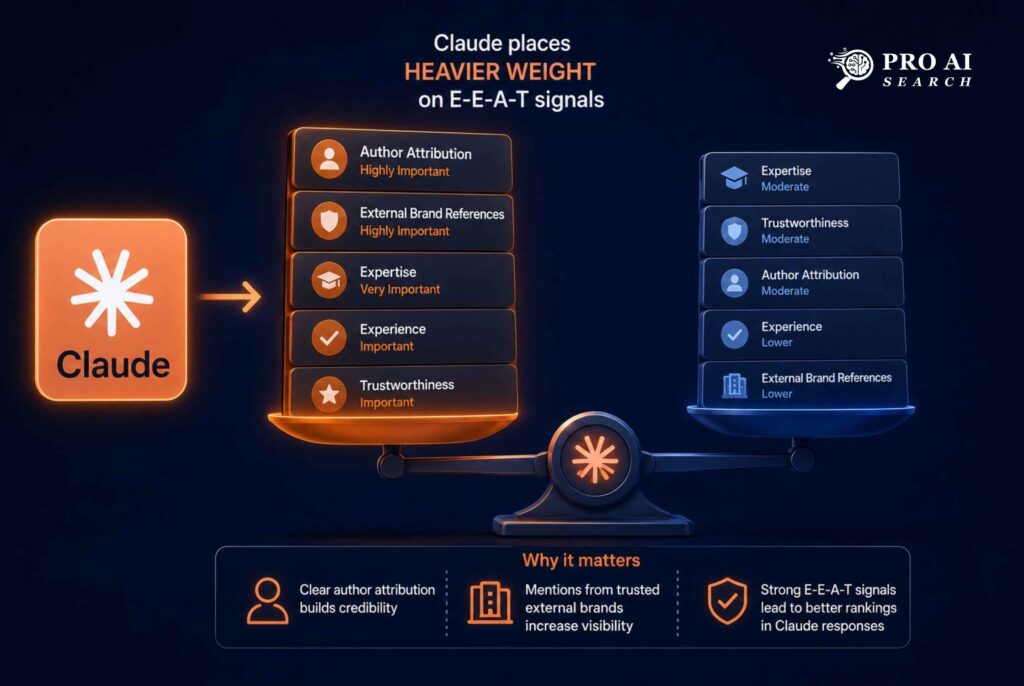
Of the major AI platforms, Claude applies the heaviest weight to E-E-A-T signals. This comes directly from Anthropic’s emphasis on safe, reliable, and verifiable information in Claude’s training.
Four signals that matter most for Claude:
Author attribution with credentials. Add a detailed author bio to every article. Include your role, years of experience, and any links to your LinkedIn or professional profile. Claude’s training data is heavily weighted toward academic and journalistic content where author attribution is standard practice, so it trusts attributed content more than anonymous pages.
An About page with real founder detail. Claude uses About pages as authority signals even when it does not cite them directly in responses. A thin About page with no real information about the people behind the site is a weak signal. Write an About page that documents your actual background and expertise.
External citations in your own content. Pages that cite external research look more credible to Claude. If you make a data claim, link to the original study. This mirrors how Claude itself behaves and signals that your content meets the same verification standard Claude applies to its own outputs.
External mentions of your brand. Getting referenced on industry publications, in case studies, or in academic papers increases the probability Claude has encountered your brand in training data. Even if Claude does not cite those external pages directly, the associations build authority signals. The brand monitoring for AI results guide covers how to track and grow these mentions systematically.
Step 4: Add the Schema Markup Claude Responds To
Structured data does not tell Claude what to cite, but it helps Brave Search understand your content structure, which feeds Claude’s source pool.
Three schema types produce the best results for Claude citation readiness. The full implementation is in the schema markup for GEO guide, but here is the priority order:
Article schema with author entity. Declare the author as a named entity with a sameAs property linking to a LinkedIn or professional profile. This is the schema type most directly tied to E-E-A-T signaling for Claude. A basic implementation looks like this:
HowTo schema. For step-by-step guides, HowTo schema marks up each step so Claude can extract them individually rather than treating the whole section as a block. This is especially useful for technical how-to content where each step is a self-contained action.
The broader impact of structured data on both AI citations and traditional search is covered in the do rich snippets help SEO analysis.
Step 5: Use Freshness Signals That Trigger Claude Citations
Claude prioritizes current information, and the data makes this concrete.
The Oltre.ai 2,170-URL citation analysis found that 24% of Claude-cited URLs contain a year token such as 2025 or 2026 in the URL itself. A 2024 arXiv study on generative engine optimization reported that content published within the past 12 months is cited at 2-3x the rate of older pages for the same query.
Three freshness practices worth implementing now:
First, include the current year in your URL where it fits naturally. How-to guides, comparison articles, and statistics pages benefit most from this. It signals current relevance to both Brave Search and Claude at the retrieval stage.
Second, add a visible “Last Updated” date near the top of every article. Claude can read this date as part of its source evaluation. I put it directly below the article intro on every proaisearch.com post.
Third, set a 90-day review schedule for your top articles. Update statistics, refresh examples, revise the date, and republish. My AI search optimization checklist includes a quarterly freshness audit as a mandatory task for this reason.
What Types of Content Claude Cites Most
Not all formats get equal treatment from Claude. Based on citation pattern analysis, these perform best:
How-to guides with numbered steps get cited because Claude can extract individual steps cleanly. The query maps to the heading, and Claude pulls the answer from the relevant section.
Comparison articles in the /vs/ format get heavy citation. If someone asks “Perplexity vs ChatGPT” and your comparison appears in Brave Search, Claude is likely to pull from it. My ChatGPT vs Claude vs Perplexity comparison follows this format specifically for this reason. For a practical breakdown of how the two platforms differ for business use, our ChatGPT vs Perplexity business comparison is structured on this same principle.
Statistics articles with inline citations attract Claude citations because the content has already done the verification work. Claude prefers citing sources that themselves cite authoritative data. My AI search statistics article and GEO statistics page are both built for this.
Definition articles (“What Is X?”) get cited when Claude needs to define a concept. The direct Q&A structure maps naturally to how Claude constructs definitional responses.
What Claude does not cite: thin brand landing pages written for conversion rather than information, pages without clear content hierarchy, content behind JavaScript render walls, and homepage URLs. If you are not sure whether AI crawlers can actually read your content, run the AI readability audit first.
The Oltre.ai analysis also confirmed that zero citations in their test dataset came from Forbes, TechCrunch, Reddit, LinkedIn, or YouTube. Claude is not pulling from big media or social platforms for most queries. It is pulling from structured, practitioner-written content on niche sites.
How to Check If Claude Is Citing Your Site
There are three approaches, from free manual testing to automated monitoring tools.
Manual testing (free): Open claude.ai and test queries your content should rank for. Ask something like: “What are the best GEO tools for AI search?” or “How do I get my content cited by AI?” If your content is appearing, Claude will include your URL in the sources panel. Do this weekly for your five most important queries and log the results in a simple spreadsheet.
LLMrefs (free basic tier): LLMrefs monitors AI mentions across Claude, ChatGPT, Gemini, and Perplexity simultaneously. The free tier gives you a baseline view of whether your domain is appearing at all. It is where I start for any new site before committing to paid tools.
Otterly ($29/month): Otterly runs queries automatically and tracks your Brand Visibility Index across Claude and five other AI engines. Once you are publishing consistently, the automation saves significant time compared to manual testing.
Beyond those tools, set up GA4 to capture AI referral traffic properly. The GA4 setup guide for AI search tracking covers how to create segments that isolate Claude-referred sessions from other AI platforms. And pair that with geo location rank tracking to monitor citation positions systematically over time.
How Claude Compares to ChatGPT for Citation Optimization
Claude and ChatGPT require different technical strategies because they pull from different web indexes.
ChatGPT uses Bing for real-time search. Claude uses Brave Search. A site that ranks well in Bing but not in Brave will get cited by ChatGPT and ignored by Claude. The reverse is equally true, and I have seen this pattern play out repeatedly across different sites.
The E-E-A-T emphasis also diverges. Claude’s training placed heavier weight on scholarly, documented, and authoritative content. Author attribution and external brand mentions matter more for Claude than for most other platforms. For the ChatGPT-specific playbook using Bing optimization signals, the ChatGPT citation guide covers that separately.
For a cross-platform strategy, the underlying GEO framework applies to both. Build the content structure and E-E-A-T signals first, then layer platform-specific signals on top. Understanding how AI search differs from traditional search also clarifies where to concentrate effort at each stage of site growth. The AEO vs SEO comparison is a useful companion read for prioritizing which signals to build first.
Check your robots.txt for AI crawlers as part of this process. If you have accidentally blocked ClaudeBot or CCBot in your robots.txt, your content will not enter Claude’s training index or live search results regardless of how well everything else is optimized. This is covered in the technical GEO audit checklist as a mandatory check.
For teams using AI agents in their workflow, the emerging agentic SEO pattern also applies here. Claude is increasingly being used as an AI agent that browses the web autonomously, and the same content structure that gets you cited in Claude’s search feature also makes you visible to Claude when it operates as an agent.
If you want to track performance across all AI platforms at once rather than managing them separately, the best GEO tools roundup compares monitoring tools that cover Claude, ChatGPT, and Perplexity in a single dashboard. And if you want to see how the Perplexity-specific approach differs from Claude, the Perplexity ranking guide covers that platform’s unique citation patterns. For Grok’s X-native citation model, which uses real-time social signals differently from Claude and Perplexity, our guide to ranking in Grok AI covers the platform-specific approach.
If you want help running this audit and implementing the full Claude citation strategy, our AI search optimization services cover the complete setup.
FAQ: How to Get Cited by Claude AI
What search engine does Claude AI use to find sources?
Claude uses Brave Search for real-time web citations. Anthropic confirmed this in their official support documentation. This is different from ChatGPT, which uses Bing, and from Google AI Overviews, which uses Google’s own index. Getting visible in Brave Search is the prerequisite for Claude citation eligibility.
Does structured data help get cited by Claude AI?
Yes. Article schema with a declared author entity, FAQPage schema, and HowTo schema all improve Claude citation readiness. Structured data helps Brave Search understand your content type and intent, which feeds directly into what Claude can retrieve and extract. See the schema markup guide for implementation details.
How long does it take to get cited by Claude after optimizing content?
In my experience, pages that are already indexed in Brave Search and have clean structure can start appearing in Claude responses within two to four weeks of optimization. New pages that need to be indexed in Brave first may take four to eight weeks. Freshness signals and consistent publishing speed this up.
Can a new website get cited by Claude?
Yes, but the barrier is higher. Claude’s citation patterns favor sites with established Brave Search rankings and external mentions. A new site can accelerate this by submitting to Brave Webmaster Tools immediately, publishing structured how-to and comparison content, and building author attribution from the first article. Focus on low-competition, specific queries where a new site can rank in Brave faster.
What is the easiest content type to get Claude to cite?
How-to guides with numbered steps are the easiest format for Claude to extract from and cite. Each step is self-contained, the heading matches the user query, and the answer is immediate. Comparison articles in the /vs/ format are a close second.
Is Brave Search the same as Brave browser?
No. Brave Search is a standalone search engine with its own independent web index, separate from Brave browser. You can use Brave Search at search.brave.com from any browser. Brave Search does not rely on Google or Bing for its results, which is why Claude’s citation pool is different from what you would expect based on Google rankings alone.