
The AI search statistics 2026 compiled here trace every major platform to its primary source, giving Indian businesses the data they need to act. In late 2024, I started tracking how often content from LearnQ.ai and VEGA AI appeared in Perplexity and ChatGPT responses for education-related queries. The results were jarring. Pages that ranked well on Google were invisible in AI responses. Pages that barely cracked Google’s top 20 were getting cited consistently in Perplexity. The difference was not domain authority or backlinks. It was content structure and data density.
That observation is what led me to build Pro AI Search. And the numbers behind it are now substantial enough to demand attention from every Indian business that depends on search visibility.
Last updated: June 2026. This post compiles every verified AI search statistics 2026 I could find, traced to its primary source. No aggregator blogs as sources. Every figure links to the original study, earnings call, or official announcement. Where data is disputed or unverified, I say so explicitly.
Key Takeaways
- Google AI Overviews now reach 2 billion monthly users across 200+ countries, with AI Mode queries averaging 3x the length of traditional searches (Sundar Pichai, Q4 2025 earnings).
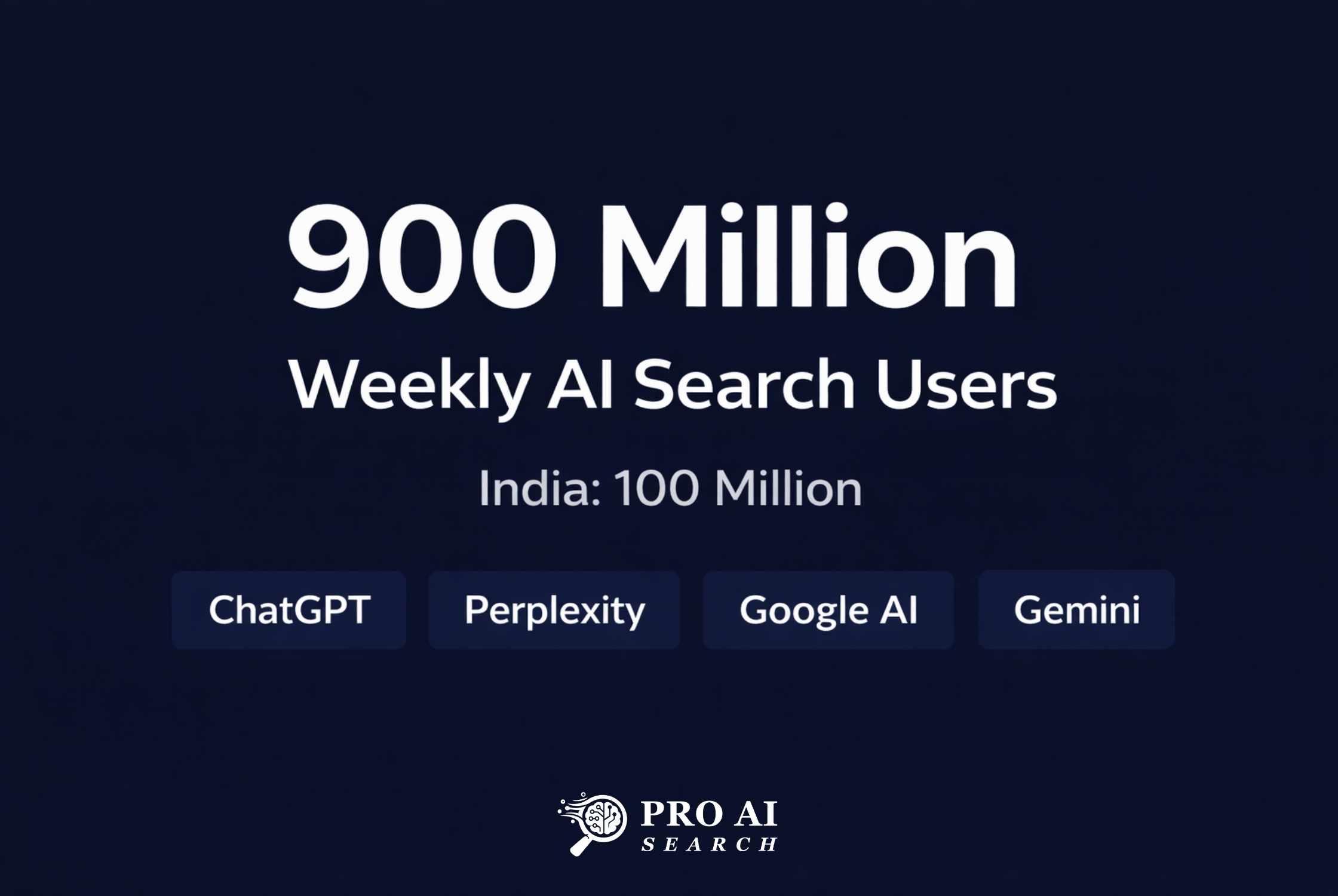
- ChatGPT has 900 million weekly active users globally, with India accounting for 100 million of them, making India the second-largest ChatGPT market after the US (Sam Altman, February 2026).
- Only 12% of URLs cited by AI search engines rank in Google’s top 10 for the same query. 80% of AI citations come from pages not ranking anywhere in Google’s top 100 (Ahrefs, August 2025).
- Google AI Overviews reduce organic click-through rates by 47 to 58% on queries where they appear (Pew Research Center, July 2025; Ahrefs, February 2026).
- AI referral traffic converts at 3 to 11x the rate of organic search traffic, despite representing less than 1% of total web traffic (Microsoft Clarity, November 2025).
- India has a 92% weekly AI tool adoption rate among office workers, the highest rate globally (BCG, October 2025).
- The Princeton/IIT Delhi GEO study found content optimized with citations, statistics, and quotations can improve AI visibility by up to 40% (KDD 2024).
For actionable content optimization techniques based on these citation patterns, see the full content optimization guide.
AI Search Market Size and Growth
The AI search market lacks a single authoritative size because research firms define it differently. Some include only dedicated AI search tools like Perplexity. Others include Google’s AI features. The figures below reflect different scope definitions, so treat them as directional rather than precise.
Future Market Insights sizes the AI search engine market at $18.5 billion in 2025, projecting a 13.6% CAGR to reach $66.2 billion by 2035. Credence Research arrives at $14.7 billion in 2024, with a 21.6% CAGR to $77.6 billion by 2032. Business Research Insights puts the 2024 figure at $15.2 billion, growing at 11.2% annually to $41.6 billion by 2033.
For broader context, Statista sizes the total AI market at approximately $244 billion in 2025, projected to exceed $800 billion by 2030.
The most cited market prediction is Gartner’s February 2024 forecast that traditional search engine volume would drop 25% by 2026 due to AI chatbots. As of early 2026, this has not materialized. Google’s search volume grew 20%+ through 2024 and 2025 (SparkToro/Datos), and Google still holds 89.6% global search market share (StatCounter). The disruption is happening inside Google, not away from it: organic click rates are falling even as total query volume rises.

Google AI Overviews: Scale, Reach, and India Rollout
Google’s AI Overviews are the most consequential AI search development for Indian businesses because they operate inside the search engine Indians already use for over 95% of queries.
How often AI Overviews appear
The percentage of Google searches triggering AI Overviews is contested, with figures ranging from 16% to 48% depending on methodology and keyword set.
The most methodologically rigorous public study comes from Pew Research Center, which analyzed 68,879 unique Google searches from 900 US adults in March 2025. Pew found 18% of searches produced an AI summary, and 58% of users encountered at least one during the study period.
Semrush’s longitudinal study of 10 million+ keywords tracked AI Overview prevalence rising from 6.5% in January 2025 to a peak of roughly 25% in July 2025, before Google pulled back to approximately 16% by November 2025.
Scale by Google’s own numbers
- 1.5 billion monthly users seeing AI Overviews (Sundar Pichai, Q1 2025 earnings, April 2025)
- 2 billion monthly users across 200+ countries and 40+ languages (Sundar Pichai, Q2 2025 earnings, July 23, 2025)
- AI Overviews drive more than 10% more search queries for the types of queries where they appear (Google I/O, May 2025)
- AI Mode reached 100 million monthly active users in the US and India combined (Q2 2025 earnings)
- AI Mode queries are 3x longer than traditional searches (Q4 2025 earnings, February 4, 2026)
- Google processes 980 trillion monthly tokens across all AI products (July 2025, up from 480 trillion in May 2025)
India-specific Google AI rollout timeline
India was among the first international markets to receive AI Overviews (August 15, 2024). AI Mode launched in India through Search Labs on June 24, 2025, then became fully available without sign-up on July 8, 2025. India was the second market globally after the US for full AI Mode rollout. Google expanded AI Mode to 7 Indian languages including Hindi in October 2025. According to Google’s “AI for Every Indian” blog, Indian users listen to AI Overviews responses more often than users in any other country.
ChatGPT Search Statistics 2026
OpenAI reports weekly active users (WAU), not monthly active users. This is a critical distinction that most statistics roundups blur. When you see “500 million monthly active users” cited for ChatGPT, the actual OpenAI metric is weekly active users, which captures a higher-engagement cohort.
- 900 million weekly active users globally (OpenAI official announcement, February 27, 2026, alongside $110 billion funding round)
- 100 million weekly active users in India (Sam Altman confirmed to Times of India, February 15, 2026, reported by TechCrunch)
- 2.5 billion prompts per day sent by users across all features (OpenAI told Axios, July 2025)
- 1 billion+ weekly web searches through ChatGPT’s search feature (OpenAI post on X, April 28, 2025)
- $10 billion annual recurring revenue (OpenAI, June 2025, confirmed by Reuters and Bloomberg)
- 50 million+ paying consumers and 9 million+ paying business users (OpenAI, February 27, 2026)
- Enterprise adoption has reached 92% of Fortune 500 companies, with more than 7 million workplace seats deployed by December 2025 — enterprise seats grew 9x year-over-year and weekly enterprise messages grew 8x (OpenAI)
- India is ChatGPT’s largest student user base globally and ranks among the top 5 developer markets on OpenAI’s platform
- OpenAI launched a Rs 399/month India-specific “ChatGPT Go” plan in August 2025 and opened offices in New Delhi, Mumbai, and Bengaluru
One important distinction: the 2.5 billion daily figure represents total prompts across all ChatGPT features, not specifically web search queries. The 1 billion weekly web searches figure specifically measures the feature retrieving live web results, which is the number most relevant to search visibility.
To put these numbers to work, see our guide on how to rank in ChatGPT search.
Perplexity AI Statistics 2026
Perplexity is the most important platform to track for GEO practitioners because it is the fastest to cite new content and the most transparent about its sources. It is also the platform with the strongest India connection of any AI search tool.
- 780 million queries per month (CEO Aravind Srinivas at Bloomberg Tech Summit, May 2025)
- Up from 250 million monthly queries in July 2024, a 212% increase in under a year
- $20 billion valuation at last funding round (The Information, TechCrunch, Bloomberg, September 2025)
- $150 to 200 million annual recurring revenue (Perplexity spokesperson to Business Insider and The Information)
- $1.5 billion+ total funding from Nvidia, Jeff Bezos, SoftBank, Accel, IVP, and NEA
- India accounts for approximately 22% of Perplexity’s total traffic by some SimilarWeb measurements
- App downloads in India hit 2.8 million in Q2 2025, a 600% year-over-year increase, following Airtel’s partnership offering free Perplexity Pro to its 360 million+ subscribers
- India users grew 640% year-over-year in Q2 2025
One important flag on the 22% India traffic figure: this number is volatile and methodology-dependent. Desktop-only SimilarWeb data from February 2026 shows India at approximately 12.6%. The higher figure likely reflects a peak period following the Airtel partnership and includes mobile app traffic. Different sources cite figures from 7.56% to 22.75% depending on timing and methodology. What is not in dispute: India is one of Perplexity’s largest markets by any measure. For a step-by-step guide to building Perplexity visibility, see how to rank in Perplexity AI.
Google Gemini and Microsoft Copilot Statistics
Google Gemini
- 750 million monthly active users of the Gemini app (Sundar Pichai, Q4 2025 earnings, February 4, 2026)
- Up from 650 million MAU in Q3 2025
- Gemini API processes 10 billion+ tokens per minute (Q4 2025 earnings)
- Gemini holds approximately 21.5% of the AI chatbot traffic share versus ChatGPT’s 64.5% (SimilarWeb, January 2026)
Microsoft Copilot
- 15 million paid Microsoft 365 Copilot seats as of Q2 FY2026 earnings (January 28, 2026)
- Paid seat count grew 160% year-over-year
- M365 Copilot daily active users grew 10x year-over-year
- 4.7 million GitHub Copilot subscribers (75% year-over-year growth)
- Bing holds approximately 3.9 to 4.4% global search market share on all devices (StatCounter 2025-2026)

AI Search Statistics 2026 in India
India is not just a large AI market. It is arguably the most strategically important AI search market in the world right now, combining the highest adoption rates, the fastest platform growth, and the most underserved content landscape of any comparable market.
The Indian internet and smartphone foundation
- 958 million active internet users (IAMAI/Kantar “Internet in India Report 2025,” published January 2026)
- 740 million+ smartphone users (Counterpoint Research 2025)
- TRAI December 2025 quarterly report: total internet subscribers at 1.028 billion, with 983 million accessing via mobile
- NSO survey: 85.5% of Indian households now own smartphones (Press Information Bureau, 2025)
India AI adoption rates
- 92% of Indian office workers use AI tools at least several times a week, the highest rate globally (BCG “AI at Work 2025” survey of 10,600+ workers across 11 countries, October 2025)
- Global average for the same metric: 72%
- Stanford’s 2025 Global AI Vibrancy Tool ranked India the third most AI-competent country globally and second on GitHub for AI projects
- India hosts 8,178 AI companies, second globally after the US
- 89% of newly formed Indian startups are using AI tools
- NASSCOM projects a 25 to 35% CAGR for India’s AI market through 2027
- Users aged 18 to 24 account for nearly 50% of all ChatGPT messages from India, nearly double the global average of 33% for the same age group (OpenAI India Signals report, February 2026)
What this means for Indian businesses
For Indian businesses, AI search statistics 2026 highlight a massive opportunity. The audience is already there and growing faster than anywhere else. But the supply of AI-optimized Indian business content is almost nonexistent. Most Indian business queries return AI answers that cite US or UK sources or cite nothing relevant at all. Most Indian business websites do not have structured content answering questions directly, do not have LLM SEO infrastructure in place, and have never been cited in an AI response. The gap between demand and supply is wider in India than in any comparable market.
AI Citation Statistics: What the Research Actually Shows
This is the section where most statistics roundups get things wrong. I have traced every figure here to its original source and flagged where common attributions are incorrect.
The overlap between AI citations and Google organic rankings
The Ahrefs Brand Radar study (August 11, 2025) is the primary source for the “low overlap” finding. Testing 15,000 long-tail queries across four AI assistants, Ahrefs found an average citation overlap with Google’s top 10 of just 10.96%. Breakdown by platform: Perplexity 28.6%, Copilot 8.6%, ChatGPT 8.2%, Gemini 6.1%. Furthermore, 80% of AI citations do not rank anywhere in Google’s top 100 for the original query.
A separate Ahrefs study from February 2026 found that for Google AI Overviews specifically, only 38% of citations come from Google’s top-10 organic results, down from 76.1% in July 2025. Semrush confirmed that roughly 90% of ChatGPT citations come from pages ranked position 21 or lower in Google (July 2025).
These numbers directly contradict the assumption that traditional SEO rankings are sufficient for AI search visibility. A strong Google ranking does not guarantee AI citations, and strong AI citation potential does not require Google top-10 rankings. This is the core reason Answer Engine Optimization is a distinct discipline. For a full breakdown of how GEO and traditional SEO differ, read our GEO vs SEO comparison for Indian businesses.
The Princeton GEO study: what it actually found
The most influential academic paper on AI search optimization is “GEO: Generative Engine Optimization” by Aggarwal, Murahari, Rajpurohit, Kalyan, Narasimhan, and Deshpande, a collaboration between Princeton and IIT Delhi, published at KDD 2024.
- Adding citations, quotations, and statistics to content can improve AI visibility by up to 40% on the Position-Adjusted Word Count metric
- On Perplexity specifically, optimized content achieved improvements of up to 37% on Subjective Impression and up to 22% on Position-Adjusted Word Count
- The study tested 10,000 website-query pairs across 9 domains including healthcare, legal, and finance
Two important caveats apply. First, “up to 40%” is a maximum result, not an average improvement. Second, the primary evaluation used GPT-3.5, not a deployed commercial search system.
One misattribution worth correcting: the “only 10% overlap between AI citations and Google organic” figure is widely attributed to the Princeton GEO paper. That attribution is incorrect. The Princeton paper does not study citation overlap with Google at all. The correct source is the Ahrefs Brand Radar study cited above.
Schema markup and AI citations
There are no peer-reviewed studies on schema markup’s impact on AI search citations as of early 2026, as noted by Search Engine Land. The most rigorous industry study is Growth Marshal’s analysis of 730 AI citations (February 2026).
Its counterintuitive finding: attribute-rich schema (Product, Review with pricing, ratings, specifications) achieved a 61.7% citation rate. But generic schema (Article, Organization, BreadcrumbList) performed worst at 41.6%, an 18-percentage-point penalty compared to pages with no schema at all (59.8%).
The implication: schema helps when it adds specific, structured information AI engines can extract. Generic schema that only labels content type without adding extractable information appears to have no benefit and may have a small negative effect.

Click-Through Rate Impact of AI Search
The most direct business impact of AI Overviews is on organic click-through rates. Multiple independent studies show significant decline, though the magnitude varies by methodology and query type.
The key studies on CTR decline
Pew Research Center (July 22, 2025, 68,879 searches from 900 US adults): Users clicked links only 8% of the time when an AI summary was present versus 15% without, a roughly 47% reduction. Only 1% of users clicked on sources cited within the AI summary itself. Users were 10 percentage points more likely to end their browsing session entirely after seeing an AI Overview.
Ahrefs (February 4, 2026): Position-one organic CTR fell 58% for keywords with AI Overviews, from 7.3% in December 2023 to approximately 1.6% in December 2025.
Seer Interactive (September 2025, 3,119 queries across 42 organizations): Organic CTR dropped 61% (from 1.76% to 0.61%) and paid CTR dropped 68% (from 19.7% to 6.34%) for queries with AI Overviews.
The zero-click picture overall
- Approximately 58.5% of US Google searches end without a click (SparkToro/Datos 2024 Zero-Click Search Study)
- For every 1,000 Google searches, only 374 clicks reach the open web
- Google AI Mode has a 93% zero-click rate, compared to 43% for standard AI Overviews and 34% for searches without AI features (Semrush data via Exposure Ninja, February 2026)
One important counterpoint: Semrush’s causal analysis found that when comparing the same keywords before and after AI Overviews appeared, zero-click rates actually decreased slightly from 33.75% to 31.53%. This suggests AI Overviews may appear preferentially on queries that were already zero-click-prone, making the causal relationship harder to isolate than the correlation studies imply.
AI Search Traffic Quality and Business Impact
The business impact paradox: AI referral traffic is growing fast in percentage terms but remains under 1% of total web traffic in absolute volume. Where it does arrive, it converts at substantially higher rates than organic search.
Conversion quality from AI referrals
- Microsoft Clarity study (1,200+ publisher and news sites, 8 months, published November 6, 2025): AI traffic converts at 3x the rate of traditional channels. For sign-ups specifically, AI traffic converted at 1.66% versus 0.15% for organic search, an 11x advantage. Copilot referrals showed a 17x subscription conversion rate compared to direct traffic.
- Semrush (July 2025): LLM visitors convert at 4.4x the rate of standard organic visitors
- Ahrefs (June 2025): AI search visitors convert 23x higher for sign-ups, but AI represented only 0.5% of traffic while generating 12.1% of sign-ups
Adobe Digital Insights tracked more than a trillion visits to US retail sites during the 2025 holiday season and found AI-driven referral traffic surged 693% year-over-year. Shoppers arriving from generative AI converted 31% better than all other traffic sources combined (paid, social, email, and direct), with AI delivering 32% higher revenue per visit. Note that this 31% figure is not comparable to the 3x–11x figures above: those studies measure AI traffic against organic search specifically, while Adobe measures against every other channel. The holiday context also matters — retail purchase intent during peak season is already high across all sources, making AI’s 31% edge significant in absolute terms.
Brand visibility in AI responses
AirOps analyzed 800 queries and 45,000+ citations across AI platforms, finding only 30% of brands stay consistently visible across consecutive AI responses. Brands earning both citations and direct mentions were 40% more likely to resurface. Approximately 48% of citations came from community platforms including Reddit and YouTube rather than brand websites. Around 85% of brand mentions originated from third-party pages rather than brand-owned content.
Seer Interactive adds a finding critical for AI SEO strategy: brands cited in Google AI Overviews earned 35% more organic clicks and 91% more paid clicks than non-cited competitors. Being cited in AI Overviews amplifies traditional search performance for the same brand. These AI search statistics 2026 clearly show how search is evolving.
What These Numbers Mean for Indian Businesses
Three patterns emerge from the verified data that are directly actionable.
India is disproportionately exposed to AI search disruption
India is the second-largest market for ChatGPT, one of the two launch markets for Google AI Mode, and one of Perplexity’s top traffic markets. With 92% of office workers already using AI tools weekly, Indian professionals encounter AI search results constantly. Yet Indian business content is almost completely absent from AI responses. Most Indian business queries return AI answers that cite US or UK sources or cite nothing India-specific at all. That gap is the first-mover opportunity.
The B2B dimension makes this even more urgent. 6sense’s 2025 Buyer Experience Report, which surveyed more than 4,000 buyers across North America, EMEA, and APAC, found that 94% of B2B buyers now use LLMs during their purchase process to synthesize and evaluate vendor options. APAC buyers are part of this shift. Indian businesses that do not appear in AI responses are being removed from consideration before a single sales conversation begins.
Traditional SEO rankings are necessary but not sufficient
Looking at AI search statistics 2026, traditional SEO alone is no longer enough. Only 12% of AI citations come from Google’s top 10. 80% come from pages outside the top 100. This means a page ranking fifth on Google for a query is not automatically getting cited in AI responses. And a page ranking 50th could be cited consistently if its content structure is right. AEO techniques, specifically the inverted pyramid writing method and question-format headings, are stronger predictors of AI citation than keyword rankings alone.
AI traffic quality is already exceptional
Less than 1% of total web traffic currently comes from AI referrals. But it converts at 3 to 11 times the rate of organic traffic. The businesses that establish AI visibility now will inherit a disproportionate share as the volume grows. For a complete implementation framework covering all four disciplines, see the AI search optimization hub: LLM SEO for technical infrastructure, GEO for content strategy, AEO for content structure, and AI SEO for authority building.
AI Search Statistics 2026 FAQs
How many people use AI search in India in 2026?
India has 100 million weekly active ChatGPT users (Sam Altman, February 2026), is one of the two launch markets for Google AI Mode (100 million global MAU), and is among Perplexity’s top traffic markets. With 958 million total internet users and a 92% weekly AI tool adoption rate among office workers (BCG, October 2025), AI search reach in India is substantial and growing faster than anywhere else globally.
Does ranking on Google guarantee AI search visibility?
No. Ahrefs research shows only 12% of AI citations overlap with Google’s top-10 organic results, and 80% come from pages outside the top 100. Content structure, specifically answer-first writing and question-format headings, is a stronger predictor of AI citation than keyword rankings.
How much have AI Overviews reduced organic click-through rates?
For queries where Google AI Overviews appear, organic CTR has declined by 47% to 58% depending on the study methodology. Pew Research found users click links only 8% of the time when an AI summary appears, versus 15% without. Ahrefs measured a 58% decline in position-one CTR for AIO-triggered queries. Google AI Mode has a 93% zero-click rate.
How well does AI search traffic convert compared to organic?
Microsoft Clarity’s study of 1,200+ sites found AI referral traffic converts at 3x the rate of traditional channels overall, and 11x higher for sign-up conversions. Semrush found LLM visitors convert at 4.4x the standard organic rate. AI referral traffic currently represents less than 1% of total web traffic but generates a disproportionate share of high-intent conversions.
For actionable steps based on these numbers, the AI search optimization for Indian small businesses guide walks through each tactic from scratch.
To put these statistics into action, the AI search optimization checklist gives you a 50-point audit to assess exactly where your site stands against the AI search requirements.
What is the most important AI search statistic for Indian businesses?
The 80% figure from Ahrefs: 80% of AI citations come from pages not ranking anywhere in Google’s top 100. This means AI visibility is accessible to Indian businesses that have never ranked well on Google, if their content is structured correctly. A well-structured page answering a specific procurement or how-to question can earn AI citations that a high-authority generic competitor does not. That is the core opportunity for Indian businesses in 2026.
Getting your AI crawler access settings right is the prerequisite before any of these statistics translate into citation opportunities for your site.
For the business implications of these numbers, the AI search vs traditional search guide breaks down what each data point means for content and measurement strategy.