
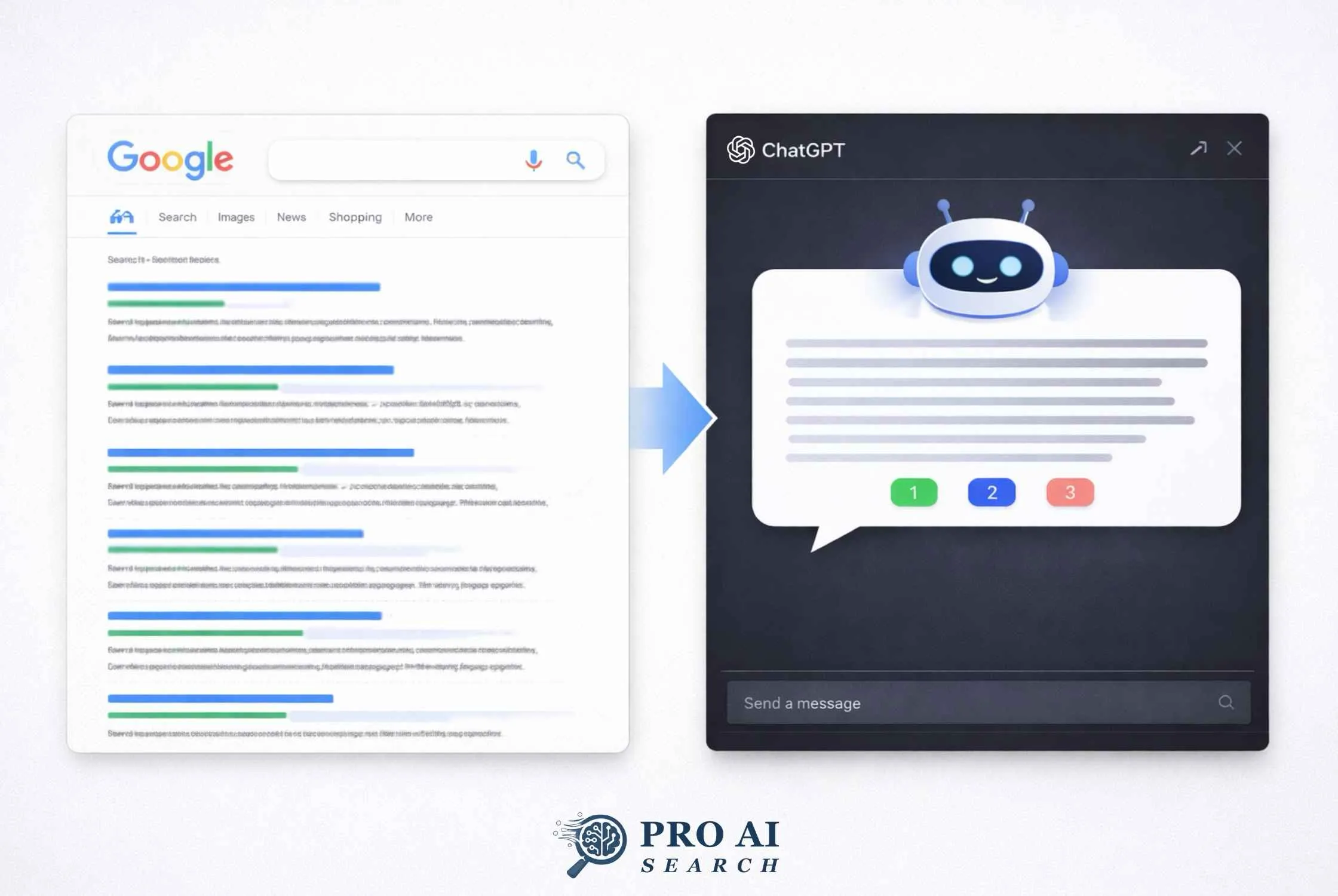
AI search vs traditional search is not a future planning question for Indian businesses in 2026, it is today’s reality. ChatGPT processes 2 billion queries every day. Google AI Overviews reach 1.5 billion users monthly. Perplexity has made India its largest global market by traffic share.
This article breaks down exactly what has changed, what has stayed the same, and what your business needs to do differently to stay visible across both channels.
What Is the Core Difference Between AI Search and Traditional Search?
Traditional search returns a ranked list of links. AI search generates a synthesized answer citing a small number of sources directly in the response.
Google’s traditional SERP gives users ten options and lets them decide. ChatGPT, Perplexity, and Google AI Mode make the decision for them, selecting two to six sources and presenting a single answer. That shift from discovery to decision is the structural change that affects everything downstream: how content is written, how success is measured, and how budgets should be allocated.
The practical consequence is concentration. In traditional search, ten blue links means ten businesses get visibility per query. In AI search, roughly 40 to 55% of ChatGPT and Perplexity citations flow to fewer than 1,000 domains, according to BrightEdge and Ahrefs data. The winner-takes-most dynamic is more pronounced than anything seen in traditional SEO.
How Has User Behaviour Shifted?
Users are not abandoning traditional search, but they are using AI search for a growing category of queries and they are asking very differently when they do.
The average Google search query is 3.4 words, according to Semrush’s 2025 search statistics analysis. The average ChatGPT search query runs to 5.48 words, according to a Nectiv study of 8,500+ ChatGPT prompts analyzed via Search Engine Land, 60% longer and far more specific. Users are not typing keywords into AI engines. They are asking complete questions.
This matters for content strategy. Short-tail keywords built around two-word phrases align with how people search on Google. That same content is unlikely to surface in AI answers, where the model is looking for a direct, detailed response to a full question like “what is the best CRM for a B2B SaaS company in India under 5 lakhs?”
Three additional behavior shifts worth understanding:
Search has grown, not shrunk.
Total search combining traditional search engines and AI has increased 26% worldwide since 2024, according to Graphite’s March 2026 research. Traditional search volume has not collapsed. The pie is larger, but the distribution of where attention goes within that pie has changed.
Younger users are leading the shift.
About 31% of Gen Z respondents say they begin research using AI platforms, compared to 20% of the general population, per ALM Corp’s AI Search Trends analysis citing Pew Research data. Indian businesses targeting under-30 audiences need to treat AI search as a primary channel today, not a secondary one.
AI referral traffic converts better.
Ahrefs’ 2025 data shows that AI traffic drove 12.1% more signups for Ahrefs despite representing just 0.5% of all visitors. LLM traffic converts at higher rates than organic search: ChatGPT referrals at 15.9%, Perplexity at 10.5%. The volume is smaller, but the quality is demonstrably higher.
Side-by-Side Comparison: AI Search vs Traditional Search
The table below covers the eight dimensions where AI search and traditional search differ most in 2026.
| Dimension | Traditional Search (Google) | AI Search (ChatGPT, Perplexity, AI Mode) |
|---|---|---|
| Output format | Ranked list of 10 links | Synthesised answer with 2-6 citations |
| Query style | Short, keyword-based (avg 3.4 words) | Conversational, question-format (avg 5.48 words) |
| Zero-click rate | 34% without AI Overview; 43% with AI Overview | 93% in Google AI Mode |
| Sources shown per query | 8-10 distinct domains | 3-6 citations; 40-55% from fewer than 1,000 domains |
| Primary ranking signal | Backlinks, keywords, on-page SEO | Authority, content structure, directness of answer |
| Success metric | Ranking position (#1-10) | Share of voice in AI answers |
| Conversion quality | Baseline organic traffic | 15.9x (ChatGPT), 10.5x (Perplexity) higher conversion vs organic |
| Content freshness weight | Important but not dominant | AI platforms cite content 25.7% fresher than traditional search |
What the Zero-Click Data Actually Means
Zero-click rates are the most cited statistic in the AI search debate, and they are often misread. Let’s be precise about the numbers.
Traditional Google Search without any AI features: 34% of sessions end without a click. Traditional Google Search with an AI Overview present: 43% zero-click. Google AI Mode (the full conversational interface): 93% zero-click, according to Semrush data cited by Superlines.
The 93% figure sounds alarming, but it contains an important caveat. Seer Interactive’s research found that pages cited inside AI Overviews earn 35% more organic clicks and 91% more paid clicks than non-cited pages. Being the source that AI engines quote reverses the zero-click penalty entirely. The new competitive objective is not to rank in position one – it is to be the source that gets cited by the AI that now occupies position zero.
For Indian businesses, this reframes the question from “how do I get to page one?” to “how do I become the source that AI engines trust enough to cite?” For MSMEs specifically, our guide on AI search optimization for Indian MSMEs translates this into a zero-budget action plan.
Ranking Signals: What Has Stayed the Same and What Has Changed?

What Still Works in Both Channels
Domain authority, backlinks, and E-E-A-T signals still matter in AI search. AI engines are not building their citation pools from scratch, they draw heavily from sources that already have established credibility on the web.
Ahrefs’ August 2025 research found that 43.2% of pages ranking number one in Google are also cited by ChatGPT, 3.5 times higher than pages ranking outside the top 20. Ranking on Google page one is not a prerequisite for AI citations, but it significantly increases your probability of being included. If you have strong traditional SEO, you have a foundation to build on. For a full side-by-side breakdown of how GEO changes that foundation, see our GEO vs traditional SEO comparison.
What AI Search Adds That Traditional SEO Ignores
Three signals matter in AI search that Google’s algorithm does not weight the same way:
Direct-answer structure.
AI models extract the most useful snippet from a page. Content that opens each section with the direct answer in the first one to two sentences is far more likely to be cited. The model does not have time to read to paragraph five to find your point. Put the point in paragraph one.
Citation density.
Statistics with inline source links act as credibility signals for AI engines. Research published via Position Digital confirms that content with more external citations and data points is more likely to be included in AI answers. Every unsupported claim is a missed opportunity.
Content freshness.
AI platforms cite content that is 25.7% fresher than traditional search results, according to Exposure Ninja’s 2026 analysis. An article last updated in 2022 with no refresh signal is at a structural disadvantage in AI citation pools, even if it ranks well on Google.
One finding worth flagging for Indian businesses:
Only 12% of URLs cited by ChatGPT, Perplexity, and Copilot rank in Google’s top 10, per Ahrefs’ August 2025 data. And 28.3% of ChatGPT’s most-cited pages have zero organic visibility in Google at all. AI search is not just a different distribution of the same Google winners, it is a genuinely parallel discovery layer that rewards a different content profile.
Success Metrics: Ranking Position vs Share of Voice
Measuring AI search success by ranking position does not work. Rank trackers report where your page sits on a Google SERP. They cannot tell you how often ChatGPT, Perplexity, or Google AI Mode mentions your brand in response to your target queries.
The metric that matters in AI search is share of voice: out of all the AI-generated answers your target audience sees for queries relevant to your business, what percentage include your brand or cite your content?
Only 14% of practitioners are currently tracking AI and LLM citation visibility, despite it being the fastest-growing source of first-touch discovery, per GoodFirms’ 2026 SEO survey. That gap is an opportunity. Businesses that start measuring AI share of voice now will have months of benchmark data before their competitors catch up. Our complete guide to AI search rank tracking shows you exactly how to build that measurement system.
Tools that currently track AI citation share for Indian businesses include Peec AI, Otterly.ai, and SE Ranking’s AI Overview tracker. None are free, but even manual tracking — searching your target queries weekly in ChatGPT, Perplexity, and Google AI Mode and noting which sources are cited gives you directional data to work with.
How This Affects Indian Businesses Specifically
India is not an average market for AI search. It is an early-adoption, high-intensity market where the shift from traditional to AI search is happening faster than the global average.
ChatGPT’s OpenAI Signals India report (February 2026) confirmed India as OpenAI’s second-largest global market with 100 million-plus weekly users. India is also Perplexity’s number one global market by traffic share. For any Indian business with an English-language online presence, AI search is already a meaningful discovery channel – not a future consideration.
The India-specific implications are three:
B2B buyers research on AI first.
Indian B2B buyers in sectors like SaaS, edtech, fintech, and logistics are using ChatGPT and Perplexity to shortlist vendors before they visit a website. If your brand does not appear in AI answers for queries like “best [your category] software for Indian businesses,” you are not in the consideration set. This is already true for enterprise buyers. If you are unsure which platform drives more value for your category, our ChatGPT versus Perplexity comparison for businesses breaks down where each platform wins.
Google AI Mode is live and expanding.
Google AI Mode launched in India in July 2025 and is now available across 40-plus languages. For Indian businesses relying on Google organic traffic, the 93% zero-click rate in AI Mode is not a future risk – it is current reality for informational queries. The shift to optimizing for AI Overview citations is not optional for businesses that depend on top-of-funnel Google traffic.
Vernacular AI search is coming.
Hindi-language AI search is growing rapidly. ChatGPT, Gemini, and Perplexity all support Hindi queries. Businesses that establish AI citation authority in English now will be better positioned as vernacular AI search matures over the next 12 to 24 months.
How to Optimize for Both AI Search and Traditional Search Together
The most important strategic insight in this article is that you do not have to choose. Optimizing for AI search makes traditional search content better at the same time.
Direct-answer openings, statistics with inline citations, question-format H2 headings, and FAQ sections: these are the four content changes that improve both Google ranking and AI citation probability simultaneously. The Princeton study on GEO found that these structural techniques boost AI visibility by up to 40% with no negative impact on traditional search performance.
The practical implementation order for Indian businesses starting from scratch:
First, audit your technical access layer. Confirm AI crawlers can reach your site by checking your robots.txt AI crawler configuration and Cloudflare settings. No content optimization matters if AI bots are blocked at the server level.
Second, restructure your highest-traffic pages for direct-answer openings. Take your five most-visited pages and rewrite each H2 section so the first sentence answers the section question directly. This is the single highest-ROI content change available.
Third, start tracking AI share of voice manually. Search your 10 most important queries each week in ChatGPT and Google AI Mode. Note which competitors appear. Build a baseline before investing in paid tracking tools.
Fourth, build the authority signals that feed both channels. Original research, authoritative external citations, and author credentials with verifiable expertise all strengthen both traditional E-E-A-T and AI citation probability. Our AI search optimization services cover this full implementation workflow for Indian businesses that want structured guidance rather than trial and error.
For a complete technical implementation framework, the GEO pillar and AEO pillar on this site cover both the strategic and structural layers in detail. For the content optimization specifics, the content optimization for AI search guide walks through the exact formatting changes that increase citation probability across all major AI platforms.
FAQ: AI Search vs Traditional Search
Is AI search replacing Google in India?
Not replacing, but supplementing at significant scale. Google still holds approximately 90% of global search market share. But in India, ChatGPT has 100 million-plus weekly users and Perplexity leads globally by traffic share. Indian users are running dual research sessions, traditional Google for local and transactional queries, AI search for informational and comparative research. Both channels matter and require distinct optimization strategies.
Do I still need traditional SEO if I optimize for AI search?
Yes. Traditional SEO is the foundation that AI search builds on. Pages ranking on Google page one are 3.5 times more likely to be cited by ChatGPT than pages outside the top 20, per AirOps research. Strong backlinks, domain authority, and technical SEO remain prerequisites. AI search optimization is the layer you add on top, not a replacement for the base.
How do AI search engines decide which sources to cite?
The primary factors are domain authority, content structure, freshness, and directness of answer. AI engines prioritize sources that have established credibility, open sections with direct answers rather than context-building preamble, cite external data with inline sources, and have been recently updated. For a detailed breakdown by platform, see the How to Appear in Google AI Overviews and How to Rank in Perplexity AI guides on this site.
What is “share of voice” in AI search and how do I measure it?
Share of voice in AI search is the percentage of AI-generated answers for your target queries that include your brand or cite your content. You measure it by running your target queries in ChatGPT, Perplexity, and Google AI Mode on a weekly basis and tracking which sources appear. Paid tools like Peec AI and Otterly.ai automate this tracking. Manual weekly audits give directional data at no cost. Only 14% of marketers are currently tracking this metric, making it a competitive advantage for businesses that start now.
Does AI search affect e-commerce businesses differently?
Yes. Traditional Google still dominates for transactional and local queries – shopping, price comparison, “near me” searches. AI search captures informational and comparative queries: “best laptop under 50,000 rupees for students,” “which cloud kitchen franchise is most profitable in India.” E-commerce businesses need traditional SEO for bottom-of-funnel transactional pages and AI search optimization for top-of-funnel research content. The two strategies serve different query types rather than competing with each other.
How do I know if my content is appearing in AI search answers?
Search your target queries directly in ChatGPT (web search mode), Perplexity, and Google AI Mode. Note which sources are cited and whether your domain appears. For Google AI Overviews specifically, Google Search Console does not yet show AI Overview impression data directly, you need to test manually or use third-party tools. A brand mention without a citation link still has value for brand awareness, but a citation link is what drives measurable referral traffic.