
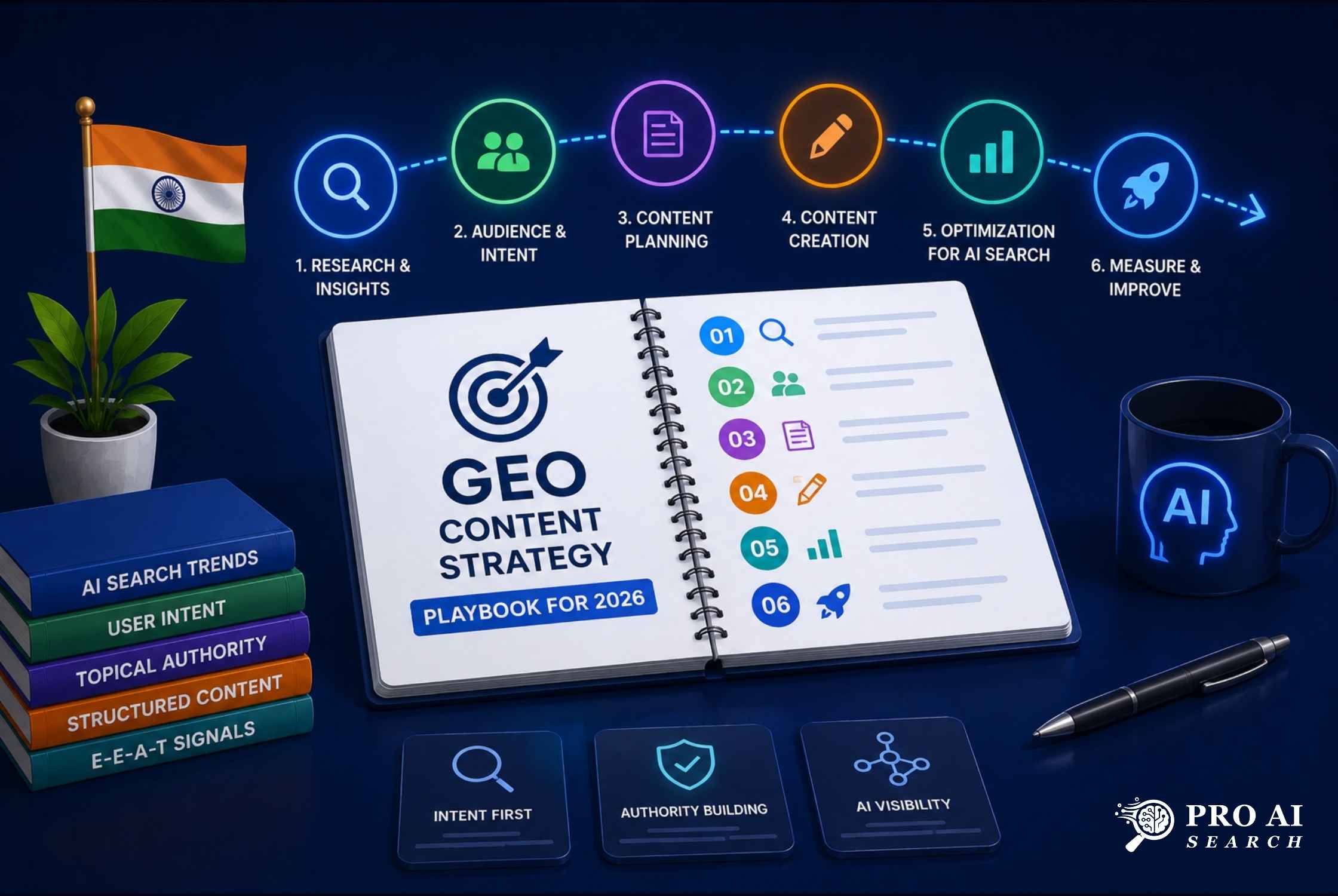
A GEO content strategy is your systematic plan for creating, structuring, and distributing content that gets cited by AI search engines like ChatGPT, Perplexity, and Google AI Overviews. I first started thinking about this as a distinct discipline when I was working on content for VEGA AI at LearnQ India, and I noticed something odd: pages we had not specifically optimized for anything were getting referral traffic from chatgpt.com and perplexity.ai. When I went back to see what those pages had in common, the answer was obvious in hindsight. They all answered specific questions directly in the first paragraph, they had clear question-format H2s, they cited external data, and they had structured FAQs at the end. None of it was intentional GEO strategy at the time. It was just good content practice. But it was working in AI search where our other, longer, more keyword-dense pages were not.
That moment became the seed for Pro AI Search, which I launched in April 2026. Today, I am going to walk you through the exact framework I use to plan, produce, and measure GEO content at scale. This is not theory. This is the process I follow every week to publish content that gets cited by AI engines.
What Is a GEO Content Strategy and How Is It Different from an SEO Content Strategy?
A GEO content strategy is a plan built around how AI search engines retrieve, evaluate, and cite sources when they generate answers. An SEO content strategy is built around how traditional search engines rank pages when they return a list of results. The core difference is the end goal: SEO aims to get your page ranked high in a list so users click through to your site. GEO aims to get your content cited inline in an AI-generated answer, whether or not the user clicks through.
When I plan SEO content, I target keywords with search volume, build backlinks, and optimize for click-through rate from the search results page. When I plan GEO content, I target the questions people ask AI engines, optimize for citation-worthiness, and structure content so an AI model can extract a clean, attributed answer in seconds.
Here is the practical breakdown:
SEO Content Planning
- Keyword research using tools like Ahrefs, SEMrush, Google Keyword Planner
- Content calendar organized by search volume, difficulty, and existing ranking position
- Success metric: organic traffic, ranking position, backlinks
- Distribution: on-site blog, guest posts for backlinks
GEO Content Planning
- Question research using ChatGPT, Perplexity, Google AI Overviews, Reddit, Quora
- Content calendar organized by citation probability, question frequency, and answer gap
- Success metric: AI referral traffic, citation count, share of voice in AI answers
- Distribution: owned site, community platforms (Reddit, Quora, LinkedIn), third-party publications
The strategy overlaps. Good SEO fundamentals still matter for GEO because Google rankings feed AI citation decisions. But the planning process is different. SEO content calendars are built around keyword opportunity. GEO content calendars are built around question coverage and citation-worthiness.
How Do I Create Content That Actually Gets Cited by ChatGPT and Perplexity?
This is the most upvoted question I see from marketers who have tried GEO and not yet seen results. They optimized a few pages for AI search, checked ChatGPT and Perplexity a few times, saw nothing, and concluded it does not work. The problem is usually not the content quality. The problem is they did not follow a repeatable process.
Here is the five-step process I use to create content that gets cited consistently:
Step 1: Identify High-Probability Citation Questions
Not all questions are equal in AI search. Some questions get answered from the same three sources every single time. Other questions get answered from a rotating pool of 15 to 20 sources. You want to target the second type.
I run a simple test. I ask the same question on ChatGPT, Perplexity, and Google AI Overviews. I look at the sources cited. If all three platforms cite the same domain, that question is dominated. If the sources vary across platforms and across repeat queries, that question is open.
Example: the question “what is answer engine optimization” currently returns HubSpot, Search Engine Land, and a few AI SEO agencies across ChatGPT and Perplexity. No single domain dominates. That is a high-probability citation opportunity.
Step 2: Write the Direct Answer First
AI engines extract content from the first 30 percent of your page. According to research I reference often, 44.2% of LLM citations come from the first 30% of a page’s text. If your answer is buried under three paragraphs of context, the AI will not find it.
I structure every article with the answer in the first 40 to 60 words. No introduction. No preamble. Just the answer. Then I expand with context, examples, and evidence in the paragraphs that follow.
This is called the inverted pyramid, and it works because it aligns with how AI search engines work. When ChatGPT or Perplexity runs a query, it retrieves 6 to 10 candidate pages and scans the opening paragraphs for relevance. If your answer is not in that opening scan, you are out of the running.
Step 3: Add Statistics with Citations Every 150 to 200 Words
AI engines favour content that includes statistics with clear attribution. The Princeton study on GEO found that adding statistics to content improves AI citation visibility by 41% across 10,000 queries. That is the highest lift of any single optimization tactic tested in peer-reviewed research.
I aim for one statistic with a citation every 150 to 200 words. The citation does not need to be a hyperlink in the body text, though that helps. It can be a parenthetical reference like (Source: Similarweb, 2025) or a footnote-style attribution at the end of the paragraph.
Where do I find these statistics? I pull from original research reports, government data, platform-published stats, and industry studies. I never fabricate or estimate a number. If I cannot find a verified statistic, I leave it out.
Step 4: Use Question-Format H2s That Match Real Queries
This is one of the simplest, highest-ROI GEO tactics. AI engines scan your H2 and H3 headings to understand what questions your content answers. If your H2 is “Benefits of GEO,” the AI has to infer what question that answers. If your H2 is “What Are the Benefits of GEO?”, the AI knows immediately.
I write every H2 as a question that matches how real people ask the query in ChatGPT or Perplexity. I verify this by running a few test queries and noting the exact phrasing people use. Then I use that exact phrasing as my H2.
Step 5: Add a Structured FAQ Section at the End
Every article I publish includes a FAQ section with at least five questions. I mark this section up with FAQ schema, which helps AI engines parse the Q&A pairs cleanly. The FAQs are not generic. They are real follow-up questions I see asked after the main query.
Example: for an article on GEO content strategy, the FAQ includes questions like “How many pieces of content do I need before GEO starts producing results?” and “Should I be publishing on Reddit as part of my GEO content strategy?” These are actual questions from Reddit, Quora, and LinkedIn discussions.
What Content Structure Works Best for AI Search Engines and How Do I Apply It at Scale?
The structure question is critical because it determines whether you can scale GEO content production beyond a few hero articles. I have tested a lot of formats over the last year, and I have found that three content structures consistently perform well across ChatGPT, Perplexity, and Google AI Overviews.
The Direct Answer Article
This is the format I use for definitional queries like “what is GEO” or “what is LLM SEO.” The structure is simple:
- Opening paragraph with the direct answer in 40 to 60 words
- H2 sections that answer related questions (how it works, why it matters, how to implement)
- One statistic per section
- FAQ at the end
Word count: 2,000 to 3,000 words. Time to write: 3 to 4 hours including research.
The Step-by-Step Guide
This format works for process queries like “how to rank in ChatGPT” or “how to rank in Perplexity.” The structure is:
- Opening paragraph summarizing the outcome
- H2 for each major step, H3 for sub-steps
- Screenshots or code examples where applicable
- Verification section at the end
- FAQ
Word count: 2,500 to 4,000 words. Time to write: 4 to 6 hours including screenshots and testing.
The Comparison Article
This format is for versus queries like “GEO vs SEO” or “AEO vs SEO.” The structure is:
- Opening paragraph defining both terms
- Side-by-side comparison table in the first 300 words
- H2 sections covering each comparison dimension (goals, tactics, metrics, tools)
- Decision framework: when to use which approach
- FAQ
Word count: 2,000 to 3,000 words. Time to write: 3 to 4 hours.
To scale these formats, I use a content brief template for each type. The template specifies the H2 structure, the statistic placement, the FAQ questions, and the internal links. A writer who follows the template can produce a citation-worthy article without needing deep GEO expertise.
How Do I Measure Whether My GEO Content Strategy Is Working?
Measurement is where most GEO strategies stall. Marketers publish a few GEO-optimized articles, check ChatGPT manually a few times, see no immediate citations, and stop. The problem is they are measuring the wrong things at the wrong time intervals.
Here is the measurement framework I use at Pro AI Search:
Leading Indicators (Check Weekly)
These are the inputs you control directly. If these numbers are moving, your GEO strategy is progressing even if you do not yet see citations.
- Content published: Number of GEO-optimized articles published this week
- Question coverage: Percentage of high-probability citation questions covered by your content
- Technical readiness: Percentage of pages with FAQ or HowTo schema, AI-readable structure, and no crawler blocks
- Third-party presence: Number of Reddit, Quora, LinkedIn posts published that link back to your owned content
Lagging Indicators (Check Monthly)
These are the outcomes you are working toward. They lag by 4 to 8 weeks after you publish content, so do not expect movement in week one.
- AI referral traffic: Sessions from chatgpt.com, perplexity.ai, gemini.google.com in GA4
- Citation count: Number of times your domain appears in AI-generated answers for your target questions
- Share of voice: Percentage of target questions where your content is cited compared to total questions tracked
- Zero-click brand awareness: Impressions where your brand is mentioned in an AI answer but the user does not click through
I track these metrics in a simple spreadsheet. Every Monday I update the leading indicators. Every first of the month I update the lagging indicators. If leading indicators are growing but lagging indicators are flat after 8 weeks, I audit the content quality. If both are flat, I audit the technical setup.
One critical point: AI referral traffic does not show up in GA4 by default as a distinct channel. You need to set up custom channel groupings and tag chatgpt.com, perplexity.ai, and other AI referral sources explicitly. Without this setup, AI traffic gets lumped into “Referral” or “Direct” and you cannot measure it cleanly.
Does Content Freshness Really Matter for AI Citations, or Is Evergreen Content Enough?
This is one of the most debated questions in GEO circles. Some practitioners argue that AI engines prioritize fresh content because they see recent articles getting cited. Others argue that evergreen content with strong authority signals gets cited regardless of publish date. Both are correct, but the answer depends on the query type.
Here is what I have observed after a year of tracking citation patterns:
When Freshness Matters
AI engines favour fresh content for queries that have a time dimension. Examples: “AI search statistics 2026,” “how to rank in ChatGPT 2026,” “best GEO tools 2026.” For these queries, content published in the last 3 months gets cited significantly more often than content published a year ago, even if the older content has better backlinks.
Why? Because AI models are trained to recognize time-sensitive queries and prioritize recent sources. This is explicit behavior in platforms like Perplexity, which labels sources by publish date and tends to cite the most recent comprehensive answer.
For time-sensitive queries, I update my articles every 90 days. I add new statistics, refresh examples, and update the publish date in the schema markup. This signals to AI engines that the content is current.
When Evergreen Content Works
For definitional and process queries like “what is generative engine optimization” or “how to create an llms.txt file,” publish date matters less than authority and structure. I have seen articles from 2024 get cited consistently in 2026 because they have strong backlinks, clear structure, and comprehensive coverage.
The key is that the content must be factually accurate and structurally optimized. If your evergreen article still answers the question completely and follows GEO best practices, it will keep getting cited. But if the space evolves and your article becomes outdated, citations will drop.
My rule: for evergreen topics, I review the content every 6 months. If the core answer is still accurate, I leave it alone. If new information has emerged, I update the article and republish.
Should I Be Publishing on Reddit and Third-Party Platforms as Part of My GEO Content Strategy?
Yes, and this is one of the biggest mindset shifts required for GEO compared to SEO. According to data from Similarweb, only 44% of AI citations come from owned sites. The other 48% come from community platforms like Reddit, Quora, and LinkedIn. If you are only publishing on your own blog, you are missing half the citation opportunity.
Here is how I think about third-party content as part of my GEO strategy:
Reddit Strategy
Reddit is heavily cited by Perplexity and increasingly by ChatGPT. I participate in relevant subreddits where my target audience asks questions. I answer those questions directly in the subreddit thread, then link to my owned content as the detailed resource.
Example: when someone asks “how do I optimize for ChatGPT?” in r/SEO or r/digitalmarketing, I post a 200-word direct answer in the thread and link to my full guide for more depth. This creates two citation opportunities: the Reddit comment itself can get cited, and users who click through may engage with the owned content, which boosts its authority signals.
I do not spam. I only comment when I have a genuinely useful answer. And I follow each subreddit’s rules on self-promotion. Most subreddits allow links if the comment provides value and is not purely promotional.
Quora Strategy
Quora is cited less frequently than Reddit by AI engines, but it still shows up in about 10 to 15 percent of the queries I track. My Quora strategy is simple: I answer high-traffic questions in my niche with the same direct-answer format I use on my blog, then link to the full article for readers who want more depth.
I prioritize Quora questions with 10,000+ views and at least 5 existing answers. This indicates sustained interest, and the AI engines are more likely to scan high-traffic Quora threads when generating answers.
LinkedIn Strategy
LinkedIn posts and articles are increasingly cited by AI engines, especially for professional and B2B queries. I repurpose my blog articles as LinkedIn posts, reformatting them into the native LinkedIn article format. I publish these as LinkedIn articles, not just status updates, because AI engines seem to favor the article format.
Each LinkedIn article links back to the original post on my site for attribution. This creates backlink signals and gives readers a path back to my owned platform.
The Hub-and-Spoke Model
I think of third-party platforms as spokes that radiate out from my owned content hub. The hub (my blog) is where the comprehensive, evergreen, fully-optimized version lives. The spokes (Reddit, Quora, LinkedIn) are where I publish shortened, platform-native versions that drive awareness and backlinks to the hub.
This model solves a common problem: if you only publish on your own site, you are competing for citations against established domains with years of backlinks and authority. If you also publish on high-authority platforms like Reddit, you borrow their domain authority for citation purposes while still driving traffic back to your owned content over time.
How Many Pieces of Content Do I Need Before GEO Starts Producing Results?
This is the budget-planning question every marketer asks before committing to a GEO content strategy. The honest answer: it depends on your niche competition, your domain authority, and how well you execute the fundamentals. But I can give you realistic benchmarks based on what I have seen across Pro AI Search and the clients I advise.
Minimum Viable GEO Content Set
To see your first AI citations, you need at least 10 to 15 pieces of GEO-optimized content covering your core topic cluster. These pieces should be interconnected with internal links, optimized for high-probability citation questions, and published over a 4- to 8-week period.
Why 10 to 15? Because AI engines evaluate topical authority when selecting sources. If you have one great article on GEO but nothing else related on your site, you look like a one-off resource. If you have 15 articles covering GEO, AEO, LLM SEO, platform-specific guides, and industry applications, you look like a topical authority. AI engines favour the second site.
Timeline to First Citation
For a new domain or a domain with low existing authority, expect 6 to 12 weeks from first publish to first citation. For a domain that already ranks well on Google for related queries, expect 4 to 6 weeks.
Why the delay? AI engines rely on a combination of real-time web retrieval and cached index data. When you publish a new article, it may take a few weeks for AI crawlers to discover it, index it, and start including it in their retrieval candidate pool. Google-based platforms like Gemini and ChatGPT (which uses Bing, which pulls from Google index overlap) are faster. Perplexity, which crawls directly, can be slower but also more willing to cite newer domains.
Volume for Consistent Results
To see consistent weekly citations, you need about 30 to 50 articles in your topic cluster. At that scale, you cover enough question variants that you start appearing in multiple AI-generated answers per week, and the compounding effect kicks in. Early citations lead to more referral traffic, which signals engagement to AI engines, which leads to more citations.
I publish 2 to 3 articles per week at Pro AI Search, so I hit 30 articles in about 12 weeks. If you can only publish once a week, you will hit 30 articles in about 7 months. The timeline scales, but the principle holds: more comprehensive coverage leads to more citation opportunities.
The Four-Phase GEO Content Strategy Framework
Now I will walk through the complete framework I use to plan and execute a GEO content strategy from scratch. This is the exact process I followed to build Pro AI Search’s content engine, and it is the process I recommend to clients.
Phase 1: Audit and Question Research (Week 1 to 2)
Before you create any new content, you need to understand what questions your audience asks AI engines and which of those questions you can realistically compete for.
Step 1: Identify Your Core Topic Cluster
What is the one topic you want to be known for in AI search? For me, it was generative engine optimization and AI search strategy. For an Indian manufacturer, it might be “steel pipe supplier India” or “CNC machining services.” For a SaaS company, it might be “project management software for remote teams.”
Write down your core topic. Then brainstorm 10 to 15 related subtopics. For GEO, my subtopics were: AEO, LLM SEO, ChatGPT optimization, Perplexity optimization, AI search statistics, GEO tools, GEO for specific industries.
Step 2: Extract AI Search Questions
For each subtopic, I run test queries on ChatGPT, Perplexity, and Google AI Overviews. I note the exact phrasing of the questions people ask. Then I check Reddit, Quora, and LinkedIn for related discussions.
I compile these into a question bank. For GEO, my question bank has over 200 questions. I prioritize the ones that appear across multiple platforms and have high engagement on community platforms.
Step 3: Competitive Citation Analysis
For each high-priority question, I ask it on all three AI platforms and record which domains get cited. If the same domain gets cited on all three platforms, I note that as a competitive stronghold. If citations vary, I note that as an opportunity.
I focus my content strategy on the opportunity questions where no single domain dominates.
Phase 2: Content Planning and Production (Week 3 to 12)
Once I have my question bank and competitive analysis, I plan a 12-week content calendar.
Step 1: Create a Content Calendar
I assign one article per question. I group related questions into topic clusters and plan to publish all articles in a cluster over a 2- to 3-week period. This signals topical authority to AI engines faster than scattering the articles over 3 months.
For each article, I specify: target question, content format (direct answer, step-by-step, comparison), word count, internal links, statistics to include, and publish date.
Step 2: Write Using the Citation-First Structure
Every article follows the structure I described earlier: direct answer first, question-format H2s, statistics every 150 words, FAQ at the end. I aim for 2,000 to 3,000 words per article. Shorter articles (1,500 words) can work if they answer the question completely, but longer articles (3,000+) tend to cover more subtopics and get cited for multiple related queries.
Step 3: Publish on Owned Site First, Then Syndicate
I always publish the full article on my owned site first. Then, 1 to 2 weeks later, I create shortened versions for Reddit, Quora, and LinkedIn. This ensures the owned content gets indexed first and benefits from any backlinks or traffic that come from the third-party posts.
Phase 3: Distribution and Amplification (Ongoing from Week 4)
Publishing is not enough. You need to actively distribute your content to give AI engines a reason to discover and cite it.
Step 1: Internal Linking Across Articles
Every article I publish includes at least 5 internal links to related articles on my site. This creates a web of topical relevance that AI engines recognize. When they scan one article and find links to 10 other related articles, they understand that the site has comprehensive coverage of the topic.
I use natural anchor text that matches the target article’s H1. Example: instead of “click here,” I use “read our guide on AI search optimization checklist.”
Step 2: Third-Party Platform Strategy
I spend 2 to 3 hours per week participating in Reddit, Quora, and LinkedIn discussions. I answer questions, link to my content when relevant, and build presence. Over time, this creates a network of third-party citations that point to my owned content.
Step 3: Email and Social Amplification
I send new articles to my email list and share them on Twitter/X and LinkedIn. Social signals do not directly impact AI citations, but they drive traffic. Traffic signals engagement to AI engines, which boosts citation probability over time.
Phase 4: Measurement and Iteration (Monthly Review)
At the end of each month, I review my leading and lagging indicators. I identify which articles are getting cited, which are not, and why. Then I iterate.
Step 1: Citation Audit
I manually search for my target questions on ChatGPT, Perplexity, and Google AI Overviews. I record which of my articles got cited, which competitors got cited, and which questions returned no citations for anyone.
For questions where I did not get cited, I analyze the articles that did get cited. What structure did they use? What statistics did they include? What made them more citation-worthy than mine? Then I update my article to match or exceed that quality.
Step 2: Traffic Analysis
I check GA4 for AI referral traffic. If traffic is growing, I continue the strategy. If traffic is flat, I audit technical readiness: are AI crawlers blocked? Is schema markup working? Are pages rendering correctly?
Step 3: Content Gap Identification
I look for questions my audience asks that I have not yet covered. These become the next batch of articles in my content calendar.
Frequently Asked Questions
How long does it take to see results from a GEO content strategy?
For a new domain with low authority, expect 6 to 12 weeks from first publish to first AI citation. For an established domain that already ranks on Google, expect 4 to 6 weeks. Consistent citations typically start appearing after you have published 30 to 50 articles in your topic cluster.
Can I do GEO content strategy with a small team or solo?
Yes. I run Pro AI Search’s entire content strategy solo, publishing 2 to 3 articles per week. The key is using a content brief template for each article format so you can write consistently without reinventing the structure every time. If you can dedicate 6 to 8 hours per week to content creation, you can publish one high-quality GEO article per week.
Do I need to hire a GEO agency to execute this strategy?
Not necessarily. Most of the tactics in this framework can be executed in-house if you have a content writer who understands AI search principles. An agency can accelerate the process by handling research, writing, and technical optimization, but it is not required. If budget is limited, start with the DIY approach using this framework, then scale with an agency once you see initial traction.
Should I repurpose my existing SEO content for GEO, or start fresh?
Repurposing is faster and often more effective than starting from scratch. Take your best-performing SEO articles and restructure them for GEO: add a direct answer to the opening paragraph, convert headings to question format, add statistics with citations, and append a structured FAQ. This leverages the existing backlinks and authority of the page while optimizing for AI citation.
How do I convince leadership to invest in a GEO content strategy?
Show them the data. AI-referred sessions grew 527% year-over-year in the first half of 2025, according to Similarweb. 63% of companies that have optimized for GEO notice an increase in AI visibility, and GEO optimization techniques improve visibility in generative engines by up to 40% on average. Frame GEO as an insurance policy: even if AI search does not replace Google tomorrow, it is growing fast enough that ignoring it is a risk. Start with a pilot, measure the results, and scale from there.
What tools do I need to execute a GEO content strategy?
You do not need specialized GEO tools to start. I use Google Docs for writing, a spreadsheet for content planning and tracking, GA4 for traffic measurement, and manual citation checks on ChatGPT, Perplexity, and Google AI Overviews. As you scale, tools like GEO Ranker, AIO SEO, or Profound can automate citation tracking and competitive analysis. But for the first 30 articles, manual execution is fine.
Is GEO content strategy only for B2B SaaS, or does it work for other industries?
GEO works for any industry where buyers use AI search to research solutions. I have seen it work for Indian manufacturers, SMBs, startups, professional services, and e-commerce. The questions change by industry, but the framework is the same: identify the questions your buyers ask AI engines, create content that answers those questions better than competitors, and distribute that content across owned and third-party platforms.