
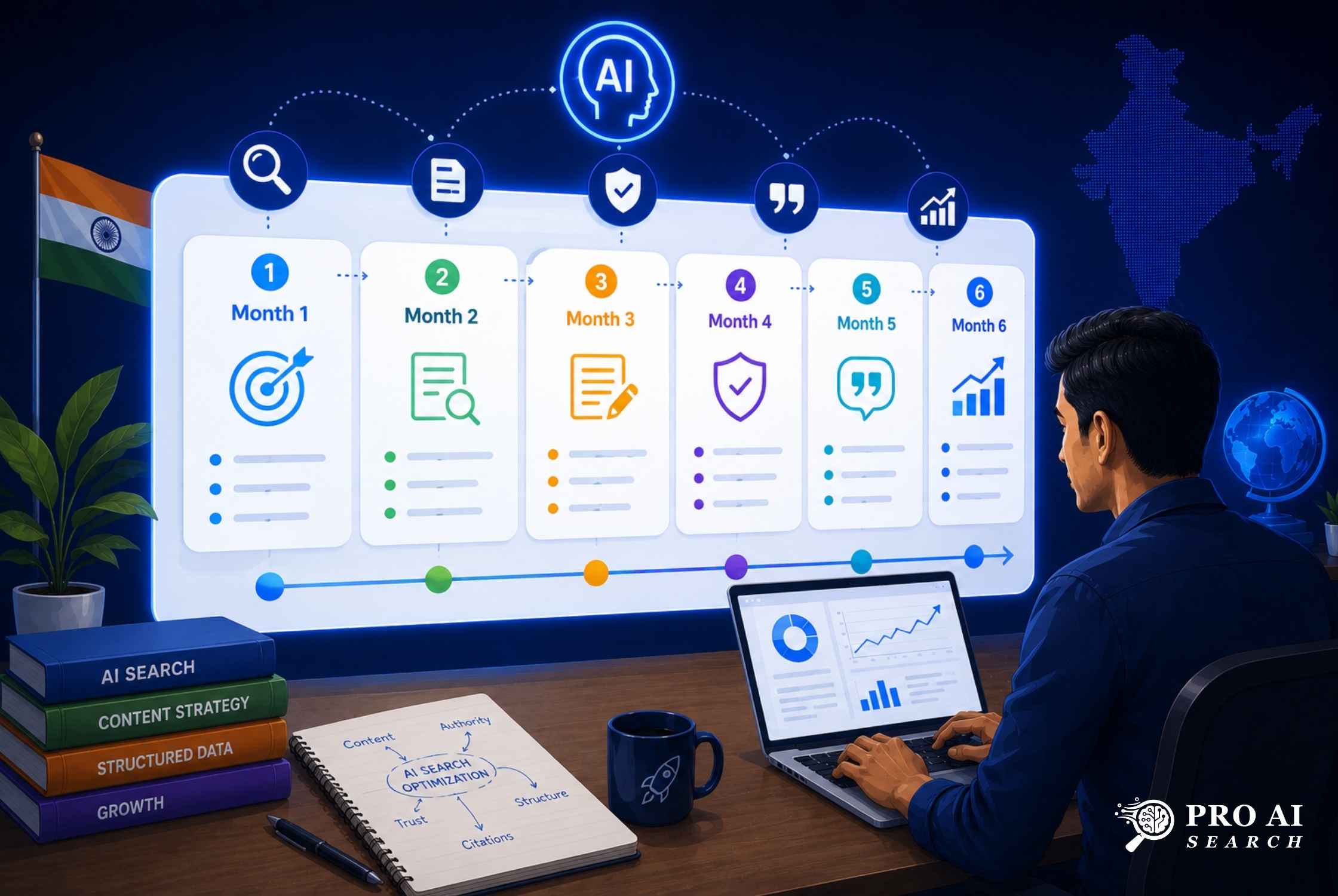
AI search optimization roadmap for new websites is the plan I wish existed when I launched Pro AI Search in April 2026. I spent the first two weeks doing things in the wrong order, writing content before fixing technical blocks, optimising for Perplexity before understanding that Gemini drives more traffic in India, and waiting for results before setting up tracking to measure them.
This is the month-by-month roadmap that fixes that sequence.
What Is an AI Search Optimization Roadmap and Why Do New Websites Need One Specifically?
An AI search optimization roadmap is a sequenced plan for getting your website cited in AI-generated answers from platforms like ChatGPT, Gemini, and Perplexity. It is different from a general GEO guide because it accounts for where you are starting: zero domain authority, zero backlinks, zero citation history.
Most roadmaps published online assume you already have an established website with existing Google rankings. They tell you to “audit your current AI visibility” and “fix content gaps.” A new website has nothing to audit. The starting point is different, and the sequence matters more.
The roadmap below is organised by month because AI citation takes time. You cannot compress six months of work into six weeks. But you can front-load the right things so results arrive as early as possible.
Is GEO Actually Different from SEO or Just Rebranded? (The Community Is Asking This)
The r/DigitalMarketing community put it clearly in a thread with 79 upvotes: “Most people wanted GEO to be a completely new game because it sounded exciting. Feels more like Google saying good fundamentals still win, the surfaces just changed.”
Google’s own AI optimization guide confirms this. Google states explicitly that the same principles driving good search performance, helpful content, clear structure, credible authorship, drive AI citation. GEO is not a separate discipline. It is SEO with a different success metric.
The difference for a new website is this: in traditional SEO, you build authority over months and rankings follow. In AI search, structure matters from day one. A brand-new page with perfect answer structure can get cited by Perplexity within two weeks. The same page with poor structure will get ignored regardless of how long you wait.
This is the opportunity for new websites. You can build AI-friendly structure from scratch without retrofitting years of existing content.
How Long Does It Actually Take a New Website to Get Cited by ChatGPT and Gemini?
FogTrail documented this precisely when they tracked their own new domain from day one. Google indexed their site within 3 days of domain purchase and Search Console verification. Perplexity began surfacing their content approximately 10 days after domain purchase. ChatGPT began citing them by day 15, one day after their first PR article went live on an external publication.
The critical detail: citations only appeared for specific keywords they had optimised for. Publishing generic content and waiting did not work. Structured, answer-first content on specific topics worked.
For Indian businesses, the timeline is similar but Gemini often moves faster than Perplexity because Google’s crawling infrastructure is more aggressive in indexing new content. ChatGPT uses Bing’s index for web search, so submitting your sitemap to Bing Webmaster Tools in week one accelerates ChatGPT discovery significantly.
Realistic expectations for a new Indian website:
- Week 1-2: Google indexes your pages
- Week 2-3: Gemini begins surfacing your structured content for specific queries
- Week 3-4: Perplexity starts citing well-structured pages
- Week 4-6: ChatGPT begins including your content if Bing has indexed it
- Month 3 onwards: Consistent citations across all three platforms as authority builds
Month 1: What Must You Fix Before Writing a Single Article?
Month 1 is technical foundation. Do not publish any content until these three things are done. Content published before the technical foundation is set will not get crawled or cited correctly, and you will waste the compounding effect of early publication.
Is Your Site Blocked to AI Crawlers Without Knowing It?
This is the most common mistake on new WordPress sites. Default security configurations block AI crawlers before you have written a single word.
Go to your website URL and add /robots.txt at the end. Check whether these user agents are allowed:
User-agent: ChatGPT-User
Allow: /

User-agent: GPTBot
Allow: /

User-agent: Google-Extended
Allow: /

User-agent: PerplexityBot
Allow: /
If you are on WordPress with Rank Math, go to Rank Math SEO, then General Settings, then Edit robots.txt, and add these lines manually. If you installed Wordfence or any security plugin, check its bot blocking settings. Wordfence’s default configuration flags AI crawlers as suspicious bots and blocks them. This single issue explains why many new sites with good content get zero AI citations for months.
Read our complete guide on how AI search engines work to understand exactly which crawlers to allow and why each one matters for your citation strategy.
Which Three Schema Types Does a New Website Add First?
Schema markup helps AI engines extract structured information from your pages. For a new website, add these three in order of impact.
Organization schema on your homepage tells AI engines who you are, what you do, where you are located, and how to verify your identity. It is the foundation of entity recognition.
Article schema on every blog post should include the author name, publish date, and modification date explicitly. AI engines use freshness signals when selecting sources, and dated content gets prioritised over undated content.
FAQ schema on your most important pages creates structured question-answer pairs that AI engines can extract directly. This is why FAQ sections get cited so frequently in AI answers, the structure makes extraction trivial. For WordPress with Rank Math Free, all three are available without a paid upgrade.
How Do You Set Up GA4 to Track AI Referral Traffic from Day One?
Most new websites check GA4 weeks after launch and have no baseline to compare against. Set up AI referral tracking on day one so you have data from the moment your first citation happens.
In GA4, go to Admin, then Attribution settings. Then go to Reports, then Acquisition, then Traffic Acquisition. Look for these referral domains in your data:
- chat.openai.com (ChatGPT)
- chatgpt.com (ChatGPT direct)
- gemini.google.com (Gemini)
- perplexity.ai (Perplexity)
- bing.com (ChatGPT web search)
Create a custom channel group called “AI Search” that includes all five. Without this setup, AI referral traffic gets lumped into “Referral” or “Direct” and you cannot measure whether your optimisation is working. Our GEO pillar page covers the full measurement framework for AI search visibility.
Month 2: How Do You Build Content Fast Enough to Get AI Citations?
Month 2 is content production. By this point your technical foundation is solid and AI crawlers can access your site. Now you need content that gives them something worth citing.
How Many Articles Before AI Engines Start Noticing a New Site?
Based on our experience building topical authority at Pro AI Search, you need a minimum of 10 to 15 articles in a focused topic cluster before topical authority signals become strong enough to influence AI citation decisions consistently.
This does not mean 10 random articles. It means 10 articles that together cover a single topic comprehensively. Every article reinforces every other through internal links and shared focus.
The reason topical clusters matter is that AI engines evaluate authority at the topic level, not the page level. A single brilliant article on a thin domain gets ignored. Ten good articles that together define a topic from multiple angles signal genuine expertise. Publish 2 to 3 articles per week in Month 2 and front-load the pillar content before satellite articles.
Why ChatGPT, Gemini, and Perplexity Cite Different Sources
This is the insight that most GEO guides miss, and it matters for Indian businesses specifically.
ChatGPT uses Bing’s search index for its web search feature. It heavily favours Wikipedia, established editorial sources like TechCrunch, Reuters, and Bloomberg, and content with strong backlink signals. A brand-new website with no backlinks will struggle to appear in ChatGPT citations until it starts earning mentions from external sources.
Gemini, as part of Google’s ecosystem, pulls from Google’s search index. For Indian businesses, this is the fastest path to AI citations because Google crawls and indexes Indian content aggressively. With 105 million monthly active users in India, fuelled by Android integration and Jio’s free Gemini Pro subscription offer, Gemini is the platform that matters most for Indian businesses to optimise for alongside ChatGPT. Our guide on answer engine optimization covers how Gemini evaluates and selects sources in detail.
Perplexity runs its own crawler and prioritises recency and answer quality over domain authority. A brand-new website with no backlinks but well-structured, factually precise content can appear in Perplexity answers within two weeks. For new Indian websites, Perplexity is the fastest first win because it rewards content quality over domain age.
What Content Structure Gets Cited vs What Gets Ignored?
AI engines extract content at the passage level, not the page level. They pull specific paragraphs that answer a specific question. This means every paragraph needs to be self-contained and answer-first.
The structure that consistently gets cited: first sentence of every H2 section is the direct answer to the question the heading asks. Not context. Not background. The answer. Second and third sentences add supporting detail or evidence. Fourth sentence onwards covers elaboration and exceptions.
The structure that gets ignored: introductory paragraphs that explain what you are about to explain. AI engines have no patience for “In this section, we will explore…” Lead with the answer. Our technical GEO audit checklist includes a content structure scoring system you can use to evaluate every page on your site.
Month 3: How Do You Know If Your AI Search Optimization Is Working?
Month 3 is measurement. By now you have 20 to 30 articles, a solid technical foundation, and several weeks of content indexed by AI engines. This is when you shift from building to monitoring and iterating.
How to Run Manual Citation Tests Without Paid Tools
Open ChatGPT, Gemini, and Perplexity in separate tabs. Search the five to ten queries your target readers are most likely to ask. Note whether your website appears in citations, who does appear if not, and what their cited content looks like structurally compared to yours.
Do this every Saturday. It takes 20 minutes. Screenshot the results with dates so you can track progression over time.
Specific queries to test for Indian businesses: ask in the format “best [your service] for Indian businesses” or “how do Indian [your target customer] solve [their problem].” These queries have lower citation competition than generic global queries and give new Indian websites a faster path to appearing in AI answers.
What AI Referral Traffic Looks Like in GA4 and What Numbers Are Realistic
In the first month, expect zero to five AI referral visits per week. This is not failure. This is the lag between content publication and AI engine indexing.
By Month 3, with your GA4 AI channel grouping set up correctly, you should see five to fifteen weekly AI referral visits across ChatGPT, Gemini, and Perplexity combined. For Indian businesses where Gemini adoption is high due to Android integration and Jio’s Gemini Pro partnership, Gemini often contributes the largest share of AI referral traffic.
The important signal is not absolute numbers in Month 3, it is trajectory. If week-over-week AI referral visits are growing, your optimisation is working. AI referral visitors convert at two to three times the rate of standard organic visitors because they arrive pre-qualified. Want to know exactly what AI search visibility looks like for your business right now? Book a free AI SEO audit and we will show you where you stand.
Month 4 Onwards: How Do You Build the Off-Site Presence AI Engines Need?
By Month 4 you have strong on-site foundations. The limiting factor becomes off-site signals, mentions of your brand and content on external platforms that AI engines use to verify authority.
Why Community Platforms Matter for Perplexity Specifically
Perplexity cites Reddit discussions in approximately 46% of its responses, more than any other single source type. For Indian businesses, this means authentic participation in relevant Reddit communities creates a direct citation pathway.
This is not about posting promotional content. It is about answering questions genuinely in communities where your potential customers are asking questions. If someone asks “how do Indian MSMEs improve their visibility on ChatGPT” in r/IndianStartups or r/digital_marketing and your answer is the most detailed and practical response in the thread, Perplexity will pull from that thread.
The same principle applies to LinkedIn articles and Quora answers. These platforms have high domain authority and are indexed by all three AI engines. A well-structured LinkedIn article on a specific industry question contributes to your citation profile across Gemini, ChatGPT, and Perplexity.
How Indian B2B Businesses Build AI Visibility Faster Than Global Competitors
An audit of 20 plus Indian B2B businesses found that fewer than 5% had meaningful AI visibility despite good Google rankings and solid customer reviews. The gap is not content quality, it is structure and off-site citation signals.
Indian businesses have one significant advantage: lower citation competition for India-specific queries. When a buyer asks ChatGPT “who are the best CNC machining suppliers in India” or “which Indian software companies specialise in healthcare automation,” the pool of well-structured content competing for that citation is small. An Indian business that publishes three to five well-structured articles answering these exact queries can dominate AI citations within two to three months.
This early mover advantage exists right now. Our articles on how IndiaMART sellers can leverage AI search and AI search optimization for Indian manufacturers cover the industry-specific application of these principles.
What Are the Biggest Mistakes New Websites Make in Their First 90 Days?
Mistake 1: Publishing content before fixing robots.txt. AI crawlers blocked by default security settings cannot discover your content regardless of quality. Fix robots.txt in week one, not month three.
Mistake 2: Optimising for Perplexity and ignoring Gemini. For Indian audiences, Gemini has 105 million monthly active users versus Perplexity’s 20 million. Gemini citations come through strong Google rankings. Do not neglect traditional SEO fundamentals in favour of Perplexity-only tactics.
Mistake 3: Writing introductory paragraphs instead of answers. Every H2 section must open with the direct answer. Not context. Not background. The answer. AI engines read opening sentences first and move on if the answer is not immediately present.
Mistake 4: Skipping GA4 AI traffic tracking. Without an AI channel grouping in GA4, you cannot tell which content is being cited or whether your optimisation is producing results. Set this up before publishing your first article.
Mistake 5: Waiting for backlinks before starting. ChatGPT weights authority signals. Perplexity and Gemini do not require them at the same level. Start with Perplexity-friendly structure now and build backlinks in parallel.
Mistake 6: Treating all three AI platforms as identical. ChatGPT needs Bing indexation and authority signals. Gemini needs Google rankings. Perplexity needs structured, recent, answer-first content. A single strategy optimised for one platform will underperform on the other two. Our full AI search optimization hub covers the platform-by-platform framework in detail.
Frequently Asked Questions
How is an AI search optimization roadmap different from a standard SEO roadmap?
A standard SEO roadmap focuses on ranking in Google’s blue links through keyword targeting, backlink building, and on-page optimisation. An AI search optimization roadmap focuses on getting cited inside AI-generated answers from ChatGPT, Gemini, and Perplexity. The technical foundation overlaps, both need crawlable, fast, mobile-friendly sites with schema markup. The content strategy diverges: SEO optimises for ranking position while AI search optimisation optimises for extractable answers, topical authority signalling, and cross-platform citation patterns.
Do I need to be on page one of Google before AI engines will cite me?
Not for all platforms. Perplexity runs its own crawler and will cite content from low-authority new websites if the content quality and structure are strong. Gemini prioritises Google-ranking content so Google rankings help significantly. ChatGPT requires Bing indexation and favours higher-authority sources for competitive queries. A new website can realistically get Perplexity citations within two to four weeks without Google rankings. Gemini and ChatGPT citations typically require three to six months of authority building.
Should I focus on ChatGPT, Gemini, or Perplexity first for an Indian audience?
Prioritise ChatGPT and Gemini given India’s user base. ChatGPT has approximately 145 million monthly active users in India. Gemini has 105 million monthly active users, fuelled by its deep Android integration and Jio’s free Gemini Pro offer for subscribers. Perplexity has around 20 million users, useful but a distant third. For Gemini, focus on Google SEO fundamentals. For ChatGPT, submit your sitemap to Bing Webmaster Tools and build external mentions. For Perplexity, prioritise answer-first content structure.
How many articles do I need before seeing AI referral traffic in GA4?
Expect your first AI referral visits between weeks two and four of publishing structured content, assuming your technical setup is correct and AI crawlers can access your site. These early visits will be small, one to five per week. Meaningful, consistent AI referral traffic typically begins after you have 15 to 25 articles in a focused topic cluster, approximately two to three months from launch for most Indian businesses publishing two to three articles per week.
Can I do AI search optimization myself or do I need an agency?
The technical setup, robots.txt, schema markup, GA4 tracking, requires an hour or two of focused work but no specialist knowledge. The content production requires time but not specialist agency involvement if you understand your industry well. An agency makes sense if you need to accelerate production beyond what your team can sustain, or if you want off-site citation building handled systematically. Our AI search optimization services exist for businesses that want execution handled rather than just guidance.
What is the fastest way to get a first citation from a major AI engine?
The fastest path is Perplexity, specifically for niche queries with low citation competition. Write a 1,500 word article that directly answers a specific question your target customers ask. Structure the opening paragraph as a direct answer in under 60 words. Add FAQ schema. Ensure PerplexityBot is not blocked in your robots.txt. Submit the URL to Google Search Console to accelerate indexing. Most Indian businesses following this approach see their first Perplexity citation within 10 to 14 days of publication.