
Do rich snippets help SEO? Yes, significantly, but not as a direct ranking factor. Rich snippets improve click-through rates, send stronger engagement signals to Google, and in 2026 they serve a second job that most SEO guides ignore: they are the primary machine-readable signal that determines whether Google AI Overviews, Perplexity, and ChatGPT cite your content in AI-generated answers. This guide covers the CTR data, which schema types still produce visual rich results in 2026, which ones Google deprecated but still matter for AI search, and how to implement structured data so it works for both traditional SEO and AI visibility simultaneously. For the broader picture of AI search optimization for Indian businesses, the hub page covers all platforms and tactics together.
What Are Rich Snippets?
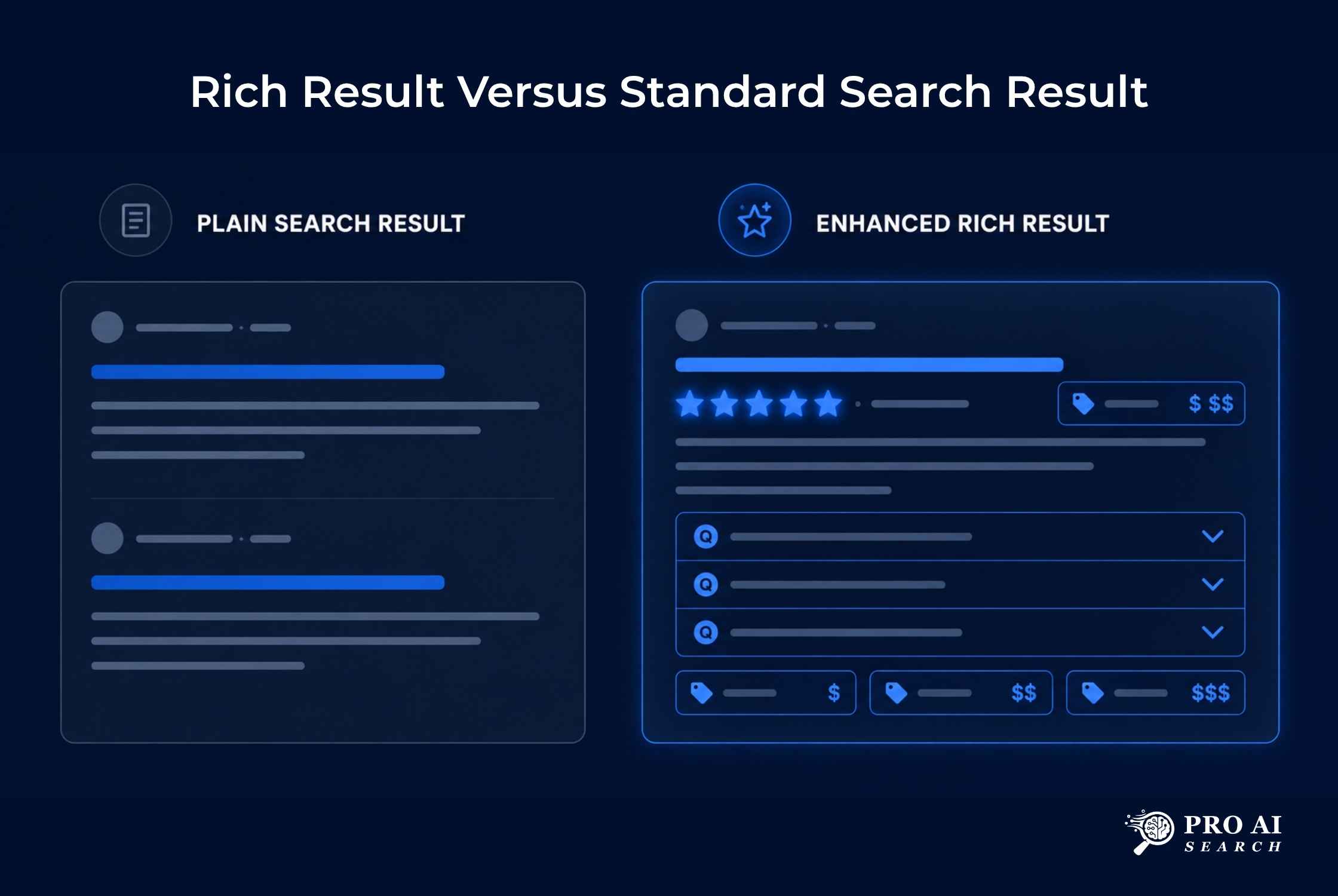
Rich snippets are enhanced search results that display additional information beyond the standard title, URL, and meta description. They are generated from structured data markup, specifically Schema.org vocabulary written in JSON-LD format, that you add to your page’s HTML. Google reads this markup and decides whether to display the extra information visually in search results. Common rich snippet types include: review stars and aggregate ratings, product price and availability, FAQ expandable boxes, recipe details (cooking time, calories, rating), event dates and locations, and job posting details. Each type requires a specific schema markup, and Google applies its own eligibility criteria before showing any of them. The key distinction for 2026: visual rich results and structured data are not the same thing. Google has removed several rich result types from display, but the underlying schema markup still sends machine-readable signals to AI search engines. More on this in the section on which schema types still work.
Do Rich Snippets Directly Improve Google Rankings?
No. Rich snippets are not a direct ranking factor, and Google has confirmed this explicitly. Google’s John Mueller has stated that structured data helps Google understand content and enables rich results, but it does not cause a page to rank higher. Adding FAQPage schema to a page at position 8 will not move it to position 3. What rich snippets do affect are the signals that indirectly influence rankings over time: click-through rate, user engagement, and content clarity. A rich result that earns significantly more clicks than a plain result sends a positive behavioral signal. Google interprets higher-than-expected CTR for a given ranking position as evidence of relevance and quality. The indirect chain is: structured data enables rich result, rich result increases CTR, higher CTR signals quality, sustained quality signals can support ranking improvements over time. It is not guaranteed or immediate, but it is the real mechanism through which schema markup influences SEO performance. For a full technical framework covering schema alongside other AI readiness signals, see the LLM SEO implementation guide.
The CTR Data: What Studies Actually Show
The clearest evidence for rich snippets comes from a Milestone Research study analyzing 4.5 million queries, which found that rich results averaged 58% CTR compared to 41% for standard results. That is a 17-percentage-point advantage simply from having structured data displayed. Different schema types produce different CTR lifts. Here is the data:
| Rich Snippet Type | CTR Performance | Visual Status in 2026 |
|---|---|---|
| FAQPage | 87% avg CTR (91% non-branded) | Removed for most sites (2023) |
| Video snippets | 62% avg CTR | Active |
| Review / AggregateRating | +26 percentage points vs no stars | Active (product/service pages) |
| Product schema | ~35% CTR increase | Active |
| HowTo | ~25% CTR increase (when shown) | Removed Aug 2023 |
| Recipe | ~22% CTR increase | Active |
| Article / BlogPosting | Supports featured snippet eligibility | Active (in Google News / Discover) |
The FAQ number is striking because Google removed FAQ rich results from most websites in 2023, limiting them to government and health sites. Yet FAQPage schema still consistently appeared in AI Overviews source selections and Perplexity citations in 2025-26 testing. The visual SERP result is gone for most sites, but the AI citation signal remains active. This is the most important nuance in the 2026 rich snippets landscape.
Which Rich Snippet Types Still Work in 2026?
This is where 2026 guidance differs most from older guides, and where most competitors miss the mark. Google has changed which schemas produce visual rich results, but that does not mean the same schemas lost their value. They still serve as structured signals for AI search engines, which makes “deprecated” a misleading term for the 2026 reality. Here is the full status breakdown:
| Schema Type | Google Visual Rich Result | AI Search Value | Verdict |
|---|---|---|---|
| FAQPage | Removed for most sites (2023) | HIGH: all major AI engines extract Q&A pairs | Implement on every article |
| HowTo | Removed (Aug 2023) | MEDIUM: AI reads structured steps | Implement on how-to content |
| Article / BlogPosting | Active in Discover, News | HIGH: author, date, E-E-A-T signals | Required on every article |
| Product | Active | MEDIUM: product entity recognition | Required on product pages |
| AggregateRating | Active on product/service pages | HIGH: authority signal | Required where genuine reviews exist |
| LocalBusiness | Active in Maps / local pack | MEDIUM: entity location signal | Required for local businesses |
| Organization | No visual rich result | HIGH: entity recognition across all AI engines | Required on homepage |
| BreadcrumbList | Active in URL display | LOW | Nice to have |
The single most important shift in 2026: FAQPage schema was removed from Google’s visual rich results for most websites, but it remains one of the highest-value AI citation signals available. Google AI Overviews, Perplexity, and ChatGPT all extract question-and-answer pairs from FAQPage markup to populate their answers. Google’s structured data policies still require the markup to be accurate and match visible content, even without the visual display. The correct framing is that structured data now serves two separate audiences: Google’s visual SERP and AI search engines. Optimizing for both requires keeping schema in place even after Google stops displaying it visually. The technical GEO audit checklist covers how to audit your schema implementation specifically for AI search readiness alongside traditional SEO signals.
How Rich Snippets Boost AI Search Visibility in 2026
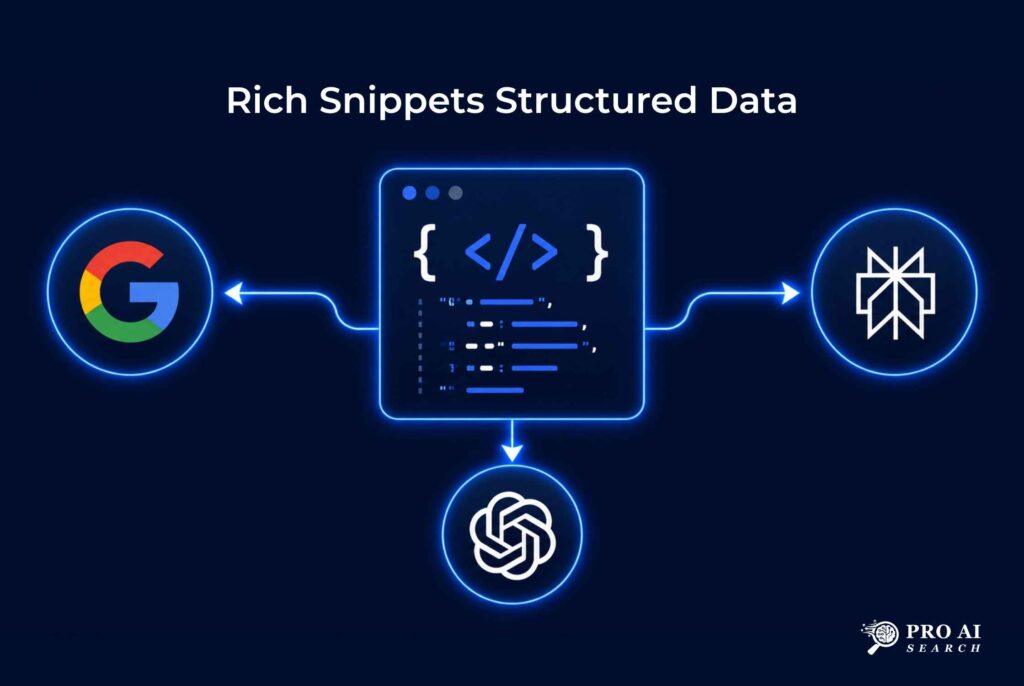
Structured data is the clearest machine-readable signal available for AI search engines to understand what your content is, who wrote it, what questions it answers, and whether it is an authoritative source. This is the section no competitor in the “do rich snippets help SEO” space covers, and it is the reason structured data has become more important in 2026, not less. Google AI Overviews: Google’s own AI content optimization documentation confirms that structured data helps AI systems understand content. Pages with Article schema (establishing authorship and publication date) and FAQPage schema (structuring Q&A pairs) are more consistently cited in AI Overviews than equivalent pages without structured data. For everything you need to do at the Google layer, see the guide on how to appear in Google AI Overviews. Perplexity: PerplexityBot reads structured data during its crawl to understand content type and authority. Organization schema establishes your entity identity. Article schema signals authorship and recency, both of which influence whether Perplexity treats a page as a citable source. FAQPage markup makes Q&A pairs directly extractable. For the full Perplexity technical setup, see how to rank in Perplexity AI. ChatGPT Search: ChatGPT retrieves through Bing, and Bing’s index reads Schema.org markup to classify pages during indexing. Organization and Article schema help Bing categorize your site as a legitimate entity and your content as a specific type of resource. This classification influences whether ChatGPT’s retrieval layer selects your page as a citation source for a given query. See the guide on ranking in ChatGPT search for the full Bing-side setup. The unified implication: implementing FAQPage, Article, and Organization schema is no longer just an SEO tactic. It is the baseline technical investment for AI search visibility across all three major platforms. The answer engine optimization guide covers how to structure the content that goes inside this schema for maximum AI citation frequency.
How to Implement Rich Snippets in 2026
Implementation is straightforward once you know which schema types to prioritize. The order below reflects highest-impact first.
1. Organization schema on your homepage (once, site-level). This establishes your entity identity for all AI search engines. On WordPress with Rank Math, set it under SEO > Titles & Meta > Local SEO. Include your organization name, URL, logo URL, founding date, and contact details. This is a one-time setup that applies sitewide.
2. Article schema on every blog post (automatic with Rank Math). Rank Math Free adds Article or BlogPosting schema automatically when you set your post type. Fill in your author profile completely, including name, bio URL, and profile image, since AI search engines use author signals as a quality indicator.
3. FAQPage schema inline in every article. Add this as a <script type="application/ld+json"> block at the end of your article HTML, not via a sitewide WPCode snippet. Per-article FAQ schema added via WPCode can conflict with Rank Math’s auto-generated schema and produce validation errors. Write each FAQ answer as a complete, self-contained response of 40-80 words. Here is the format:
<script type="application/ld+json">
{
  "@context": "https://schema.org",
  "@type": "FAQPage",
  "mainEntity": [
    {
      "@type": "Question",
      "name": "Do rich snippets help SEO?",
      "acceptedAnswer": {
        "@type": "Answer",
        "text": "Yes, significantly, but indirectly. Rich snippets improve click-through rates by making your search result more visually prominent, and the underlying structured data sends machine-readable signals to AI search engines including Google AI Overviews, Perplexity, and ChatGPT."
      }
    }
  ]
}
</script>
4. Validate before publishing. Run every page through Google’s Rich Results Test before publishing. It confirms whether your markup is valid and which rich result types your page is eligible for. Check the Enhancements section of Google Search Console weekly after publishing to catch any new validation errors. For a full audit of what AI crawlers can and cannot access on your site, use the AI crawler access checker. 5. AggregateRating schema only where you have genuine reviews. Do not manufacture or inflate ratings. Google’s structured data policies explicitly prohibit fake or misleading ratings, and violations result in removal from rich results and potential manual actions. Only add AggregateRating schema when you have authentic user reviews on the page.
Common Mistakes That Prevent Rich Snippets from Appearing
Most structured data implementations that fail to produce rich results come down to a small set of recurring errors.
Marking up hidden content. Any content you add to schema markup must be visible to users on the page. If the FAQ answers exist only in the JSON-LD but not in the page body, Google will reject the markup. The content does not need to be in an identical format, but it must be accessible without requiring a user action like clicking to expand.
Missing required properties. Each schema type has required fields. AggregateRating requires both ratingValue and ratingCount (or reviewCount). FAQPage requires both the question text and the accepted answer. Missing required properties means the markup is valid JSON-LD but ineligible for rich results. The Schema.org documentation lists required and recommended properties for every type.
Using WPCode for per-article FAQ schema. A global WPCode snippet for FAQ schema applies the same Q&A to every page on your site, which is incorrect and will be flagged as misleading. Add FAQPage schema inline at the end of each article’s HTML content block. This is per-article, not sitewide.
Not re-validating after site updates. Theme updates, plugin changes, and CMS migrations can break schema markup silently. Run the Rich Results Test after any significant site update, and check Search Console Enhancements monthly. Schema errors accumulate unnoticed and erode your rich result eligibility over time.
Expecting results too quickly. Google needs to recrawl and reindex pages before rich results can appear. For pages that are already indexed, submitting the URL for re-inspection in Search Console can accelerate this. For new pages, allow 2-4 weeks before evaluating whether rich results are showing. The AI search optimization checklist includes a structured data audit section to work through systematically.
FAQ: Do Rich Snippets Help SEO?
Is FAQPage schema still worth implementing after Google removed it from visual results? Yes, absolutely. Google removed FAQ rich results from most websites in 2023, limiting them to government and health sites, but FAQPage schema remains one of the highest-value structured data types for AI search. Google AI Overviews, Perplexity, and ChatGPT all extract Q&A pairs from FAQPage markup when selecting citation content. The visual Google SERP display is gone for most sites, but the AI citation signal is active and important. How long does it take for rich snippets to appear after implementing schema? Typically 2-4 weeks after Google recrawls and reindexes the page. You can accelerate this by submitting the updated URL through the URL Inspection tool in Google Search Console. Schema eligibility also depends on content quality: the page must meet Google’s quality guidelines before it becomes eligible for enhanced display, regardless of how well the markup is written. Why did my rich snippets disappear? The most common causes are: a site update broke the schema markup (validate in Rich Results Test), Google changed display eligibility for that schema type (check the Search Central blog), a competitor’s content became more relevant for that query, or Google detected a policy violation like marked-up content not matching visible content. Check Search Console Enhancements for error flags first, then re-run the Rich Results Test to confirm the markup is still valid. Do rich snippets help with Perplexity and ChatGPT citations specifically? Yes. Both platforms use structured data to understand content type, authorship, and what questions a page answers. FAQPage schema makes Q&A pairs directly extractable by AI engines. Article schema establishes author credentials and publication recency. Organization schema confirms your entity identity. For Perplexity specifically, see the Perplexity AI ranking guide. For ChatGPT, see how to rank in ChatGPT search. What is the single highest-impact schema type to implement first? FAQPage schema, inline in your article HTML. It produces the largest CTR lift when Google displays it (87% average vs 41% standard), and it remains the strongest AI citation signal even when the visual display is absent. After FAQPage, implement Organization schema on your homepage and Article schema on every post. These three together cover the majority of structured data value available for both traditional SEO and generative engine optimization. The full implementation framework is in the answer engine optimization guide. For Indian businesses looking to build AI search presence from the ground up, our AI search optimization services include a structured data audit as part of every engagement. The combination of correct schema implementation and answer-first content structure is consistently the fastest path to AI citation visibility for new and growing sites.