
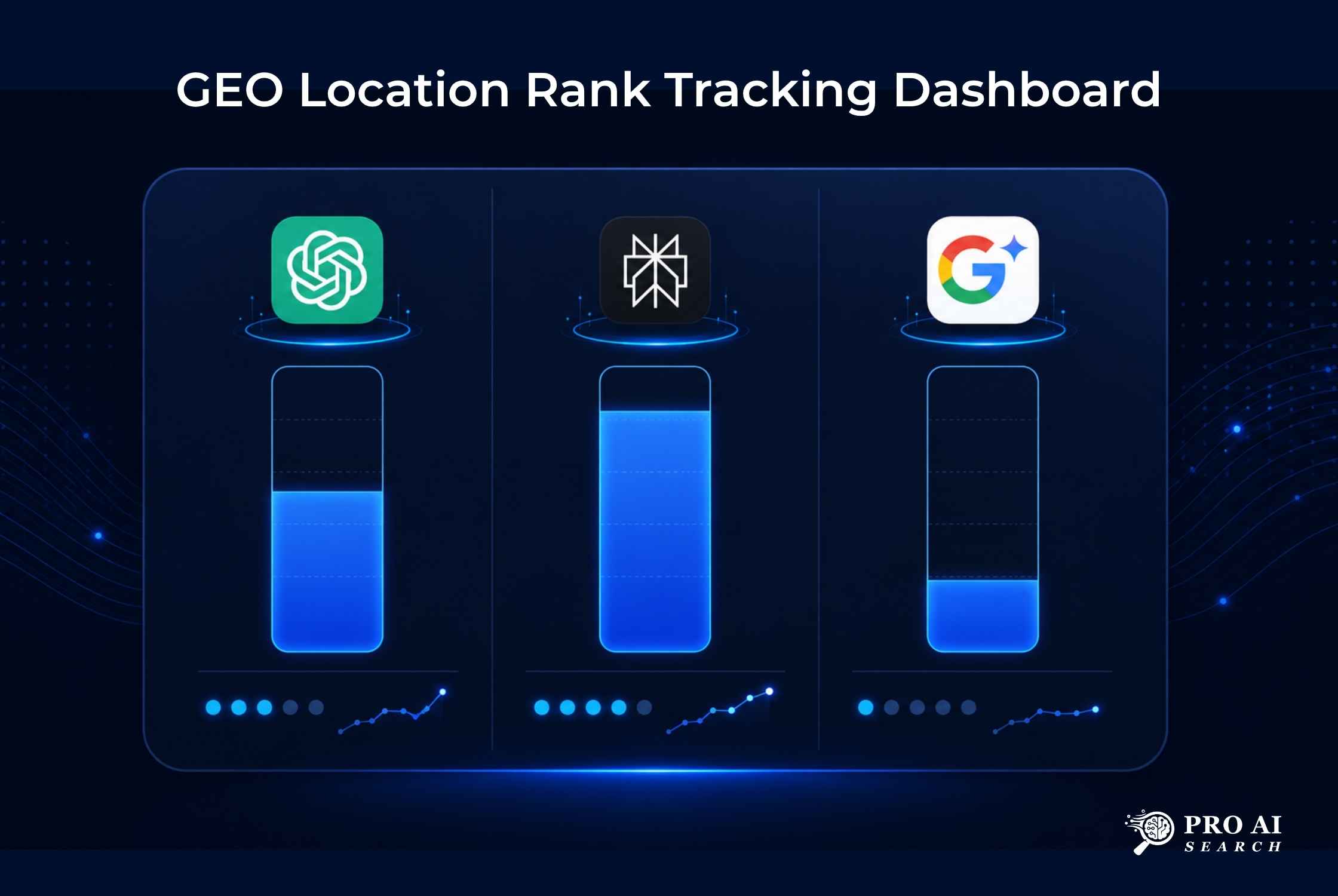
GEO location rank tracking is the process of measuring how often and how prominently your website appears in AI-generated answers across platforms like ChatGPT, Google AI Overviews, and Perplexity. Unlike traditional SEO, where rank means a numbered position on a results page, generative engine optimization visibility works on a completely different measurement model. This guide covers every tracking method available in 2026, from free manual approaches to enterprise platforms, so you can choose the right level for your site and budget.
According to our 2026 AI search statistics, over 40% of queries on ChatGPT and Perplexity now return a cited source list alongside the AI-generated answer. If your site is not tracking whether it appears in those citations, you are flying blind on one of the fastest-growing traffic channels in digital marketing.
What Is GEO Rank Tracking? (And Why It Is Different from SEO)
In traditional SEO, ranking means your page appears at position 3 or position 7 for a given query. You can export it from your rank tracker and graph it moving up or down over time. That model does not apply to AI search. For a side-by-side explanation of how the two disciplines diverge, see our GEO vs SEO comparison guide.
When ChatGPT answers a question, there is no position 1 through 10. There is only cited or not cited. Your URL either appears as a source in the response, or it does not. Your brand gets mentioned, or it does not. That binary distinction is the foundation of GEO rank tracking, and it requires a completely different measurement framework.
The Three Metrics That Replace “Position”
AI search rank breaks into three distinct measurements, each capturing a different type of visibility.
Citation rate is the percentage of your target queries where your site appears as a cited source. If ChatGPT cites you in 6 out of 20 tracked queries, your citation rate is 30%. This is your primary GEO rank metric and the closest equivalent to an organic rankings report.
Citation prominence measures whether you are the first source cited, a secondary source, or one of several listed at the bottom of a response. Being the primary cited source drives more clicks and more brand trust than being the fourth source in a list. Track this as a ratio: primary citations versus secondary citations versus lower-position mentions.
Brand mention rate tracks how often your brand name appears in AI responses even without a source link. Some AI systems, particularly Gemini and Claude, sometimes reference brands by name without hyperlinking the source. These no-link mentions still build awareness and influence future citations even when they produce no immediate click traffic. For brands focused on building Claude citation share specifically, our Claude AI citation strategy guide explains the content signals Claude prioritizes when generating responses.
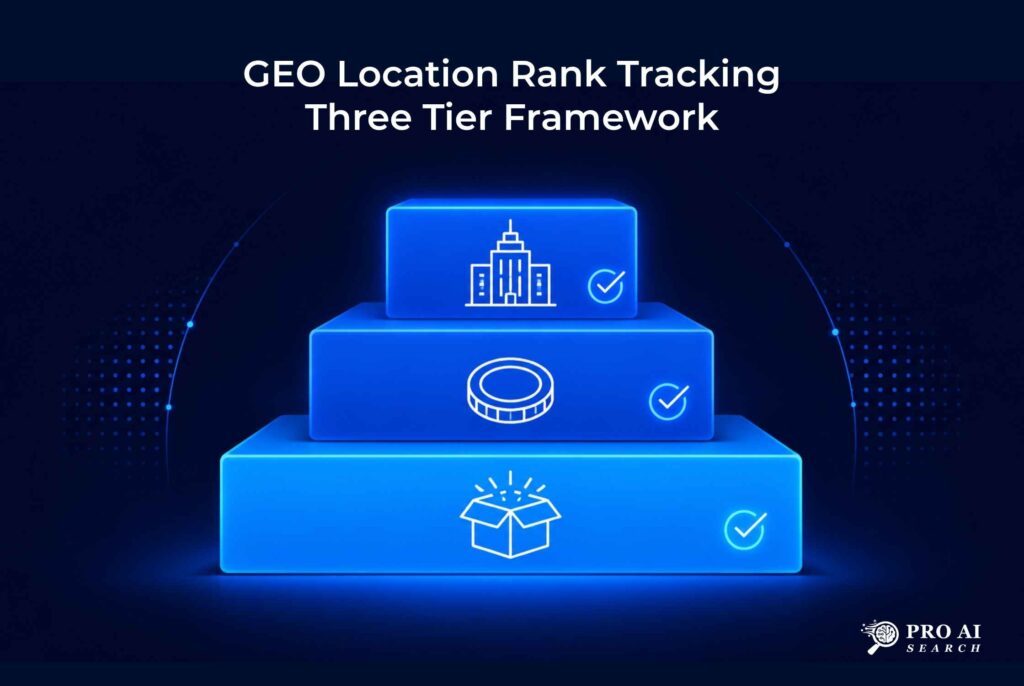
The 3-Tier GEO Tracking Framework
Before choosing a tool, match your tracking approach to where your site is right now. Most sites should start with Tier 1 and move up only when they are generating consistent AI-driven traffic. Our complete GEO tools comparison covers the full landscape including content optimization and audit platforms alongside rank tracking tools.
| Tier | Method | Monthly Cost | Best For |
|---|---|---|---|
| Tier 1 | Manual prompts + GA4 | Free | New sites, under 5K monthly sessions |
| Tier 2 | SE Ranking, Surfer, Otterly.ai | $52-150 | Growing sites, active GEO campaigns |
| Tier 3 | Peec AI, AthenaHQ | $300+ | Agencies, enterprise brands, multi-country |
If your site is under three months old or has fewer than 20 published articles, paid tracking tools will mostly show you zeros. Confirm you have AI search visibility first using Tier 1 methods, then invest in tools to measure it more precisely.
Tier 1: Free GEO Rank Tracking Methods
These methods cost nothing and should be your starting point regardless of budget. They also give you data that paid tools often miss: the actual wording of the AI response, how your brand is described, and whether the description is accurate.
Method 1: Manual Prompt-Based Tracking
This is the most underused and most practical tracking method available to Indian marketers in 2026. Here is the exact process.
Step 1: Build your query list. Write down 15 to 20 queries your target reader would type into ChatGPT or Perplexity. These should map directly to your published articles, not your homepage. For a GEO-focused site, example queries would be: “how to rank in AI search”, “what is GEO in SEO”, “best tools to track AI citations”, and “how to appear in ChatGPT answers”.
Step 2: Create a tracking spreadsheet. Set up columns for: Date, Query, Platform, Cited Y/N, URL Used in Citation, Citation Position (1st, 2nd, 3rd source), Brand Mentioned Y/N, and Competitor Cited Instead. This structure gives you a complete weekly snapshot in one view.
Step 3: Run the queries weekly. Paste each query into ChatGPT (GPT-4o), Perplexity, and Google AI Overviews. Use a fresh incognito window for Google AI Overviews to avoid personalization effects skewing your results. Do not run the same query twice in quick succession on Perplexity, as it can serve cached responses.
Step 4: Log and review. For each query, note whether you appeared, at what position, and which competitor took the citation if you did not appear. Over 4 to 6 weeks, patterns emerge clearly: which of your articles are consistently cited, which topics you are being displaced on, and which competitors dominate specific query categories.
This method takes roughly 30 to 45 minutes per week for 20 queries across three platforms. When the spreadsheet reveals articles that are not earning citations, connect that data to your GEO technical audit checklist to identify the structural gaps causing those pages to be skipped by AI systems.
The manual method also gives you something no paid tool currently provides: accurate response text monitoring. If ChatGPT is describing your product category incorrectly, or attributing capabilities to your brand that you do not have, only manual checking will catch it. Paid tools report whether you are cited; they do not report what was said about you in the response body.
Method 2: GA4 Referral Traffic Monitoring
Google Analytics 4 captures referral traffic from several AI platforms, most reliably from Perplexity and from Bing (which powers Copilot). This method does not show you how often you are mentioned, but it confirms that AI-driven clicks are reaching your site, which is the first measurable proof that your GEO efforts are producing real results. To understand how the two platforms differ in the referral traffic and citation patterns they produce, our full Perplexity vs Copilot breakdown covers both platforms in detail.
In GA4, go to Reports, then Acquisition, then Traffic Acquisition. Filter by Session source containing “perplexity.ai”, “bing”, or “chatgpt”. You can also build a custom Exploration report segmenting these AI referrers to track month-over-month growth in a dedicated view. Our full guide on setting up GA4 for AI search tracking covers the complete configuration, including custom channel groupings and the UTM parameters Perplexity automatically appends to outbound links.
The key limitation of this method: it only records clicks that reach your site. If ChatGPT mentions your brand without linking your URL, GA4 records nothing. If Perplexity cites you in a response but the user does not click through, GA4 records nothing. Manual prompt tracking fills that visibility gap. Run both methods simultaneously for a complete picture in your first 90 days of GEO work.
Tier 2: Mid-Range AI Rank Tracking Tools ($52 to $150 Per Month)
These tools automate the manual tracking process, run your target queries on a schedule, and provide dashboards to spot trends without weekly manual effort. They are worth the investment once you have 15 or more articles competing for AI citations, have your LLM SEO technical setup in place, and are seeing consistent AI referral traffic in GA4.
SE Ranking AI Tracker
SE Ranking is the most practical mid-tier option for Indian marketers because it combines traditional rank tracking with AI visibility monitoring in a single subscription. The AI Tracker feature monitors how your brand and specified URLs appear across ChatGPT, Google AI Overviews, Copilot, and Perplexity. You set up a project with your target queries, and SE Ranking runs them automatically and logs citation rates, which URL was cited, and how competitors performed on the same queries.
The dashboard shows citation rate trends over time by platform, which makes it easy to see whether a model update caused a drop in ChatGPT citations while Perplexity citations held steady, or vice versa. This platform-level breakdown is not available in the free manual method. India pricing: SE Ranking starts at $52 per month on the Essential plan billed annually, which covers AI Tracker queries alongside traditional keyword tracking. For a site running 20 GEO queries weekly, the Essential plan is sufficient.
SE Ranking pairs well with the ChatGPT ranking strategies covered in our platform guide, since you can set up tracking queries that mirror the exact prompts you are optimizing for, creating a direct line between your optimization work and your tracking data.
Surfer AI Tracker
Surfer’s AI Tracker is included in Surfer SEO subscriptions (starting at $89 per month) and monitors how your content appears in ChatGPT, Google AI Overviews, Bing AI, and Perplexity. The details are available at Surfer’s AI Tracker page. It is best suited to content-focused teams who are already using Surfer for on-page optimization and want AI visibility tracking in the same platform without adding a separate subscription.
The differentiator from SE Ranking is Surfer’s content integration. When the AI Tracker shows you are not being cited for a target query, you can jump directly to the Surfer Content Editor for that article and see what content score improvements are available. This creates a direct loop between your tracking data and your optimization workflow, removing the manual step of diagnosing which changes to make when citation rates drop.
Otterly.ai
Otterly.ai is built specifically as an AI search monitoring platform rather than a general SEO suite. It tracks brand mentions and citations across ChatGPT, Perplexity, Gemini, Claude, and Copilot, with a focus on share of voice analysis and response sentiment. The entry price is lower than SE Ranking for teams that need pure AI monitoring without traditional rank tracking bundled in.
Otterly is particularly strong for brand monitoring use cases. If you want to understand how AI systems describe your brand, what attributes they associate with it, and how that description compares to how competitors are described in the same responses, Otterly handles that analysis better than tools built primarily for citation rate tracking. For Indian brands running active GEO campaigns, it fills the gap between knowing you are cited and understanding what is being said about you. Understanding how to build the right foundation for those citations is covered in our multi-platform AI SEO guide.
Tier 3: Enterprise AI Visibility Platforms ($300+ Per Month)
Enterprise platforms go beyond citation tracking into share of voice, sentiment analysis, competitive benchmarking, and multi-country monitoring. They are built for agencies managing multiple clients or large brands that need AI visibility data at the same depth and reporting cadence as their traditional SEO dashboards.
Peec AI
Peec AI monitors brand presence across ChatGPT, Gemini, Perplexity, Claude, Google AI Overviews, Copilot, DeepSeek, Grok, and Llama, with support for multi-country query sets. This means you can track your brand’s AI search visibility in India separately from the US or UK, which matters if your content strategy and audience differ by market. The platform tracks citation rate, prominence, and how competitors appear in the same AI responses, giving you a complete share-of-voice view at scale. If Grok is one of the platforms you are prioritizing, our step-by-step Grok AI ranking guide covers the content and X/Twitter signals xAI uses to select citations.
Peec AI becomes relevant when your GEO work spans multiple markets or when you need to present AI search visibility data to clients or senior stakeholders alongside traditional SEO metrics. For most Indian startups or independent publishers, this tier is premature until Tier 2 tracking is consistently generating meaningful trend data over several months.
AthenaHQ
AthenaHQ is designed specifically for GEO rather than general search monitoring. It combines prompt tracking with citation analysis, competitive benchmarking, and an action center that flags visibility gaps and recommends specific content changes to close them. The platform ties tracking data directly to optimization recommendations, making it more than a monitoring tool. For the broader strategic framework that sits behind this level of investment, see our complete GEO strategy guide.
For a broader look at what other enterprise-grade tools are available beyond these two platforms, the Rankability comparison of 22 AI visibility tools covers the full enterprise landscape with side-by-side feature comparisons.
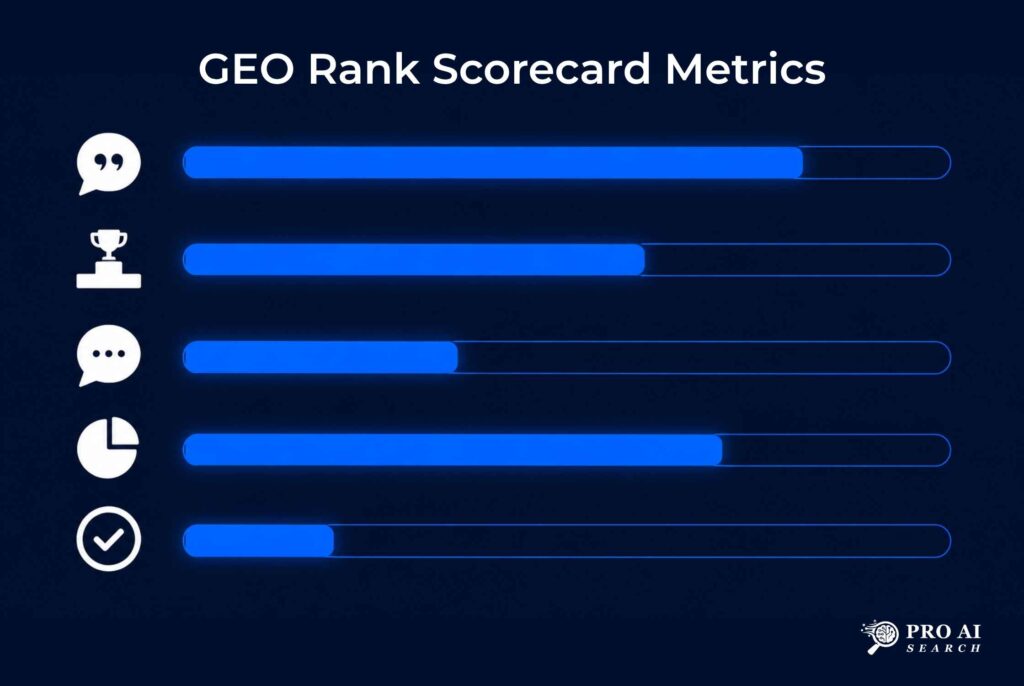
Your GEO Rank Scorecard: 5 Metrics to Track Monthly
Whichever tracking tier you use, these five metrics make up a complete GEO rank scorecard. Review them monthly and compare quarterly to measure whether your AI search optimization strategy is producing compounding results over time.
1. Citation rate. The percentage of your target queries where your site is cited as a source. A reasonable baseline target for a site that is three to six months old: 20 to 35% of tracked queries. For a site with established topical authority on its core subjects: 50% or higher. Track citation rate per platform separately, because ChatGPT and Perplexity have different citation tendencies and indexing behaviors. For context on how different AI platforms behave as traffic sources, see the breakdown in our 2026 AI search data roundup.
2. Citation prominence. Of the queries where you are cited, what percentage of the time are you the first or primary source? A site cited in 30% of queries but always as the third or fourth source is in a weaker position than a site cited in 20% of queries but always as the primary reference. Track as a ratio: primary citations versus secondary citations versus lower-position mentions, and watch whether prominence improves as you publish more authoritative content.
3. Brand mention rate. How often does your brand name appear in AI responses, with or without a URL citation? This metric matters most for tracking Claude and Gemini responses, where attribution practices differ from Perplexity’s more link-heavy citation style. A rising brand mention rate without a corresponding rise in citations often signals that AI systems recognize your brand but are not using your specific URLs as sources.
4. Competitor share of voice. For each target query where you are not cited, which competitor is? Tracking this over 60 to 90 days reveals whether you are consistently losing ground to one specific domain, which helps you prioritize which competitor’s content to analyze and identify what they are doing structurally that you are not. Connect these findings to your answer engine optimization strategy to restructure the underperforming pages.
5. Response accuracy. Does the AI describe your product, service, or expertise correctly? Inaccurate descriptions are a GEO problem that tracking tools do not surface. Manual prompt checks are the only way to catch them reliably. When an AI describes your content category incorrectly or attributes capabilities to your brand that do not exist, it means your pages are not providing clear enough entity definitions for AI systems to extract. This connects directly to the structured data and entity clarity work covered in our guide on making your site accessible to AI crawlers.
Once you have baseline data for all five metrics, a monthly GEO rank report takes under an hour to compile. Add your scorecard data to a simple spreadsheet, flag any metric that moved more than 10 percentage points month over month, and use those movements to prioritize which articles to refresh or expand. For professional-grade tracking and reporting across all these metrics, our AI search optimization services include monthly GEO rank scorecard delivery.
How Often to Check Your AI Search Rankings
AI search results fluctuate on a different cycle from Google organic rankings. A Google ranking shift is typically driven by algorithm updates, link changes, or content recrawls, and positions tend to be relatively stable between major update events. AI search citations change when the underlying model is retrained or updated, when the retrieval pool expands, or when competing content earns new citations that shift the model’s preference signals.
For manual tracking, run your full query set weekly. Dedicate 30 to 45 minutes on the same day each week so data points are directly comparable. Weekly data catches sudden drops after model updates quickly enough to diagnose the cause while it is still recent. For mid-tier tool tracking, review our guide to the best GEO tracking platforms to compare automated query frequency options by tool, then set queries to run weekly and review dashboards monthly. Most meaningful GEO trends are visible at the monthly level. Weekly data is most useful for spotting acute drops immediately after a model update event.
Several trigger events warrant an immediate re-check of all priority queries outside your normal schedule: an OpenAI model update (new GPT version), a Google AI Overviews algorithm change, a major Perplexity index refresh announcement, or the publication of a major competitor piece targeting your core queries. Any of these can shift citation patterns within 48 to 72 hours. Building your LLM SEO technical foundation correctly reduces how much a single model update can move your citation rates, because sites with strong entity clarity and structured content tend to be more stable across model versions.
For sites in the first 90 days of GEO work, the recommended sequence is: start with Method 1 (manual prompt tracking) and Method 2 (GA4 referral monitoring) simultaneously. Once GA4 shows consistent month-over-month growth in AI referral traffic, that is the signal to upgrade to a Tier 2 tool. The manual tracking data you collected already tells you exactly which queries to set up first in any paid platform, since you have six to twelve weeks of real citation data identifying your highest-priority targets. Your Perplexity ranking strategy and your ChatGPT visibility guide should both inform which queries you prioritize when building your tracked query list.
Frequently Asked Questions
What is GEO location rank tracking?
GEO location rank tracking is the process of monitoring how often and how prominently your website is cited in AI-generated answers from platforms like ChatGPT, Perplexity, and Google AI Overviews. Unlike traditional rank tracking, which measures your numbered position on a search results page, GEO rank tracking measures citation rate (cited or not), citation prominence (primary versus secondary source), and brand mention frequency across AI responses. The term “location” in GEO rank tracking refers to your visibility position within AI-generated content, not geographic location.
Can I track AI search rankings for free?
Yes. The most effective free method is manual prompt-based tracking: run your 15 to 20 target queries in ChatGPT and Perplexity weekly and log whether you are cited, at what citation position, and which competitor appeared instead. Combined with GA4 referral traffic monitoring, this gives you a complete free tracking setup that paid tools replicate with automation. Most sites should run this free setup for at least 60 days before evaluating whether a paid tool adds enough additional insight to justify the cost.
Which tool is best for tracking Perplexity rankings specifically?
SE Ranking’s AI Tracker and Otterly.ai both monitor Perplexity citations specifically. For teams focused on Perplexity as their primary tracking target, Otterly.ai’s brand mention monitoring gives you the most granular Perplexity-specific data, including how Perplexity describes your brand in responses where it mentions you without citing your URL. For the underlying optimization work that improves your Perplexity citation rate, see our guide to ranking in Perplexity AI.
How often should I check my AI search rankings?
Check weekly if tracking manually (30 to 45 minutes per session) and review monthly dashboards if using a paid tool. Key trigger events, including OpenAI model updates, Google AI Overviews algorithm changes, and major Perplexity index refreshes, warrant an immediate re-check of all priority queries since these can shift citation patterns within 48 to 72 hours of going live. Set a calendar reminder to run a full manual audit within two days of any confirmed model update announcement.
How is AI rank tracking different from traditional SEO rank tracking?
Traditional rank tracking measures a numbered position on a search results page and reports whether that number went up or down. AI rank tracking measures citation rate (cited or not), citation prominence (primary versus secondary source), brand mention frequency, and competitor share of voice in AI-generated answers. There are no positions 1 to 10 in AI search responses. Tools like SE Ranking and Surfer now offer both traditional and AI tracking in one platform, but the metrics they report for each are fundamentally different and should be reviewed separately rather than combined into a single performance view.