
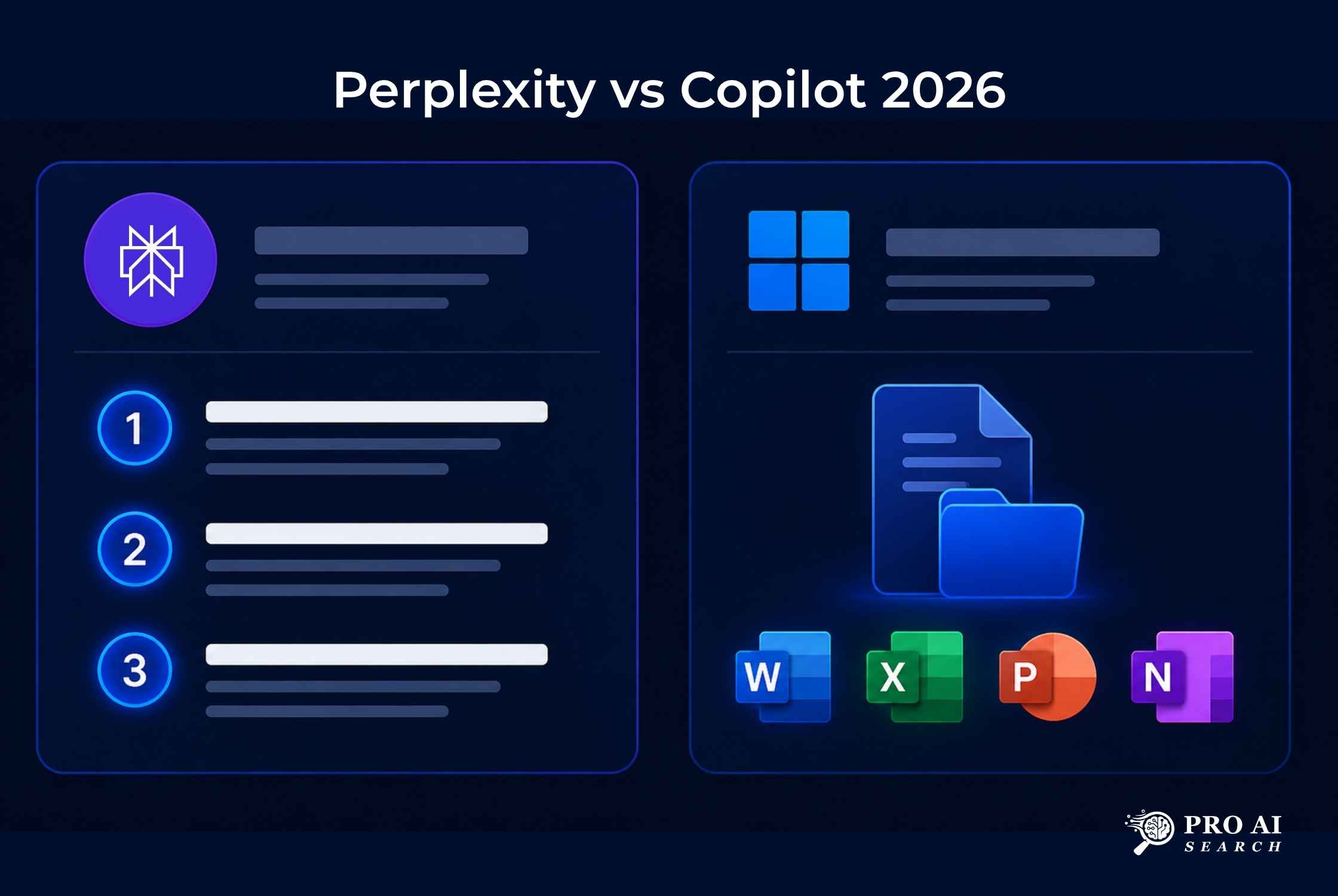
The perplexity vs copilot debate comes down to a single question: do you want an AI built to search the live web with numbered citations, or one built to automate work inside the apps you already use? Both platforms retrieve real-time information, both use capable AI models, and both are relevant to anyone building an AI search optimization strategy. But they run on different search indices, serve different workflows, and require different approaches to earn citations in each one.
This comparison covers citation quality, accuracy data, India pricing, and the angle most articles miss: which platform matters more when you want your own content to appear in AI-generated answers.
Perplexity vs Copilot: Quick Comparison
Here is the full side-by-side before going into detail on each area.
| Feature | Perplexity | Microsoft Copilot |
|---|---|---|
| Search Index | Own (PerplexityBot) | Bing (Bingbot) |
| Citation Style | Numbered inline per claim | Source list appended at end |
| Answer Success Rate | 99.95% (1,999 / 2,000 queries) | 72.6% (1,452 / 2,000 queries) |
| Free Plan | 5 Pro searches/day | Unlimited, no account needed |
| India Pro Cost | ~₹1,670/month | Free |
| AI Models | Perplexity models, GPT-4o, Claude | GPT-4o, Microsoft Prometheus |
| Microsoft 365 Integration | None | Full (Teams, Word, Outlook) |
| Best For | Research, fact-checking, citations | Microsoft 365 workflows, free search |
How Each Platform Crawls and Indexes the Web
Perplexity uses its own proprietary crawler called PerplexityBot to build a dedicated research-focused index. Microsoft Copilot runs entirely on Bing’s index via Bingbot, the same crawler that drives Bing organic search results. These are two separate indices with no overlap, which means a site can be well-cited in one and invisible in the other.
This matters for your GEO strategy for a specific reason. If your robots.txt blocks PerplexityBot, Perplexity cannot cite your content regardless of your Google or Bing rankings. If you block Bingbot, you lose both Bing organic traffic and Copilot citations simultaneously because they share one crawler. Our technical guide on whether AI can read your website covers the correct robots.txt configuration for each platform.
The correct setup to allow both crawlers is:
User-agent: Bingbot Allow: / Perplexity’s crawler prioritizes sources with clear authorship, verifiable inline citations in the content itself, and pages that other Perplexity-cited sources link to. Bing’s crawler follows standard web authority signals: backlinks, E-E-A-T signals, structured data, and page speed. Earning citations in each platform requires different on-page signals because the indices are built by different crawlers with different ranking priorities. This is the single most important technical difference that most Perplexity vs Copilot comparisons skip entirely.
Citation Quality: How Perplexity vs Copilot Show Their Sources
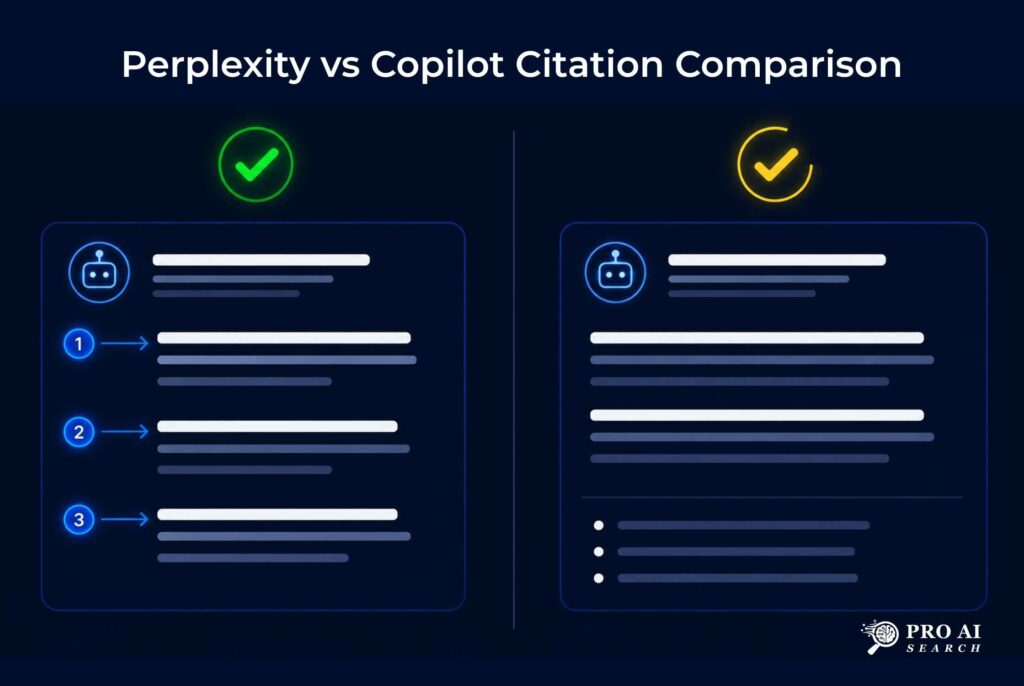
Perplexity’s citation system maps numbered references to specific claims within the answer. Every sentence that uses a sourced fact carries a clickable superscript number pointing to the original article. This makes it fast to verify individual claims without reading the entire source. For journalists, SEOs, and research-heavy content creators, this is a meaningful workflow advantage over tools that give you a source list without claim-level attribution.
Copilot appends its sources as a list at the end of the response. The answer synthesizes information from multiple sources, but individual claims are not mapped to individual sources. You get the overall picture quickly, but tracing a specific statistic or fact back to its original article requires manually checking each source. For most everyday queries, this is fine. For fact-heavy research where accuracy and attribution matter, Perplexity’s inline system is more practical.
A 2024 SE Ranking study analyzing 2,000 queries across major AI platforms found Perplexity answered 1,999 queries successfully, a 99.95% answer rate. Copilot answered 1,452 of the same queries, a 72.6% rate. The gap is partly intentional: Microsoft’s safety guardrails cause Copilot to decline ambiguous or borderline queries more frequently than Perplexity. For users tracking information across dozens of keywords or research topics, Perplexity’s higher completion rate means fewer gaps in the data.
Free Tier and India Pricing
For Indian users, Microsoft Copilot is the stronger free option and it is not close. Copilot at copilot.microsoft.com is completely free with no daily limit and no account required. Perplexity’s free plan caps Pro searches at five per day, which is sufficient for light use but quickly becomes a ceiling for anyone relying on AI search as a daily research tool.
| Plan | Perplexity | Microsoft Copilot |
|---|---|---|
| Free | 5 Pro searches/day | Unlimited searches, no account needed |
| Individual Pro | ~₹1,670/month | Free (Pro features not paywalled for individuals) |
| Enterprise | ~₹3,340/user/month | ~₹2,500/user/month + requires M365 base license |
Perplexity Pro at approximately ₹1,670/month (billed in USD at $20) adds unlimited AI searches with access to multiple underlying models including GPT-4o, Claude, and Llama 3. For heavy research users who hit the daily cap consistently, the Pro upgrade is justified. For casual research needs, Copilot’s free unlimited access handles the same queries at no cost. Perplexity’s Pro also enables file uploads and deeper research modes, which Copilot’s free tier does not match.
For enterprise teams, Copilot for Microsoft 365 is priced at approximately $30 per user per month, but this requires an existing Microsoft 365 subscription. Indian organizations already paying for Teams and Outlook typically find the Copilot add-on cost acceptable because it integrates directly into tools they are already using daily. Perplexity Enterprise at $40/user/month is an additional standalone cost with no Microsoft 365 integration.
Use Cases: When to Choose Perplexity vs Copilot
Choose Perplexity for research and fact-checking. Perplexity’s numbered inline citations, 99.95% answer rate, and Focus modes (Academic, Reddit, YouTube, and more) make it the better choice when accuracy and source traceability matter. The Focus modes let you point Perplexity’s search at specific parts of the internet: academic papers only, Reddit discussions only, or news sources only. This level of source filtering is not available in Copilot’s standard interface. Our guide to ranking in Perplexity explains how Perplexity’s citations work and what signals it responds to when choosing which sources to cite.
Choose Copilot for Microsoft 365 workflows. Copilot’s exclusive advantage is access to your internal documents. It can read Teams meeting transcripts, summarize SharePoint files, and draft emails in Outlook using context from your own organization’s data. Perplexity searches the public web only and has no visibility into your internal files. Any workflow that requires summarizing, drafting, or acting on internal company information belongs in Copilot, not Perplexity.
For content marketers and SEOs. Perplexity is the faster research tool for writing data-backed content briefs because its sourced answers can be used directly as evidence without additional verification steps. Copilot is better for drafting and editing within Word or publishing workflows tied to SharePoint. The two tools complement each other rather than competing when used in a well-structured AI search workflow.
Which Platform Matters More for GEO?
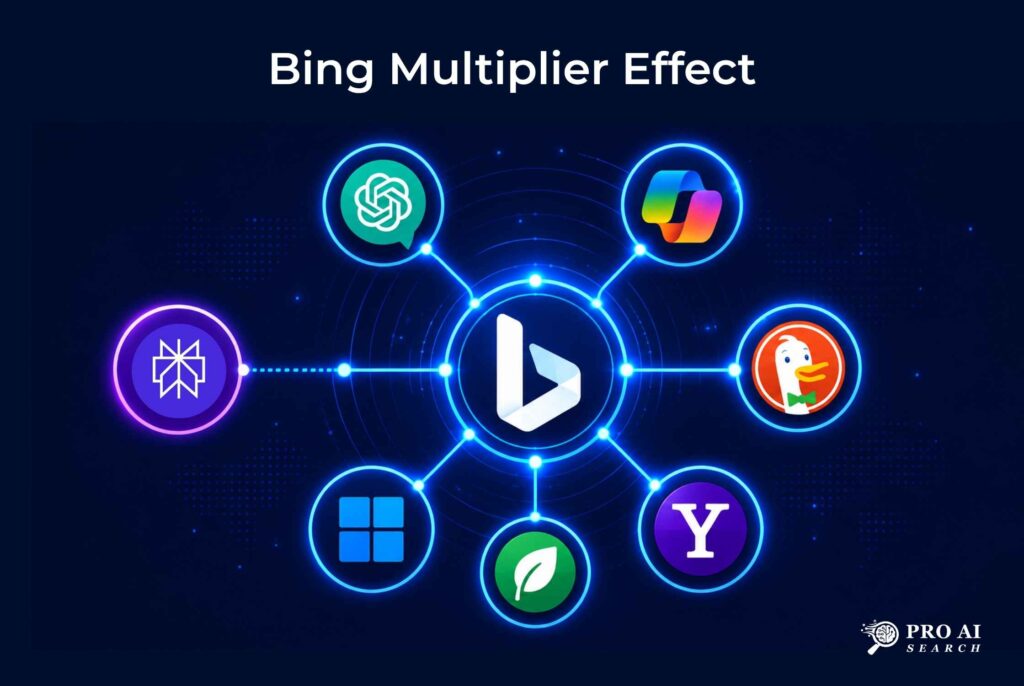
Optimizing for Copilot has a higher citation ceiling because of what we call the Bing Multiplier. Copilot runs on Bing’s index. When you earn strong Bing signals through on-page SEO, structured data, and E-E-A-T, you simultaneously increase your citation probability across six AI-powered surfaces: Microsoft Copilot, ChatGPT Search, DuckDuckGo AI, Yahoo AI features, Ecosia, and Windows 11 built-in AI search. One optimization effort reaching six citation surfaces is a significant leverage point compared to Perplexity, which is a single platform with its own separate index.
Perplexity reaches a smaller but higher-intent audience. Perplexity’s users skew toward researchers, journalists, and professionals actively seeking sourced information on specific topics. According to 2026 AI search statistics, Perplexity holds approximately 5.8% of AI search market share globally, with India as its largest traffic market by country. This audience engages more deeply with cited sources and is more likely to click through to original articles than the broader ChatGPT or Copilot user base. Being cited by Perplexity often drives higher-quality referral traffic per citation than a Bing or ChatGPT citation of the same content.
The practical GEO priority order for most sites: optimize for Bing first (because it covers Copilot plus ChatGPT Search in one effort), then layer in Perplexity-specific signals. For Perplexity specifically, the key additional signals are: allowing PerplexityBot explicitly in robots.txt, publishing content that itself cites primary sources inline, and building entity recognition through consistent structured data. Our full LLM SEO guide covers the technical implementation for both Bingbot and PerplexityBot in parallel.
To understand how ChatGPT Search relates to this, see our ChatGPT ranking guide, which explains the Bing index connection and what additional signals ChatGPT Search uses beyond standard Bing optimization. The GEO vs SEO breakdown covers why standard search optimization and AI search optimization require different content structures even when they share the same underlying index.
The Verdict: Perplexity vs Copilot
Perplexity is the better tool for research, fact-checking, and any workflow that depends on verifiable cited answers from the live web. If your primary use case is gathering sourced information quickly, whether for content briefs, journalism, academic research, or competitive analysis, Perplexity’s inline citation system and 99.95% answer completion rate make it the stronger choice.
Copilot is the better tool for Microsoft 365 users and for anyone in India who needs a completely free unlimited AI search option. Its ability to work inside Teams, Outlook, and Word with access to your internal documents gives it capabilities Perplexity simply does not have. For enterprise teams already paying for Microsoft 365, Copilot represents better value per seat because the integration adds productivity that a standalone Perplexity subscription cannot replicate.
For AI search optimization: run both in your GEO strategy, but start with Bing because its Multiplier effect is larger. Add Perplexity-specific optimization as the second layer. The complete AEO guide walks through how to structure content for both platforms in parallel, and our AI search optimization services cover done-for-you implementation if you want both indices covered from the start.
Frequently Asked Questions: Perplexity vs Microsoft Copilot
Is Perplexity better than Microsoft Copilot for research?
Yes, for most research tasks, Perplexity is the better tool. Its numbered inline citations map every claim to a specific source, making verification faster. Its answer success rate of 99.95% across a 2,000-query study outperforms Copilot’s 72.6% rate. For research that requires accurate, traceable sourcing, Perplexity’s purpose-built research interface is more reliable than Copilot’s general-purpose approach. For businesses evaluating Perplexity against other AI search tools beyond Copilot, our tested guide to the best Perplexity alternatives ranks ChatGPT, Gemini, and Grok by use case.
Can I use Microsoft Copilot for free in India?
Yes. Microsoft Copilot at copilot.microsoft.com is completely free with unlimited searches and no account required. It works in India without any restrictions, VPN requirements, or regional limitations. Perplexity’s free plan is available in India as well, but caps Pro searches at five per day, which makes Copilot the stronger free option for users who need unrestricted daily search access.
Do Perplexity and Copilot use the same search index?
No. Perplexity uses its own proprietary index built by PerplexityBot, a crawler it operates independently. Microsoft Copilot runs on Bing’s index via Bingbot. These are separate indices with no shared data. A page that ranks well on Bing may still be absent from Perplexity’s index if PerplexityBot has not crawled it, and vice versa. This means AI search optimization for the two platforms requires separate crawl permissions and different on-page signals.
Which platform should content marketers prioritize for GEO?
Start with Bing optimization, which covers Microsoft Copilot and also extends to ChatGPT Search, DuckDuckGo AI, Yahoo AI features, Ecosia, and Windows 11 AI search through the Bing Multiplier. This gives you six AI citation surfaces from one optimization effort. Add Perplexity-specific signals second: allow PerplexityBot in robots.txt, publish content with inline citations, and build entity authority. Perplexity’s audience is smaller but higher-intent, so citations there drive better referral quality per click. For the step-by-step Copilot ranking approach, our how to rank in Microsoft Copilot guide covers the Bing optimization factors that drive Copilot appearances.
Does Copilot have better Microsoft 365 integration than Perplexity?
Yes, completely. Microsoft Copilot integrates natively into Teams, Word, Outlook, Excel, and SharePoint. It can summarize meetings, draft emails, and pull context from your internal documents. Perplexity has no integration with Microsoft 365 applications and no access to internal company data. For teams whose daily work happens inside Microsoft’s ecosystem, Copilot’s integration capability is a decisive advantage that Perplexity cannot match.