
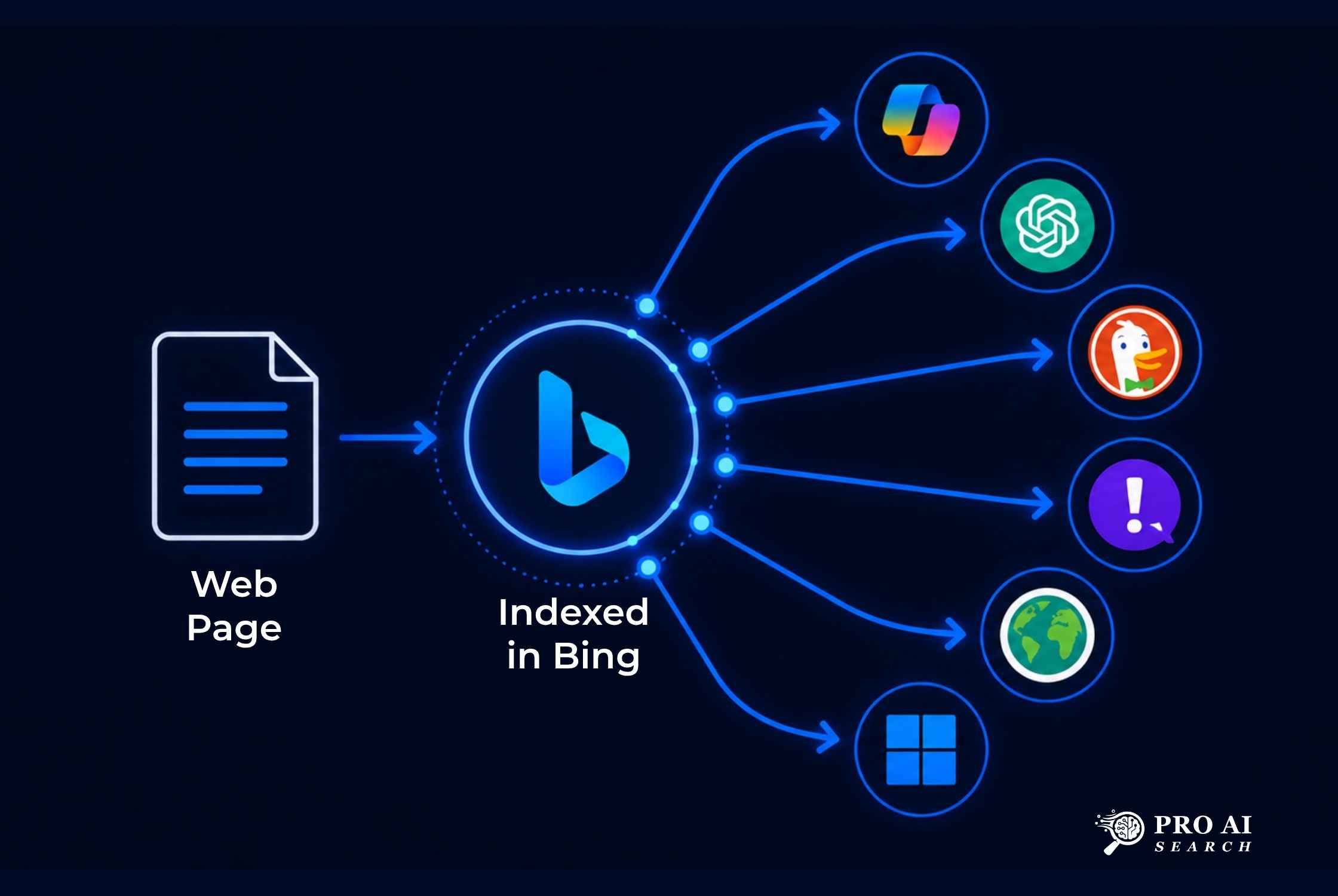
Learning how to rank in Microsoft Copilot starts with one fact most brands overlook: Copilot does not have its own crawler. It pulls directly from Bing’s search index, which means every step that earns you a Bing ranking also makes you eligible for Copilot citations. Microsoft Copilot reached 89 million weekly active users as of March 2026, according to Microsoft Q3 FY26 earnings data, with the largest enterprise footprint of any AI assistant, embedded across Windows 11, Microsoft 365, Edge, Bing, and GitHub. For businesses selling to enterprise buyers in India and globally, Copilot is the AI surface where your decision-makers spend their workday. This guide covers every step required to earn citations there.
How Microsoft Copilot Finds and Cites Your Content
Microsoft Copilot operates on the Prometheus architecture: Bing’s index is queried first to retrieve candidate pages, then GPT reads those pages and writes a cited answer. This is retrieval-augmented generation, not recall from training data. Copilot retrieves fresh content from Bing in real time with every query. Winston Digital’s Copilot optimization guide describes this as two gates: rank in Bing first, then be the clearest liftable answer on the page. Understanding how AI search engines retrieve and rank sources at a technical level makes this process clearer.
Citation eligibility follows that strict two-gate process. Gate 1: your page must be indexed and ranking in Bing for the query. If you are not in the candidate pool, you cannot be cited regardless of how good your content is. Gate 2: your page must be the clearest, most liftable answer once the model reads it. Failing Gate 1 makes Gate 2 irrelevant entirely.
The reach behind this architecture is considerable. Microsoft’s announcement of the new Bing established the foundation: combining search with large language models that synthesize cited answers from the web. Copilot now surfaces across more than 400 million Microsoft 365 users, 300 million Edge browser users, and approximately 1 billion Windows devices. Copilot queries skew heavily enterprise: IT decision-makers, finance teams, and procurement managers researching vendors inside Microsoft tools during working hours. This is a meaningfully different audience from ChatGPT’s broader consumer base, and the content strategy for each platform reflects that difference.
The Bing Multiplier: One Optimization, Six AI Surfaces
Bing does not power only Microsoft Copilot. It is the search backbone for ChatGPT Search, DuckDuckGo, Yahoo Search, Ecosia, and the Windows 11 taskbar search simultaneously. When you optimize a page to rank and earn citations in Bing, you become eligible for all six surfaces from a single piece of work. No other AI platform index offers this multiplier effect.
This is the most undervalued opportunity in AI search optimization today. Most brands pour resources into Google and treat Bing as an afterthought, so competition for Bing citations is a fraction of what it is on Google. CapstonAI’s Q1 2026 cohort of 86 customers saw a +234% Copilot citation rate after implementing Bing-first optimization, alongside measurable B2B inbound from enterprise buyers who discovered them through Copilot responses. The GEO content strategy framework addresses all AI platforms, but Bing work compounds across more surfaces than optimization for any other single index.
Gartner predicts traditional search engine volume will drop 25% by 2026 as AI assistants absorb more queries. Businesses that earn Copilot and ChatGPT citations from a single Bing-optimized content base now will be difficult to displace as that shift accelerates.
Gate 1: Win Bing’s Index First
Getting into Bing’s index requires three specific steps most sites skip because they assume Google optimization carries over. It does not.
Set Up Bing Webmaster Tools
Verify your site at bing.com/webmasters, submit your XML sitemap, and import settings directly from Google Search Console with one click. Monitor crawl errors, check indexed page counts, and use the URL inspection tool to confirm that priority pages are reachable by Bing’s crawler. This is the foundational step for Copilot optimization, and the one most brands skip entirely.
Implement IndexNow
IndexNow is a protocol that notifies Bing the moment a page is published or updated, rather than waiting for a crawl cycle. Bing crawls smaller sites less aggressively than Google, so without IndexNow, new content can sit unindexed for days or weeks before entering the Copilot candidate pool. CapstonAI’s cohort tests found IndexNow-submitted URLs appeared in Copilot citations 4 to 7 times faster than non-submitted URLs. On WordPress, enable IndexNow through Rank Math’s built-in integration or install a dedicated IndexNow plugin. Setup is a one-time job, and every future publish triggers an automatic Bing ping.
Confirm Bingbot Can Access Your Content
Server-render critical content so it loads in the initial HTML response. Bingbot does not reliably execute JavaScript, so content loaded dynamically or hidden behind accordions, tab switches, or scroll-triggered reveals will not be indexed. Review your robots.txt configuration for AI crawlers to ensure Bingbot is not accidentally blocked. Cloudflare Bot Fight Mode is the most common cause of silent AI crawler blocking: it blocks legitimate AI user-agents by default, with no notification sent to the site owner. Disabling it takes under one minute in your Cloudflare dashboard.
Gate 2: Structure Content So Copilot Can Cite It
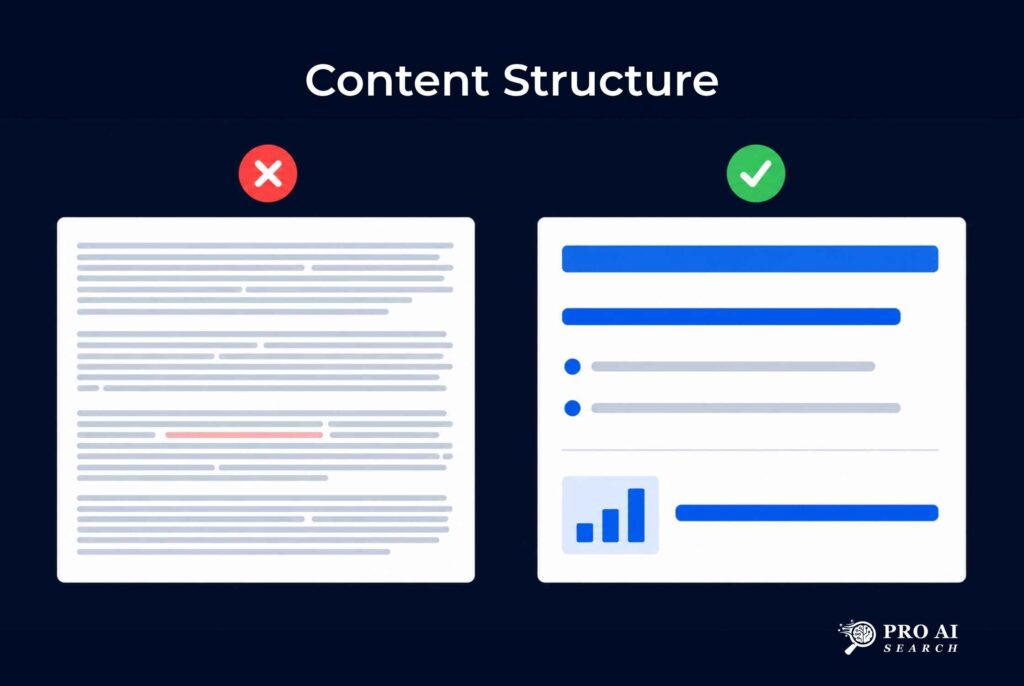
Once you are in the candidate pool, Copilot’s GPT model reads your pages and decides which passages to quote. Content structure determines whether your page gets cited or passed over for a competitor’s.
Lead with the direct answer. Every H2 section must open with a complete response in the first one to two sentences. Microsoft’s official AI content guidelines, published October 2025 by Principal Product Manager Krishna Madhavan, state that AI systems parse content into chunks and evaluate each chunk independently for relevance and trustworthiness. Sections that bury the answer in paragraph three rarely get cited. The full approach to answer-first writing is in our complete AEO strategy guide.
Keep sections tight. Each H2 should cover one question in approximately 100 to 150 words. This chunk size lets Copilot extract a self-contained answer from a single section without combining fragments from multiple locations on the page.
Use specific, verifiable claims. Microsoft’s guidelines are explicit: vague language like “world-class” or “industry-leading” provides nothing for AI to cite. Measurable, specific statements, “reduces deployment time by 40%”, “supports 99.9% uptime SLA”, “integrates natively with Microsoft Teams”, are what Copilot quotes and attributes. Generic claims get skipped in favour of competitors who use concrete numbers. The broader framework for structured content that boosts AI citations covers this principle across all platforms.
Keep content out of JavaScript. Any information behind a click, accordion toggle, tab switch, or scroll-triggered reveal is invisible to Bingbot. Critical facts, pricing, FAQs, and specifications must load in the initial HTML. The 30-point technical GEO audit checklist covers the full range of access issues that block AI citation across Copilot and every other platform.
Schema Markup Priorities for Microsoft Copilot
Schema markup does not guarantee Copilot will cite you, but it removes ambiguity about what your entity is and what each page covers. Ambiguity causes candidate pages to be dropped at the citation selection stage. A well-connected schema graph gives both Bing’s index and the GPT model precise entity context for every claim you make. Our research on whether rich snippets actually move AI citation rates has the cross-platform data.
Bing is stricter than Google on schema validation. Errors that Google silently ignores cause Bing to skip your markup entirely. Always validate using Bing’s Markup Validator, not just Google’s Rich Results Test. If your schema is invalid in Bing’s system, it does not exist for Copilot citation purposes.
The minimum schema stack for pages targeting Copilot citations: Organization (with a stable @id linking to your homepage and sameAs references to LinkedIn, Crunchbase, or Wikidata), BreadcrumbList, and FAQPage on any page with genuine question-and-answer content. For content pages, add Article with Person author markup. For product or service pages, add Product or Service schema with specific pricing or offering details. All markup should be JSON-LD, embedded inline in the page head. LLMRefs’ breakdown of Microsoft’s official AI content guidelines confirms that schema is one of the four core practices Microsoft recommends for AI search inclusion. The LLM SEO technical guide covers schema implementation step by step, including Rank Math configuration for WordPress sites.
The LinkedIn Signal: Copilot’s Exclusive Authority Layer
Microsoft owns LinkedIn, and that ownership creates a Copilot-specific citation signal that no other AI platform has. LinkedIn Company Page activity, employee posts mentioning your brand, and brand references in LinkedIn articles feed directly into Copilot’s entity recognition graph for B2B queries. This is the natural result of Microsoft’s data integration across its owned platforms, and it is a meaningful differentiator from how traditional search engines evaluate authority.
In practice: an active LinkedIn Company Page with consistent weekly posts signals to Copilot that your brand is a current, credible entity in your space. CapstonAI’s case study data shows one customer growing LinkedIn followers from 1,240 to 3,670 between Q4 2025 and Q1 2026, alongside Copilot citations increasing from 2 to 18 across a 30-query tracked prompt panel. The correlation between Company Page activity and B2B Copilot citation growth is measurable and reproducible.
ChatGPT, Perplexity, and Google AI Overviews do not draw on LinkedIn signals in the same way. If your business sells to enterprise buyers, LinkedIn optimization is not a social media task. It is a Copilot citation task. Target 50 or more employee posts per month mentioning your products, use cases, or expertise areas. Make your Company Page description accurate and keyword-specific for your enterprise category. The signal compounds over time.
Enterprise Queries: What Copilot Users Actually Search For
Copilot’s audience skews toward enterprise IT decision-makers, finance teams, operations, and procurement. This follows directly from Copilot being embedded in Microsoft 365, which 90% of Fortune 500 companies use. When these professionals research vendors in Copilot, they are not asking broad awareness questions. They are asking queries like:
- “Vendor risk assessment for [vendor name]”
- “[Product name] SOC 2 compliance documentation”
- “[Brand A] vs [Brand B] for enterprise data management”
- “[Vendor] total cost of ownership analysis for mid-market teams”
- “[Product] Microsoft Teams integration architecture”
Generic awareness content underperforms for these queries. Content that addresses enterprise-specific concerns, security certifications, compliance documentation, integration architecture, SLA terms, and procurement requirements, earns Copilot citations because it answers exactly what these buyers are researching. Stridec’s Copilot platform research found that pages with clear entity definitions and enterprise-specific structured information consistently outperform higher-authority domains that lack semantic precision for these query types. See our 2026 AI search statistics roundup for data on enterprise AI search adoption patterns and how query types differ across platforms.
For Indian businesses, this is a direct opportunity. Indian IT and procurement teams inside global companies use Microsoft 365 daily, which means Copilot is already in the workflow of buyers evaluating Indian software vendors. The AI search optimization guide for Indian SMBs covers the India-specific content approach, and our guide for Indian B2B startups addresses early-stage companies building Copilot presence before competitors do. The ChatGPT usage data for India shows how rapidly AI adoption is growing among the same enterprise audience Copilot serves.
How to Track Your Copilot Citations
Microsoft launched the AI Performance report inside Bing Webmaster Tools in February 2026, making it the first major AI search provider to offer publishers direct data on how their content is used by an AI system. This report is now the primary measurement tool for Copilot optimization.
The report introduces two metrics that change how you think about Copilot performance:
Grounding Queries are the internal search queries Copilot generates when formulating an answer. These are not the user’s original prompt. They are the reformulated queries Copilot runs against Bing’s index to find relevant source pages. Knowing which grounding queries pull content from your site tells you exactly what topics Copilot associates your brand with, and where to invest content next.
Website Citations are the visible attributions that appear in Copilot’s response to the user. This is the metric most people track, but it represents only a fraction of total AI influence. OtterlyAI’s analysis of their own Bing Webmaster Tools data from November 2025 through February 2026 found 30,398 total grounding events but only 169 visible citations: 99.6% of their Copilot content influence was invisible. Being grounded (used to inform an answer) and being cited (publicly attributed) are different things. Both are now measurable and both matter strategically.
Supplement the Bing Webmaster Tools data with a manual prompt panel: build 25 to 50 questions your target buyers ask Copilot, test them weekly, and log when competitors appear instead of you. Those prompts become your immediate content priority list. For tracking AI referral traffic across all platforms, the guide to setting up GA4 for AI search traffic covers the full configuration. The best GEO tools in 2026 includes platforms that track Copilot citations automatically without manual testing.
Copilot vs ChatGPT vs Perplexity vs Google AI Overviews
Each AI platform uses different signals to select citations. Understanding where Copilot differs from the other platforms helps you allocate optimization effort correctly. For a direct head-to-head between Copilot and its closest rival in the AI search space, our Perplexity vs Copilot head-to-head compares both platforms across citation rates, audience profile, and optimization strategy.
| Platform | Primary Index | Unique Signal | Best For |
|---|---|---|---|
| Microsoft Copilot | Bing | LinkedIn integration, Microsoft ecosystem | Enterprise B2B buyers |
| ChatGPT Search | Bing + web | Forum and Reddit mentions | Consumer and general research |
| Perplexity | Real-time web | Academic sources, Reddit | Research-focused queries |
| Google AI Overviews | E-E-A-T, Google Business Profile | Consumer and local |
What overlaps across all four: answer-first content structure, accurate schema markup, entity clarity, and authority from credible third-party sources. The Copilot work you do on content structure and schema directly improves your position on every other platform as well. Our guide to how ChatGPT chooses which sources to cite explains the ChatGPT-specific selection factors. For the full breakdown of how GEO, AEO, and LLM SEO map to each platform, the GEO vs AEO vs LLM SEO comparison covers the differences in detail.
For a platform-by-platform checklist covering Copilot alongside all three other major surfaces, the 50-point AI search optimization checklist is the fastest way to audit your current status. Our Perplexity ranking guide and complete GEO framework cover the other primary platforms in the same depth as this guide. For done-for-you implementation across all platforms including Copilot, see our AI search optimization services.
Frequently Asked Questions: How to Rank in Microsoft Copilot
Is Microsoft Copilot the same as Bing Chat?
Bing Chat was rebranded to Microsoft Copilot in late 2023. Copilot was then extended across Microsoft 365, Windows, Edge, GitHub, and Dynamics as Microsoft’s unified AI assistant brand. The web-search variant pulls from Bing’s index, which is the component most relevant to content optimization. GitHub Copilot is a separate code-focused product that shares only the brand name, not the search infrastructure.
Does optimizing for Bing also help my content appear in ChatGPT?
Yes, directly. ChatGPT’s web search feature is Bing-powered, so content that ranks and earns citations in Bing is automatically eligible for ChatGPT Search citations. One Bing optimization effort covers both platforms simultaneously, plus DuckDuckGo, Yahoo, and Ecosia. Our ChatGPT ranking guide covers the additional ChatGPT-specific factors beyond Bing indexing.
What is IndexNow and how do I set it up on WordPress?
IndexNow is a protocol that notifies Bing instantly when you publish or update a page, instead of waiting for a scheduled crawl. On WordPress, enable IndexNow through Rank Math’s settings panel or install a dedicated IndexNow plugin from the WordPress repository. After setup, every page you publish sends an automatic Bing ping. New content enters the Copilot candidate pool in hours rather than days or weeks.
How long before I see Copilot citations after optimization?
Technical fixes like IndexNow and Bing Webmaster Tools setup produce measurable Bing indexing changes within 1 to 2 weeks. Consistent Copilot citation rates across a topic cluster typically take 6 to 12 weeks, depending on your existing Bing authority and content depth. CapstonAI’s Q1 2026 cohort saw an average increase from 2 to 18 Copilot citations across a 30-query prompt panel within one quarter of implementation.
Does Copilot use Google’s search data or only Bing?
Copilot uses only Bing’s index for web retrieval. Google data does not feed into Copilot responses at all. A site ranking number one on Google for a query but absent from Bing’s index will not appear in Copilot’s answer. This is why Bing Webmaster Tools setup is the mandatory first step in any Copilot optimization program. For appearing in Google AI Overviews by comparison, Google’s own index and E-E-A-T signals are what matter.
Should I optimize for Copilot before or after Google AI Overviews?
The choice depends on your audience. Enterprise B2B businesses selling to companies that run Microsoft 365 should prioritize Copilot, as the content reaches buyers in their active vendor evaluation context. Consumer-facing and local businesses should prioritize Google AI Overviews first. For most Indian businesses with B2B revenue, running both in parallel is practical: the content structure work overlaps entirely, and the Bing-specific technical steps are a one-time setup rather than ongoing maintenance. The AI search optimization roadmap maps out the sequencing across all platforms for different business types.