
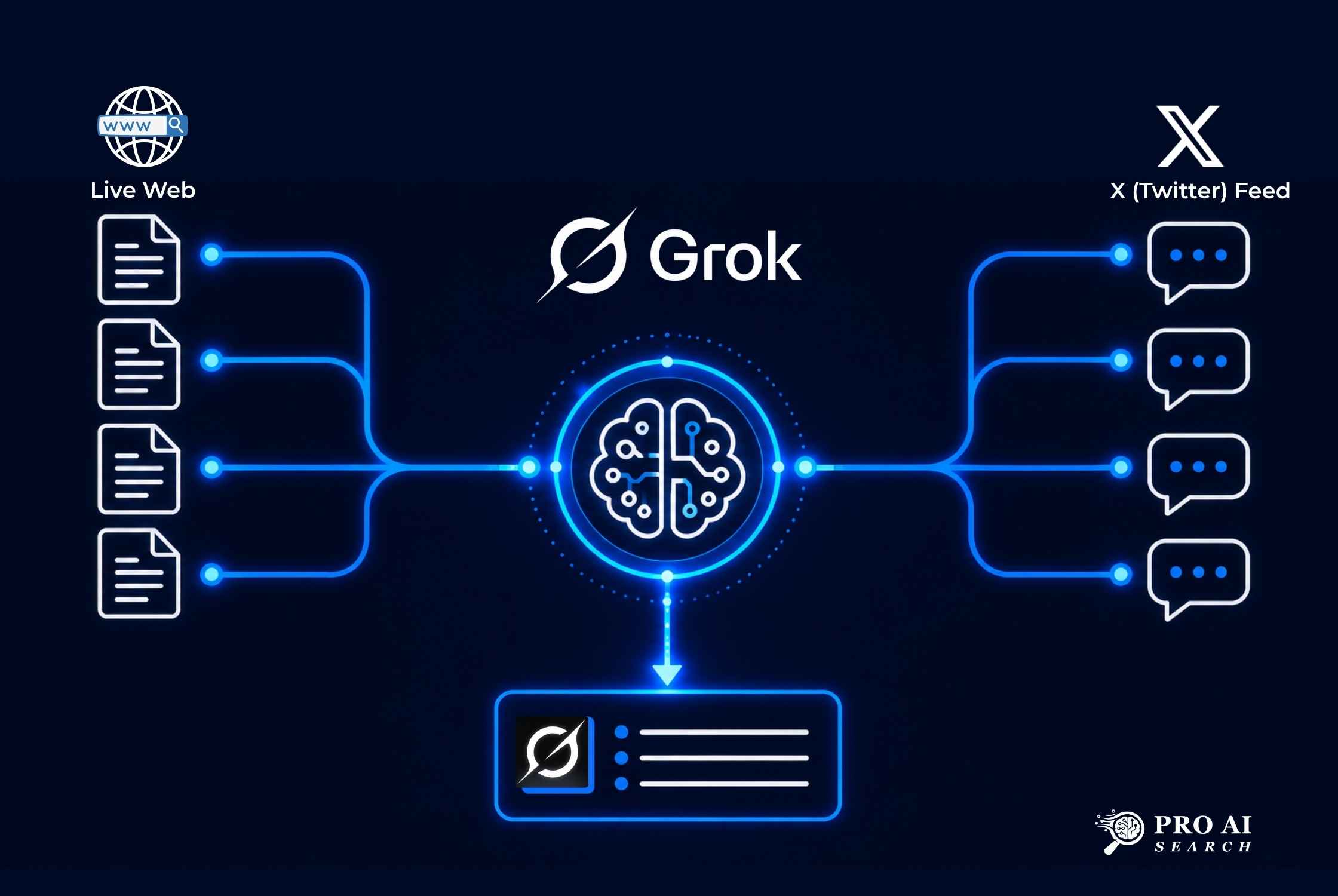
If you want to know how to rank in Grok AI, you need to understand one thing upfront: Grok is not a reskinned version of ChatGPT or Perplexity. It uses two completely separate data sources at the same time, a live web crawl and the real-time X (Twitter) feed, and most guides only talk about one of them.
I ran into this when auditing AI search visibility for LearnQ.ai and VEGA AI earlier this year. Grok was not picking up pages that ranked well everywhere else, and the reason turned out to be the most overlooked technical issue in the space: Grok’s crawler user agents, xAI and Grok, were being silently blocked because neither string contains the word “bot” or “crawler.” Default security setups do not recognize them. The content never got indexed, so it never got cited.
That is just the floor. On top of access, Grok rewards fresh, evidence-backed content and treats X posts as a first-class citation signal in a way no other AI search engine does. Understanding how AI search engines retrieve and rank content across platforms helps frame why Grok requires a different approach than the rest. This guide goes deep on Grok specifically, from the technical setup through the X presence strategy and the DeepSearch optimization layer.
If you are already familiar with the broader GEO framework, see our complete GEO strategy guide for the full picture. For platform comparisons, the guides on how to rank in ChatGPT and how to rank in Perplexity cover those surfaces in the same depth.
Why Grok Works Differently From Other AI Search Engines
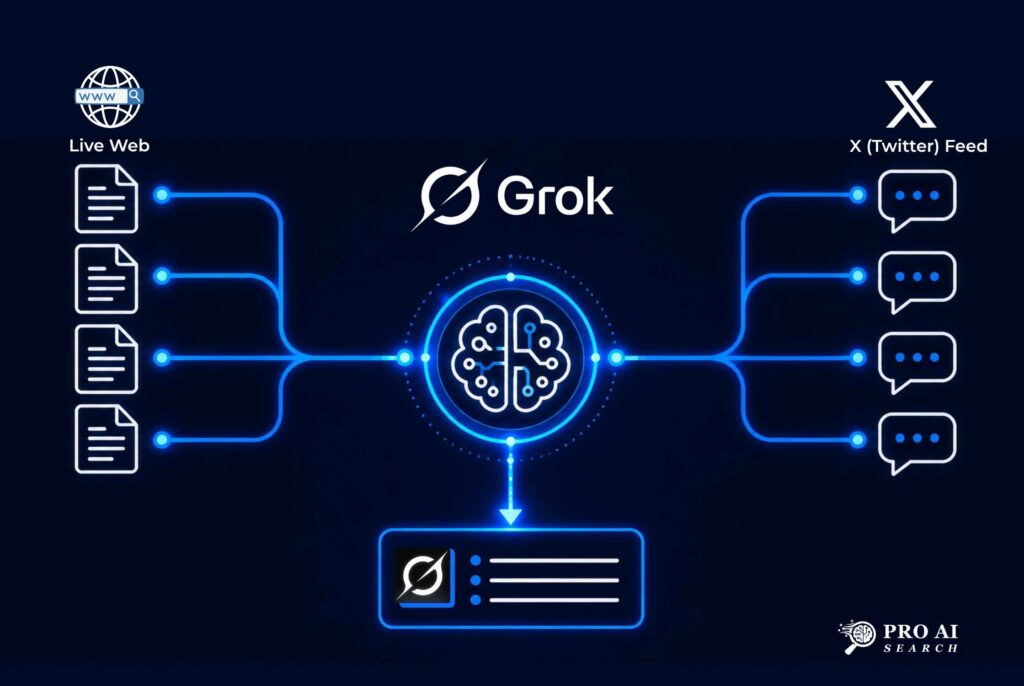
Grok is built by xAI and is natively embedded in X. That integration is not a feature toggle. It gives Grok direct, real-time access to the X firehose, meaning when someone runs a query, Grok does not just search the web. It also scans current X posts and threads on the same topic, simultaneously.
No other major AI search engine has this. ChatGPT retrieves from Bing’s index. Perplexity uses its own web crawler. Neither has a social media firehose as a primary data source. For any brand with an active X presence, this is a structural advantage that does not exist on any other AI platform.
The second key difference is Grok’s DeepSearch mode. On complex queries, Grok does not answer immediately. It formulates a series of sub-queries, retrieves results for each one, evaluates source quality, and iterates before producing a final cited answer. Research questions, “how to” queries, and comparisons typically trigger DeepSearch. This mode is where your content structure matters most, since Grok is essentially deciding which of your pages best answers each sub-question in its internal research chain.
The growth trajectory for Grok is significant. According to TechCrunch, worldwide daily visits jumped from 627,000 to 4.5 million in the week of Grok 3’s release alone. AI search overall grew 42.8% year-over-year from Q1 2025 to Q1 2026, reaching 27.4 billion visits globally. Grok is a growing slice of a rapidly expanding market, and it requires its own optimization strategy. The AI search statistics for 2026 lay out the full platform-by-platform data if you want the broader numbers.
The Technical Fix Most Sites Miss: Allow xAI’s Crawler in Your robots.txt
This is the section none of the top-ranking “how to rank in Grok AI” guides cover, and it is the highest-leverage fix. Before content quality, before X presence, before schema markup, Grok’s crawler has to be able to access your pages. Most sites are blocking it without knowing.
Grok crawls using two user agent strings: xAI and Grok. Neither contains the word “bot,” “crawler,” or “spider.” That is a problem because most robots.txt configurations, WAF rules, and security plugins block agents based on pattern matching for exactly those terms. A request from xAI does not match, so it gets blocked at the server level, no error logged, no indication anything went wrong.
If Grok cannot crawl your site, everything else in this guide is irrelevant. Fix access first.
How to Check and Fix Your robots.txt
Go to yourdomain.com/robots.txt right now and look for User-agent: * with Disallow: /, or any pattern that blocks user agents not explicitly on an allowlist. Add these two directives to allow Grok’s crawler:
User-agent: xAI Allow: /


User-agent: Grok Allow: /
Check Your Cloudflare Settings Too
robots.txt is not the only place Grok gets blocked. If your site runs behind Cloudflare, go to your dashboard, Security, then Bots. If “Block AI Scrapers and Crawlers” is enabled, that toggle blocks unrecognized AI crawlers at the network level, before your server even sees the request. Because xAI and Grok are not in Cloudflare’s built-in bot list, they get caught here.
Also check your Firewall and WAF custom rules for anything targeting non-browser traffic or unknown user agents. Check any security plugins (Wordfence, Sucuri) for bot-blocking rules. Run through all three layers, since a block at any one of them prevents Grok from reading your content regardless of what your robots.txt says.
Step 1: Structure Your Content for Grok’s Extraction Pattern
Once access is confirmed, content structure is the next lever. Grok extracts citable content from your pages, and where that content sits on the page matters. Research published in the 2025 AI Visibility Report by The Digital Bloom, analyzing 680 million citations across platforms, found that 44.2% of AI citations come from the first 30% of page text. If your strongest claim is buried in section five, Grok often never gets to it.
The language pattern matters equally. Definitive statements get cited 36.2% of the time. Hedged, conditional language gets cited 20.3% of the time, according to Kevin Indig’s analysis of 1.2 million search results. Write conclusions as conclusions. “Grok’s crawler user agents are xAI and Grok, not GPTBot” is cited. “Grok may potentially use various user agents depending on context” is not.
The structural elements that Grok extracts most cleanly are short paragraphs (three sentences maximum), H2 and H3 headings phrased as questions, tables for comparisons, and FAQ sections. Tables in particular get extracted at high rates in DeepSearch mode because they answer comparison sub-queries in a single, structured unit. The 50-point AI search optimization checklist covers structural requirements in full alongside the access and schema layers.
Add a Visible Last Updated Date
Grok’s recency weighting is strong. The same Digital Bloom report found that 65% of AI bot traffic targets content published or updated within the past year. Display a “Last updated: [date]” line at the top of every article and refresh your statistics, examples, and dates on a regular schedule. A page updated this week has a measurable advantage over an identical page that has not been touched in 18 months, specifically in Grok’s retrieval. The GEO content strategy framework covers how to build a sustainable update cadence that keeps your key pages fresh across all AI search platforms.
Step 2: Build an X Presence That Feeds Grok’s Dual-Source Signal
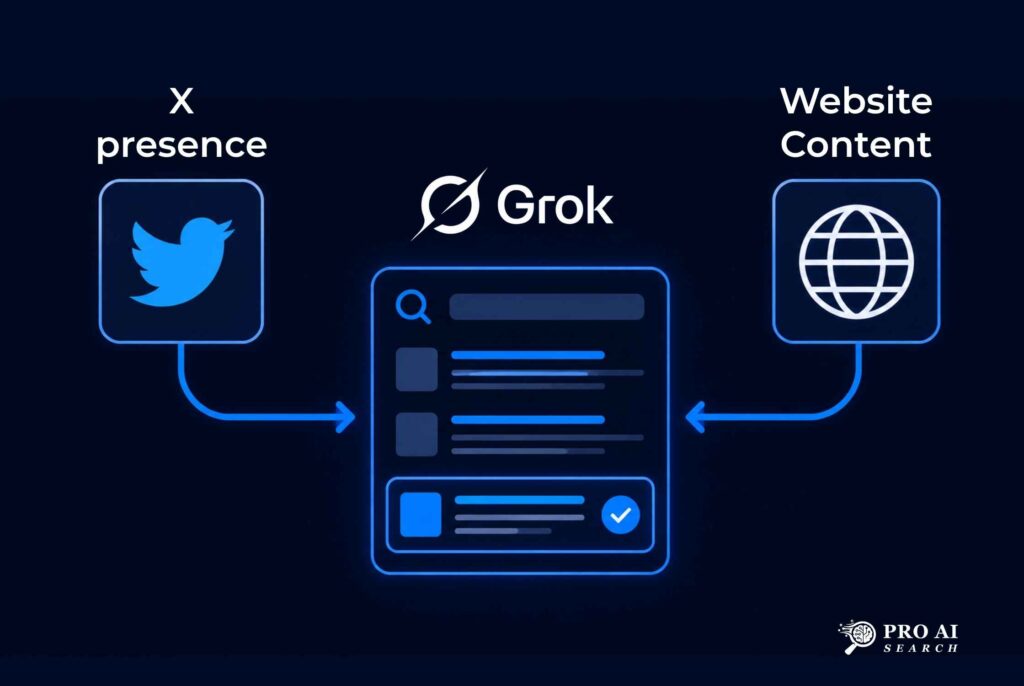
This step is non-negotiable for Grok in a way it simply is not for any other AI search engine. Grok does not just evaluate your website. It checks whether your brand, your claims, and your topical expertise appear in current X posts at the same time as they appear on your pages.
The mechanism works like this: when Grok’s retrieval finds the same brand or claim supported by both a web page and a recent X post from a credible account, it has two independent signals pointing at the same source. That double corroboration increases citation confidence. Without an X presence, you are competing on one signal against brands running two simultaneously. This is the AEO principle of multi-surface authority at its most direct application.
What to Actually Do on X
Posting links to your articles is not enough. Grok needs to see your brand associated with your topic in the actual X conversation, not just linked to from it. Post substantive, declarative takes on your core subjects. “Most sites are blocking Grok’s crawler because xAI and Grok user agents contain no bot signal. Check your robots.txt before doing anything else.” That type of post, paired with a link to the full article, gives Grok two extractable sources.
According to Goodie AI’s analysis of Grok’s algorithm, verified X accounts (Premium subscribers) receive higher priority weighting in retrieval. Engagement signals, including likes, replies, and reshares, also affect how Grok evaluates topical authority for an account. The format matters: threads that open with a clear, direct claim perform better than scattered thoughts.
Consistency builds the topical association. A steady output of accurate, expert posts on your core subject, over weeks and months, creates a strong link between your brand and that subject in Grok’s dual-source retrieval. This is not about posting volume. It is about building a recognizable expert presence on the topics you want to be cited for. For how this fits into a multi-platform AI search strategy, the LLM SEO implementation guide covers cross-platform presence-building in depth.
Step 3: Publish Evidence-Backed, Frequently Updated Content
Grok’s core philosophy is “maximally helpful truth-seeking.” It cites content that makes it easy to extract and verify specific claims. The Digital Bloom AI Visibility Report makes this concrete: adding statistics to a page increases AI visibility by 22%. Adding quotations from named sources increases it by 37%. Both figures come from the Princeton GEO study analyzing 10,000 queries, and they apply across platforms including Grok.
The implication is direct: replace vague claims with specific, sourced numbers. When I restructured pages for LearnQ.ai and VEGA AI, the pattern that consistently moved the needle was replacing benefit statements with measured outcomes tied to real data. “Improves test scores” became “students improved diagnostic scores by X% in 8 weeks.” The more specific and verifiable the claim, the more extractable it is. The AI search statistics article on this site is itself an example of this format at scale, with 60+ sourced data points across AI platforms.
Unlike ChatGPT, which answers many queries from training data, Grok queries the live web on every request. A page updated this week has a direct freshness advantage over the same information on a page last updated a year ago. Keep your most important pages on a regular update cycle, verify that statistics are current, and keep the “Last updated” date accurate. The technical GEO audit checklist includes a freshness check as part of the full site audit so nothing gets overlooked.
Step 4: Optimize for Grok’s DeepSearch Mode
DeepSearch is Grok’s agentic research mode. On complex queries, it does not answer immediately. It formulates a set of sub-queries, retrieves results for each, evaluates them, and iterates. This matters for your content because DeepSearch assembles its answer from multiple pages, each cited for answering a specific sub-question. A single article can supply answers to several sub-queries in one retrieval pass if it is structured to do so.
The practical approach: build articles that answer multiple related sub-questions within a single page. An article on how to rank in Grok AI might generate DeepSearch sub-queries like “what are Grok’s crawler user agents,” “does X presence affect Grok citations,” “how does Grok DeepSearch select sources,” and “how fast does Grok index new content.” If your article answers three of those four clearly and specifically, it will be cited for those three. FAQ sections are the most direct structural match for DeepSearch sub-query format: each H3 question with a direct-answer paragraph is a clean, extractable citation unit.
Comparison tables also perform well in DeepSearch because they answer comparison sub-queries in a single, structured unit. The GEO vs SEO comparison is an example of how a well-structured table can serve as a standalone citable unit across multiple related queries. For a full framework on how to structure content for multi-query extraction, the AI search optimization hub covers the architecture behind high-citation content.
How Grok Compares to ChatGPT, Perplexity, and Claude
Each AI search engine has its own retrieval logic, and the optimization signals that matter on one platform do not automatically transfer to another. Here is how Grok differs from the other major platforms on the factors that determine citation probability, based on platform documentation and the GEO Compass engine profile for Grok:
| Factor | Grok | ChatGPT | Perplexity | Claude |
|---|---|---|---|---|
| Real-time data | Yes (web + X firehose) | Limited (Bing-indexed) | Yes (own index) | Limited |
| X/Twitter integration | Native, first-class signal | None | None | None |
| Agentic research mode | DeepSearch (multi-turn) | Deep Research | Deep Research | Extended thinking |
| Primary crawler user agents | xAI, Grok | ChatGPT-User, OAI-SearchBot | PerplexityBot, Perplexity-User | ClaudeBot |
| Recency weighting | Very high | Moderate | High | Low to moderate |
| Social signals | Direct (X posts) | Indirect (via Bing) | None | None |
The critical insight from this table: Grok is the only major AI search engine where your social media presence directly and materially affects citation probability. For a full breakdown of what the differences between AI search and traditional search mean for your content strategy, the AI search vs traditional search guide covers the structural shifts. To optimize across multiple platforms simultaneously, the AI SEO framework covers the multi-platform strategy layer.
If Claude is the platform you want to prioritize, our how to get cited by Claude AI guide covers the content and entity signals that differ significantly from Grok’s X-native retrieval model.
Step 5: Track Whether Grok Is Actually Citing You
Grok citations fluctuate based on content freshness, X post activity, and how DeepSearch runs at the moment of a specific query. This is not a set-and-forget surface. Tracking needs to be regular and iterative, not monthly.
The manual method takes five minutes weekly. Open Grok at grok.com, run your 10 to 15 most important queries, and log: whether your brand appears in citations, where in the response it appears (first citation, supporting citation, mentioned but not linked), and what competitors are cited for instead. Track changes over four-week rolling periods. This gives you a baseline and makes it possible to see whether a page update or new X posts moved your visibility on a specific query.
In GA4, go to Reports, then Acquisition, then Traffic Acquisition. Look for grok.com in your referral sources. If you are being cited with linked results, you will see direct referral clicks. Set up a custom channel grouping that captures grok.com, chatgpt.com, perplexity.ai, and gemini.google.com together as an AI referral channel. The step-by-step setup is in the GA4 AI search tracking guide, which covers the full configuration including traffic annotations.
One insight that changed how I approach multi-platform tracking: citation overlap between AI engines is far lower than most assume. The Digital Bloom AI Visibility Report found that only 11% of domains are cited by both ChatGPT and Perplexity. Grok adds a third distinct surface with its own sourcing logic. Strong ChatGPT visibility does not transfer to Grok automatically. Test each platform separately, find the queries where you are absent, and strengthen the matching pages and X posts. The best GEO tools guide covers the current AI citation tracking tools, from free manual methods to enterprise-grade platforms, with honest assessments of what each one actually does well.
Three Mistakes That Kill Your Grok Visibility
Blocking xAI and Grok crawlers without knowing it. Your robots.txt may explicitly allow Googlebot and all the standard crawlers, while blocking everything unrecognized by default. Because xAI and Grok do not contain standard bot signals, they get caught by these rules silently. The fix takes two minutes once you know to look for it. The consequences of not fixing it are total invisibility in Grok, regardless of everything else you do.
Posting links on X instead of posting substance. Sharing article headlines on X is distribution, not presence. Grok needs to see your brand making specific, citable claims on your core topics in the X feed itself, not just pointing at a page where those claims live. Post the insight directly, then link to the article for depth. The X post and the page each become a separate citation source for Grok on the same topic.
Assuming your ChatGPT or Google rankings carry over. They do not. Grok uses its own live crawl, its own recency weighting, and its own X firehose integration. A site cited frequently by ChatGPT has no automatic advantage in Grok. Test each platform as a separate optimization surface. The Google AI Overviews guide and the guide on how ChatGPT chooses sources cover those surfaces in the same depth as this guide covers Grok, and the strategies overlap less than you would expect. If you want professional help auditing your current visibility across all platforms and building a fix plan, the Pro AI Search services page covers what that engagement looks like.
Frequently Asked Questions: How to Rank in Grok AI
What crawler user agents does Grok use?
Grok’s web crawler uses two user agent strings: xAI and Grok. Neither contains the word “bot,” “crawler,” or “spider,” which causes many sites to block them silently through default security rules, WAF configurations, or Cloudflare bot-blocking toggles. To allow Grok to crawl your site, add explicit allow directives for both user agents in your robots.txt, and check your Cloudflare security settings separately.
Does ranking well on Google automatically help me rank in Grok?
No. Grok uses its own live web crawl and the X firehose, independent of Google’s index. Strong domain authority and high-quality content help across all platforms, but Grok has its own retrieval logic, recency weighting, and social signal integration that Google rankings do not influence. A page ranking well on Google is not automatically visible in Grok answers. Test Grok as a separate surface.
Do I need an X account to rank in Grok?
You can appear in Grok citations without an X account, but you are at a structural disadvantage against brands that have one. Grok treats X posts as a first-class citation source alongside web content. When Grok finds the same brand or claim supported by both a web page and a current X post from a credible account, it has double corroboration, which increases citation confidence. For any brand actively optimizing for Grok, building an X presence on core topics is worth doing.
How quickly does Grok index and cite new or updated content?
Grok’s real-time architecture means new or updated content can appear in Grok answers within days, significantly faster than traditional Google SEO timelines. This is one of Grok’s key advantages for content teams: a page refreshed this week can be cited this week. Freshness is a first-class signal for Grok in a way it simply is not for models that rely more on training data. Keep your most important pages updated and accurate, and the turnaround on citation improvement is much faster than in traditional search.
Is Grok DeepSearch the same as Perplexity’s Deep Research?
Similar concept, different implementation. Both run multi-step agentic retrieval where the model formulates sub-queries, retrieves results, and iterates before answering. The key difference is Grok’s exclusive access to the X firehose during this process. In DeepSearch, Grok can pull from both web sources and current X posts as part of the same research chain, giving X-active brands an advantage in DeepSearch results that does not exist in Perplexity. For a deeper look at the technical implementation side of multi-platform AI search, the LLM SEO technical guide covers the framework distinctions across platforms.
What is the fastest way to see if Grok can crawl my site?
Go to yourdomain.com/robots.txt and check for explicit allow directives for xAI and Grok user agents. If they are not there, add them. Then check your Cloudflare Security, Bots settings, and look for any toggle related to blocking AI scrapers. For a full access audit, the AI crawler access audit guide walks through every layer, from robots.txt through CDN settings and security plugins, in a step-by-step process you can run in under 30 minutes.