
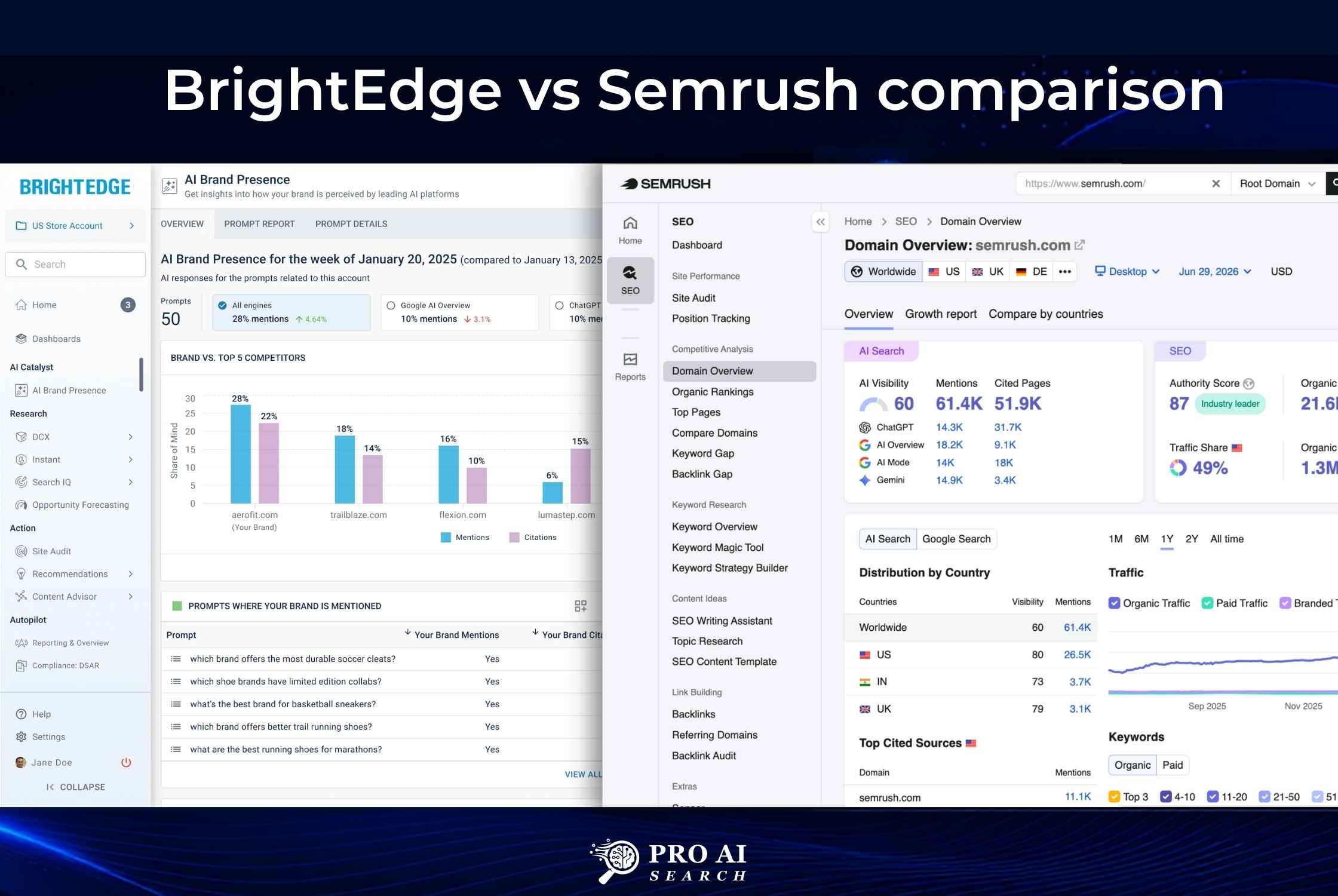
When comparing BrightEdge vs Semrush for enterprise SEO, the decision comes down to two questions: how large is your keyword portfolio, and do you need AI search tracking without a six-figure contract commitment? I’ve evaluated both platforms across client work at Pro AI Search and through managing multi-client SEO at VEGA AI, and the answer is rarely as simple as “BrightEdge for enterprise, Semrush for everyone else.”
This comparison covers the real pricing math (including BrightEdge’s credit model most reviews skip), the 2026 AI search tracking features on both platforms, and the specific threshold where BrightEdge starts making financial sense. Understanding how AI search differs from traditional search is the foundation for making sense of why both platforms have invested so heavily in AI visibility features this year.
Quick Verdict: BrightEdge vs Semrush at a Glance
| Factor | BrightEdge | Semrush |
|---|---|---|
| Starting Price | $30,000+/year (custom quote) | $139.95/month |
| Pricing Model | Custom enterprise quote | Transparent public tiers |
| Free Trial | No | Yes (7 days) |
| AI Search Tracking | AI Hyper Cube (enterprise plan) | AI Visibility Toolkit ($99/mo add-on) |
| Keyword Database | 5B+ keywords (DataCube) | 26.3B+ keywords |
| Site Audit Scale | Millions of pages (ContentIQ) | Plan-based crawl limits |
| Onboarding Time | 4 to 6 weeks | ~30 minutes |
| Contract Type | Annual minimum, 2 to 3 years typical | Monthly or annual, cancel anytime |
| G2 Support Score | 9.3/10 | 8.6/10 |
| Best For | Fortune 500, 50K+ keyword portfolios | Agencies, SMBs, mid-market |
Pricing: BrightEdge’s Enterprise Math vs Semrush’s Transparent Tiers
When I looked at BrightEdge for FinLecture.in, the personal finance site I run on a constrained budget, the pricing conversation ended before it started. BrightEdge does not publish pricing on its website. You submit a contact form, a sales rep calls, and the quote typically lands between $30,000 and $150,000 per year depending on domains, keywords tracked, and user seats. Based on Vendr’s dataset of 27 actual enterprise purchases, the median annual contract value is approximately $51,000/year.
Semrush is the opposite. Three public plans: Pro at $139.95/month for freelancers and small teams, Guru at $249.95/month for growing agencies, and Business at $499.95/month for agencies and larger teams. Annual billing saves 17%. You can start a 7-day free trial without speaking to anyone. Even Semrush Business at $499.95/month works out to $5,999/year, roughly one-tenth of BrightEdge’s entry-level enterprise contract. If you’re comparing tools as part of a broader GEO vs SEO strategy, the pricing gap shapes the decision before features even enter the picture.
The part most BrightEdge reviews skip is the credit-based pricing model. BrightEdge charges one credit per keyword per SERP per country. Tracking 10,000 keywords across five markets and three search engines multiplies credit consumption fast. Enterprise accounts managing global keyword portfolios regularly report costs escalating well beyond the quoted base price as teams add markets and data integrations. This is the mechanism behind the most common user complaint: BrightEdge locks you into $50,000+ annual contracts with no performance guarantees.
BrightEdge also requires a minimum annual contract, with 2-3 year commitments being standard for enterprise deals. Semrush lets you cancel any monthly plan immediately. That flexibility matters when evaluating a new platform alongside your AI search optimization workflow and you need room to iterate without a long-term financial commitment.
AI Search Tracking in 2026: BrightEdge AI Hyper Cube vs Semrush AI Visibility Toolkit
This is the comparison section no competitor article covers properly. At LearnQ.ai, when Google AI Overviews started cannibalizing test-prep queries, our team needed to track both traditional SERP position and AI channel visibility simultaneously. In 2026, both BrightEdge and Semrush have platforms for this. The difference is access and cost.
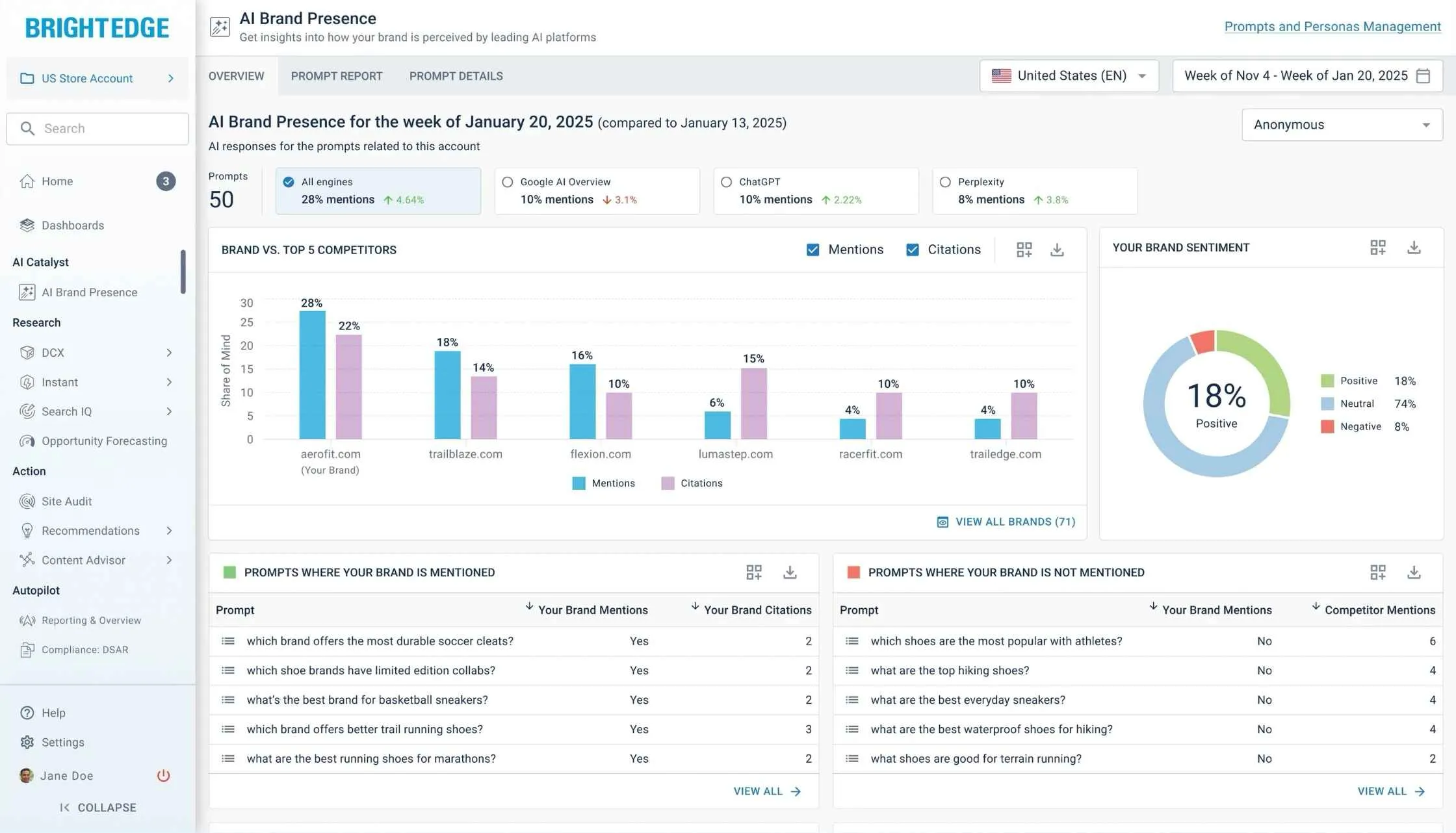
BrightEdge launched AI Hyper Cube in March 2026, a dedicated platform for tracking brand visibility across AI-powered search engines including ChatGPT, Gemini, and Perplexity. The platform also includes the AI Early Detection System (real-time traffic attribution from AI channels) and AI Agent Insights (how AI agents interact with and crawl your site). These are enterprise-grade features for large-scale AI search monitoring at the scale of companies managing multiple brands across global markets. The limitation is they live inside BrightEdge’s enterprise contract. AI Hyper Cube is not available without a minimum $30,000/year commitment.
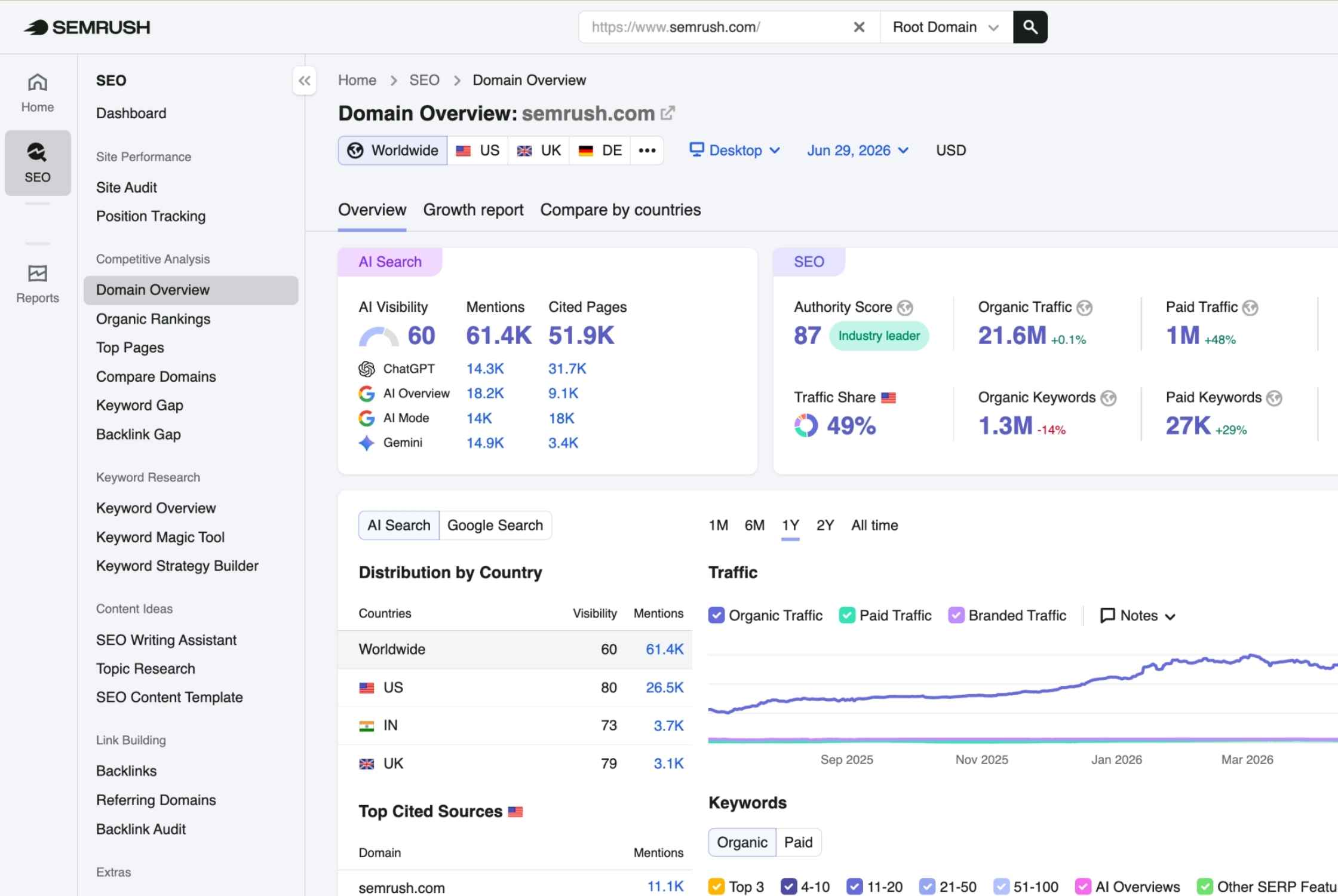
Semrush launched its AI Visibility Toolkit as a $99/month add-on. It tracks brand mentions and citations in Google AI Overviews, Google AI Mode, ChatGPT, Gemini, and Perplexity. Position Tracking now includes Google AI Mode data, which matters for monitoring visibility in AI-driven search results. If you need to understand your brand’s AI search presence without committing to a six-figure enterprise contract, Semrush’s AI Visibility Toolkit at $99/month on top of a Guru or Business plan is the practical answer for most SEO teams in 2026.
Both platforms now track the same core AI search channels: Google AI Overviews, ChatGPT, Gemini, and Perplexity. The question is whether you need BrightEdge’s enterprise-grade implementation across multiple brands and markets, or whether Semrush’s add-on covers your monitoring requirements. For the GEO strategy work I do at Pro AI Search, the Semrush toolkit handles core AI search tracking without the enterprise contract overhead. Knowing how ChatGPT chooses sources is more important than which platform you use to monitor it.
Data Depth and Keyword Research
With VEGA AI’s B2B SaaS clients, managing keyword portfolios at scale surfaced a real difference between the two platforms. BrightEdge’s DataCube tracks 5 billion keywords across 170 countries. Semrush’s Keyword Magic Tool covers 26.3 billion keywords. On raw data volume, Semrush wins clearly. But for enterprise teams, BrightEdge’s DataCube advantage is not about volume, it’s about enterprise competitive intelligence: share-of-voice tracking at scale, SERP layout analysis per keyword, and market opportunity scoring that Semrush’s tools do not fully replicate at the same depth.
BrightEdge Instant delivers real-time keyword insights and trend monitoring, which matters for enterprise teams where a 24-hour data delay has measurable revenue consequences. Semrush updates most keyword data daily, which covers the vast majority of SEO use cases. For granular rank tracking across multiple markets simultaneously, BrightEdge’s infrastructure is purpose-built for that specific problem. Semrush’s Position Tracking is strong, but it operates at a different scale ceiling.
ContentIQ, BrightEdge’s site audit tool, crawls millions of pages and integrates audit results directly with revenue and conversion dashboards, correlating technical fixes with measurable business outcomes. Semrush’s Site Audit and Content Audit Tool are excellent for teams running AI-focused content optimization, but they have plan-based crawl limits and do not natively connect to revenue attribution at the same enterprise depth. Whether you also need to configure robots.txt for AI crawlers or run a technical GEO audit alongside your keyword research, Semrush covers both without additional contract negotiation.
Onboarding, Setup, and Time to Value
When onboarding a new client at Pro AI Search, the practical question is always: how quickly can we start delivering measurable results? Semrush takes approximately 30 minutes to connect Google Analytics 4 and Google Search Console, set up Position Tracking, and start pulling live data. The GA4 AI search tracking setup adds another hour or two on top of that. By the end of day one, you have a live dashboard showing keyword positions, organic traffic, and AI channel attribution.
BrightEdge typically requires 4 to 6 weeks for full enterprise onboarding. This includes API integrations with existing enterprise data infrastructure, custom report builds with the dedicated account team, and dashboard configuration. BrightEdge provides a dedicated customer success manager throughout this process, which explains why its G2 support score of 9.3 outperforms Semrush’s 8.6. That support quality is genuine. The 4-6 week delay before you have usable data is also genuine, and comparison articles almost never acknowledge the operational cost of that gap.
The contract commitment compounds this risk. You sign a 2-3 year enterprise deal, spend 6 weeks onboarding, and only then discover whether BrightEdge fits your team’s actual workflow. Semrush lets you run a free 7-day trial, then stay month-to-month on any plan. If your team needs to check whether AI can read your site and run a technical GEO audit from day one, Semrush removes that implementation risk entirely. BrightEdge’s onboarding quality is excellent once the 6 weeks are complete, but the investment comes before you have proof of fit.
When Does BrightEdge Actually Beat Semrush?
Based on what I’ve seen across the VEGA AI client base, BrightEdge stops being an overpriced Semrush alternative and starts being the right tool at a specific combination of scale thresholds. Get clear on all three before requesting a BrightEdge demo.
Keyword portfolio scale: BrightEdge’s DataCube enterprise competitive intelligence justifies its cost above approximately 50,000 keywords under active management. Below that threshold, Semrush Business at $499.95/month handles enterprise keyword research as well or better at a fraction of the price. Building a structured GEO content strategy on top of a large keyword portfolio is where Semrush’s faster iteration speed becomes the practical advantage, not a liability. The AI search optimization process for most businesses at this scale is fully addressed by Semrush plus the AI Visibility Toolkit add-on.
Team size: BrightEdge returns the most value to dedicated SEO teams of five or more who can fully utilize enterprise dashboards, custom reporting pipelines, and the dedicated account management relationship. For a two-person SEO team inside a large company, BrightEdge’s feature depth typically goes underutilized and Semrush Business delivers better return per feature actually accessed. If you’re building an AI SEO strategy across a lean team, Semrush’s faster iteration speed is the practical advantage.
Budget floor: the enterprise math works when BrightEdge’s contract represents under 5% of your annual digital marketing budget. That typically means $150,000 or more in total marketing spend per year. Below that budget level, committing $50,000 to a single SEO platform carries a real opportunity cost when the remaining budget needs to cover content production, link building, and paid acquisition. Above that threshold and at enterprise keyword portfolio scale, BrightEdge’s infrastructure advantage is real and the ROI case becomes clear. Understanding AEO vs SEO strategy helps frame which platform capabilities matter most at your current scale.
Who Should Choose BrightEdge vs Semrush
Choose BrightEdge if:
You are a Fortune 500 or large enterprise with a dedicated SEO team of five or more, managing 50,000+ keywords across multiple global markets. You have existing enterprise data infrastructure (BI tools, data warehouses, revenue dashboards) that BrightEdge can integrate with. Your annual digital marketing budget exceeds $150,000 and a $30,000 to $150,000 platform investment is proportionate. You need enterprise-grade AI search tracking across multiple brands through AI Hyper Cube. The 57% of Fortune 500 companies already on BrightEdge are your direct competitors. BrightEdge also wins on support quality: if you need a dedicated customer success manager and white-glove implementation, this is not a Semrush strength at any price point.
Choose Semrush if:
You are an agency, SMB, or mid-market company managing keyword portfolios under 50,000 terms. You need to track AI search visibility in Google AI Overviews, ChatGPT, Gemini, and Perplexity without committing to a multi-year enterprise contract. You want a free trial and the flexibility to cancel if your needs change. Your team needs to be fully operational within a day, not six weeks. If your AI search priorities include ranking in ChatGPT, improving Perplexity visibility, or reviewing which AI search platforms matter most for your audience, Semrush’s AI Visibility Toolkit paired with focused content work is the faster path to results. The best GEO tools complement Semrush well for anything outside its core feature set.
My Verdict
BrightEdge is a genuinely excellent platform for the specific use case it is built for: Fortune 500 enterprises with large keyword portfolios, dedicated SEO headcount, and existing data infrastructure to integrate with. Its G2 support score beats Semrush, its DataCube competitive intelligence is enterprise-grade, and AI Hyper Cube (March 2026) is a serious investment in AI search tracking infrastructure. If you are at the Fortune 500 level and your competitors are already on BrightEdge, the case for BrightEdge is self-evident.
For 95% of companies evaluating this comparison, including most mid-market companies and agencies, Semrush Business at $499.95/month plus the AI Visibility Toolkit at $99/month delivers comparable capability for $7,188/year versus BrightEdge’s $30,000+ entry point. That price gap only closes when you hit the enterprise thresholds I outlined: 50,000+ active keywords, five or more dedicated SEO team members, and a total marketing budget above $150,000/year. Below those thresholds, the additional cost of BrightEdge does not translate into proportionally better results.
If you are building an AI search optimization strategy in 2026, start with Semrush. Add the AI Visibility Toolkit. Run the llms.txt and technical setup to make sure AI systems can properly read your site. Check the rich snippet and structured data fundamentals. You will not hit the ceiling of what Semrush can do until you are well into enterprise keyword portfolio territory, and if and when you do, the case for BrightEdge becomes clear on its own.
Frequently Asked Questions: BrightEdge vs Semrush
Is BrightEdge better than Semrush?
BrightEdge is better than Semrush for Fortune 500 enterprises managing 50,000+ keyword portfolios with dedicated SEO teams and existing enterprise data infrastructure. For agencies, SMBs, and mid-market companies, Semrush delivers comparable or better ROI at a fraction of the price. The right answer depends on your scale and budget, not the feature list alone.
How much does BrightEdge cost?
BrightEdge does not publish public pricing. Based on third-party purchase data, contracts typically start around $30,000/year for small enterprise implementations and range to $150,000+ for large global accounts. The median annual contract value is approximately $51,000/year according to Vendr’s dataset of 27 actual BrightEdge purchases. Annual and multi-year contracts of 2-3 years are standard. Semrush starts at $139.95/month with public pricing and a 7-day free trial.
Does BrightEdge track AI search results?
Yes. BrightEdge launched AI Hyper Cube in March 2026, tracking brand visibility across ChatGPT, Gemini, Google AI Overviews, and Perplexity. It also includes the AI Early Detection System for real-time AI traffic attribution and AI Agent Insights for monitoring how AI agents interact with your site. These features are included in BrightEdge’s enterprise contract. For teams that need to set up AI search tracking without an enterprise contract, Semrush’s AI Visibility Toolkit at $99/month covers the same channels.
Can Semrush replace BrightEdge for enterprise SEO?
Semrush Business at $499.95/month replaces BrightEdge for enterprises below the 50,000 keyword and five-person SEO team thresholds. Above those thresholds, BrightEdge’s DataCube competitive intelligence, ContentIQ at millions of pages, and revenue dashboard integration provide capabilities that Semrush Business does not fully replicate. For most companies calling themselves “enterprise,” Semrush Business is sufficient and the price difference rarely justifies the upgrade.
What is BrightEdge AI Hyper Cube?
AI Hyper Cube is BrightEdge’s enterprise AI search platform launched in March 2026. It tracks brand visibility and citation presence across ChatGPT, Gemini, Google AI Overviews, and Perplexity. It pairs with the AI Early Detection System for real-time AI traffic attribution and AI Agent Insights for monitoring how AI agents crawl and interpret your site. Understanding how AI search engines retrieve and rank content is the foundation for making sense of AI Hyper Cube data.
Which is the best enterprise SEO tool in 2026?
For enterprises with 50,000+ keyword portfolios, dedicated SEO teams, and annual marketing budgets above $150,000, BrightEdge is the best enterprise SEO tool in 2026 due to its DataCube depth, ContentIQ scale, and AI Hyper Cube infrastructure. For every other company, Semrush Business paired with the AI Visibility Toolkit is the best enterprise-grade SEO tool at a fraction of the cost. The latest AI search data shows both Google AI Overviews and ChatGPT search driving measurable traffic, so AI channel tracking is now a baseline requirement for any serious SEO platform in 2026.