
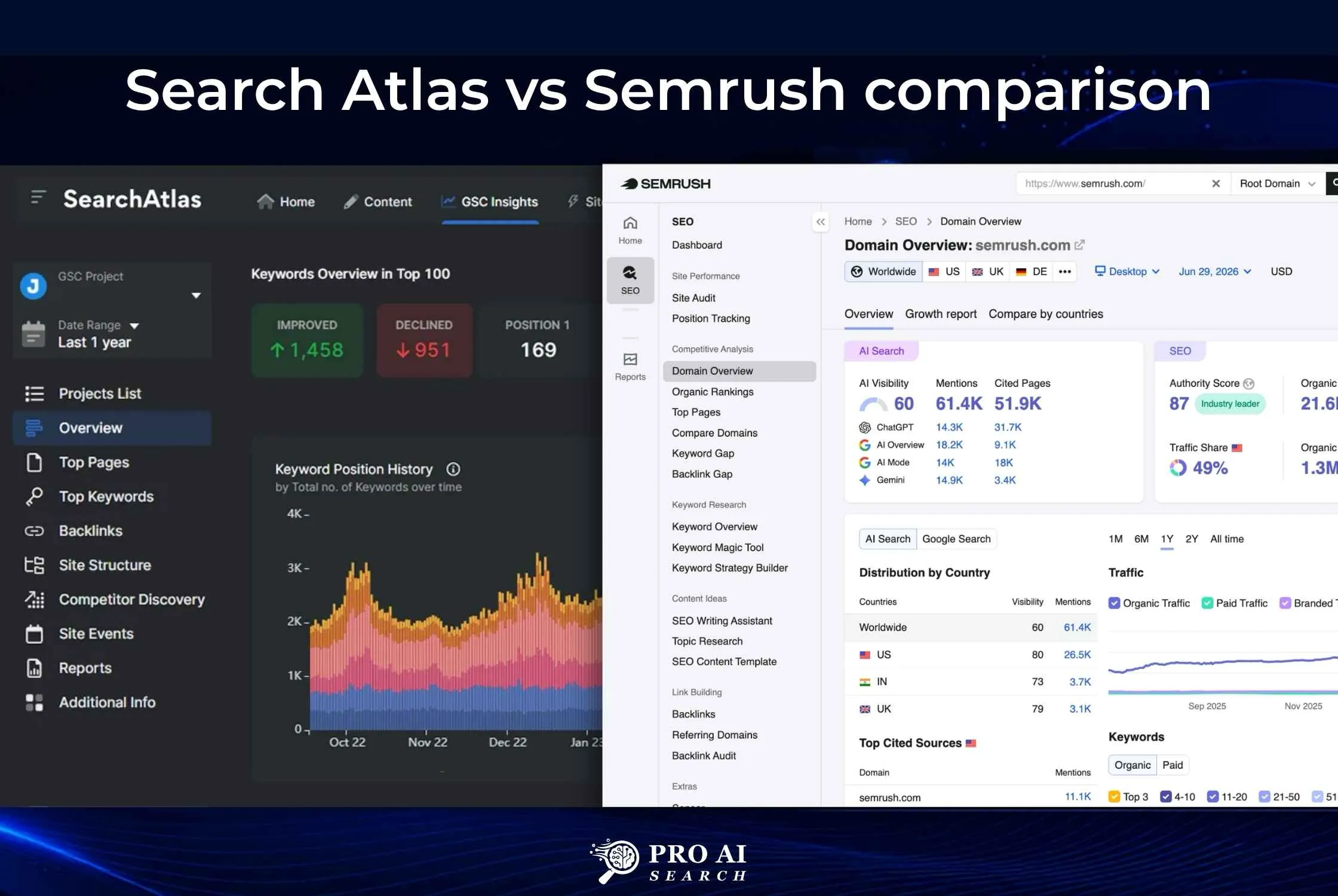
The search atlas vs semrush debate has a clear answer in 2026 if you are running an agency or tracking AI search visibility: these two tools are solving different problems. I run Pro AI Search, an AI SEO agency, and have managed multi-client SEO at VEGA AI across multiple educational institution accounts. I have used both platforms where it actually matters: on real teams with real budgets making real tool decisions. This comparison covers the AI tracking differences, the pricing math most reviews skip, and how OTTO SEO’s autonomous implementation changes the calculus for anyone with more than one person on their SEO team.
The context behind both platforms investing heavily in AI features is the broader shift from traditional search to AI-driven results, where ranking in Google AI Overviews, Gemini, and ChatGPT now requires a different toolset than ranking in the ten blue links. Understanding why GEO and SEO require different strategies sets the frame for evaluating which platform is actually built for where search is going.
Quick Verdict: Search Atlas vs Semrush at a Glance
| Factor | Search Atlas | Semrush |
|---|---|---|
| Starting Price | $99/month | $139.95/month |
| User Seats | Included in all plans (1 to 10 seats) | 1 seat per plan; extra $45 to $100/mo each |
| AI/LLM Tracking | Growth ($199/mo, included); 6 platforms, daily updates | $99/mo add-on; 5 platforms, monthly cadence |
| Keyword Database | 11B+ keywords | 26.3B+ keywords |
| SEO Automation | OTTO SEO (autonomous implementation) | Audit only; manual implementation |
| Content Creation | Content Genius (drafts + topical maps + 1-click WP publish) | SEO Writing Assistant (scoring only, no generation) |
| Daily Rank Tracking | All plans | Plan-dependent |
| White Label | Pro plan ($399/mo) and above | No |
| Free Trial | 7 days + free 1:1 onboarding session | 7 days |
| Best For | Agencies, multi-client teams, multi-platform AI tracking | Solo operators, large-scale keyword discovery |
Pricing: The Agency Seat Math Nobody Shows You
The first question I ask any agency owner before recommending an SEO tool is how many people are on the team. That single answer changes the cost calculation entirely. Search Atlas includes multiple user seats in every plan: Starter at $99/month includes 1 seat, Growth at $199/month includes 3 seats, Pro at $399/month includes 5 seats, and Agency at $999/month includes 10 seats. Semrush includes exactly 1 seat in every plan tier, from Pro at $139.95/month to Business at $499.95/month, with extra seats costing $45 to $100 per month each depending on plan.
Here is the actual cost math for a 3-person SEO team. Search Atlas Growth at $199/month covers all three seats. Semrush Guru at $249.95/month plus 2 extra seats at $45/month each totals $339.95/month. Search Atlas saves that team $141/month, or $1,692/year. For a 5-person team, Search Atlas Pro at $399/month covers everyone. Semrush Business at $499.95/month plus 4 extra seats at $45/month comes to $679.95/month, a difference of $281/month or $3,372/year.
When I was evaluating tools for the VEGA AI team managing multiple client accounts, this seat math ended the conversation before features did. For FinLecture.in, where I run a lean content operation on a tight budget, the Search Atlas Starter plan at $99/month with built-in AI content creation removed the need for a separate writing tool subscription entirely. The data on AI search growth makes the platform choice a longer-term decision than it looks at first glance: the tool you lock your team into now needs to handle where search is going, not just where it is.
AI Search and LLM Visibility Tracking: Where the Platforms Split
Both platforms now offer AI search tracking, but the architecture, cost, and breadth are meaningfully different. Search Atlas launched its LLM Visibility tool in October 2025, monitoring brand and content citations across ChatGPT, Claude, Gemini, Perplexity, Grok, and Copilot with daily query data refreshes. This feature is included in the Growth plan at $199/month and above, not sold as an add-on. Understanding how AI search engines retrieve and cite sources explains why daily update cadence matters: citation patterns in LLM responses shift faster than a monthly refresh cycle can detect.
Semrush’s AI Visibility Toolkit is a $99/month add-on on top of your existing Semrush plan. It tracks brand mentions across Google AI Overviews, Google AI Mode, ChatGPT, Gemini, and Perplexity. Semrush’s AIO dataset is stronger for Google AI Overviews specifically, with 158M+ prompts updated monthly, which matters if the Google AI ecosystem is your primary focus. But for cross-platform LLM tracking that includes Claude, Grok, and Copilot with daily refreshes, that coverage is not in Semrush’s current offering.
When Google AI Overviews started cannibalizing high-volume test-prep queries at LearnQ.ai, the team needed to track both SERP rankings and AI citation presence simultaneously. That dual-tracking need is where the daily versus monthly update gap becomes a real operational issue, not just a spec comparison. For a broader look at what the category offers, the best GEO tools comparison covers the full AI visibility tracking landscape. For the platform-specific strategy side, the guides on how to rank in ChatGPT and appearing in Perplexity results both apply regardless of which tracking tool you use.
OTTO SEO vs Semrush Site Audit: Analytics Engine vs Execution Engine
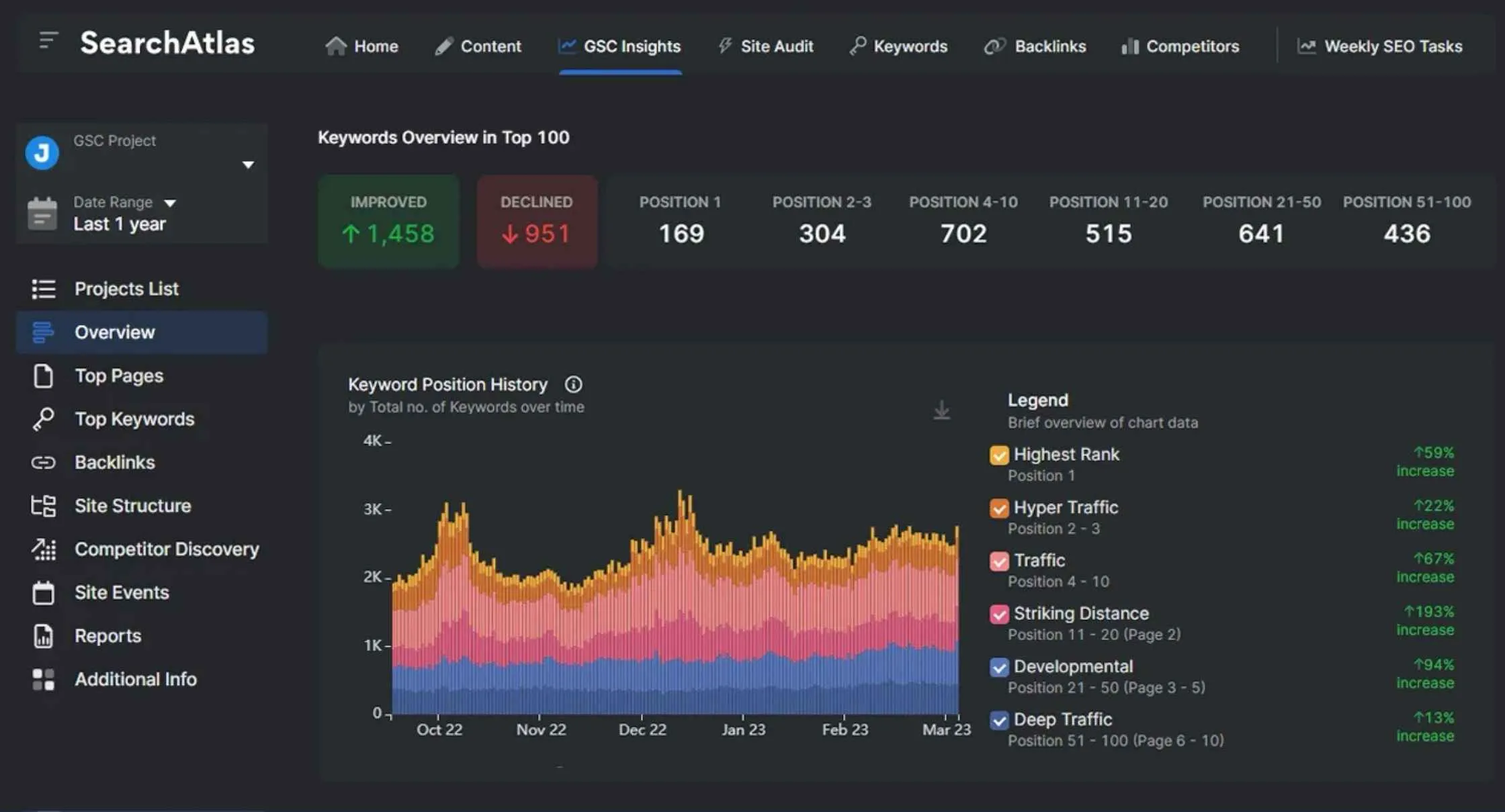
This is the most important distinction in this comparison, and most competitor articles frame it incorrectly. Semrush is a world-class analytics engine: it audits your site and delivers a precise list of issues. 47 missing H1 tags. 12 broken internal links. 8 pages with duplicate meta descriptions. The diagnosis is accurate. The implementation is your team’s problem. Search Atlas built OTTO SEO to audit AND fix, autonomously, without your developers or editors touching each issue manually.
OTTO SEO works through an on-site pixel and an assigned project per plan tier: 1 OTTO project on Starter, 2 on Growth, 4 on Pro, and 10 on Agency. The system reads your site’s technical issues and applies fixes directly: schema markup, meta tag corrections, internal linking improvements, and other on-page work that would normally sit in a backlog for weeks. This is what running a full technical SEO audit looks like when the audit output is also the implementation queue. For sites where robots.txt configuration for AI crawlers needs attention or GA4 AI search tracking needs setup, OTTO handles those implementation tasks in the same workflow. Whether llms.txt improves AI visibility for your site is a question OTTO can help test by managing the file across properties.
At VEGA AI, managing SEO across multiple educational institution clients, the bottleneck was never knowing what to fix. It was having the bandwidth to fix it across every property simultaneously. Semrush gave us better diagnosis reports. OTTO SEO would have replaced the implementation hours those reports generated. The honest caveat: OTTO works best on standard CMS setups, particularly WordPress. Complex enterprise custom stacks may need the OTTO Implementation Service for initial configuration. For the agencies doing their own setup, the AI search optimization checklist maps well to what OTTO automates, which gives you a useful baseline for calculating how much manual effort it removes from your current process.
Keyword Research: Semrush’s 26.3B Database vs Search Atlas
Semrush has the largest publicly available keyword database in the market at 26.3B+ keywords with daily updates. For enterprise competitor research, topical authority mapping, and broad keyword discovery, this is a genuine and unmatched advantage. When I build a GEO content strategy for a new client site from scratch, I typically start in Semrush for initial keyword universe discovery before moving to tracking and implementation.
Search Atlas has approximately 11B+ keywords in its database, but overlays Majestic TrustFlow and CitationFlow metrics on keyword and backlink data, which are not available inside Semrush natively. The rank tracker in all Search Atlas plans runs daily position updates, while Semrush’s tracking frequency varies by plan. For a 300-keyword project on Search Atlas Growth versus the same scope on Semrush Guru, Search Atlas delivers fresher position data and includes all the user seats your agency needs. The guide to tracking AI search rankings covers how to configure both platforms for monitoring visibility across traditional SERP and AI-driven results simultaneously.
For content strategies built around AI search optimization rather than traditional keyword volume, the 26.3B vs 11B gap matters less than it did in previous years. The relevant dataset for answer engine optimization is the prompts and questions AI engines are responding to, not the full long-tail keyword universe. That is where Search Atlas’s LLM Visibility data adds context that keyword databases alone cannot provide. The latest AI search statistics show the shift in query patterns that makes this distinction increasingly important for 2026 strategy planning.
Content Creation: Content Genius vs Semrush Writing Assistant
Search Atlas includes Content Genius v3 in its plans as a full AI content suite: topical map generation, complete article draft creation, bulk generation across multiple keywords, competitor URL-based content, and 1-click WordPress publishing from inside the dashboard. The workflow goes from keyword cluster to published article without leaving the platform. Semrush’s SEO Writing Assistant scores an existing draft and provides improvement recommendations. It does not generate content, create topical maps, or publish to your CMS. Understanding how ChatGPT chooses which sources to cite is part of what should inform your content structure either way, since the goal is not just ranking but being extracted and cited by AI engines.
For FinLecture.in, replacing Semrush plus a separate AI writing tool with Search Atlas Growth at $199/month made the budget math work. The alternative was Semrush Guru at $249.95/month plus a content generation subscription at $60 to $100/month, versus one Search Atlas plan covering both. The trade-off is keyword discovery depth: Semrush wins for broad keyword universe research, Search Atlas wins for workflow integration when content production volume matters. The AEO vs SEO distinction is also relevant here: if your content goal is structured for direct AI answers rather than traditional ranking, Content Genius’s topical map and draft generation workflow aligns with that objective in a way Semrush Writing Assistant does not.
When Should You Choose Search Atlas Over Semrush in 2026?
Choose Search Atlas if your SEO operation has two or more people. The multi-seat pricing alone justifies the switch at the Growth plan level for any team of three or more. Choose Search Atlas if you need daily LLM visibility tracking across ChatGPT, Claude, Gemini, Perplexity, Grok, and Copilot bundled into your plan rather than priced as an add-on. Choose Search Atlas if OTTO’s autonomous implementation fits your workflow: agencies managing multiple WordPress client sites where implementation hours are the constraint, not audit data, get the most from it. The complete AI SEO strategy framework covers how to layer these tools into a full multi-platform optimization workflow.
Choose Semrush if you are a solo operator where single-seat pricing is not a disadvantage, and you need the deepest keyword database available for competitive research at scale. Choose Semrush if Google AI Overviews is your primary AI channel and you want the most comprehensive AIO prompt dataset on the market. Choose Semrush if switching costs outweigh the pricing advantages: years of historical data, existing integrations, and team muscle memory on a platform are real switching costs worth quantifying. Adobe’s 2025 acquisition of Semrush has not visibly impacted the product yet, but the pricing trajectory and feature roadmap are worth monitoring if you are evaluating a multi-year commitment.
For agencies making a long-term platform decision, the honest positioning is this: Search Atlas is the better-built tool for the future of generative engine optimization and multi-platform AI search visibility. Semrush is the stronger tool if traditional keyword research depth remains your primary use case and you are working solo or in a small team where seat pricing does not change the math. At Pro AI Search, we use both depending on client context: Semrush for enterprise keyword discovery work, Search Atlas for agency-scale tracking and content production. Our AI search optimization services include tool recommendations tailored to team size and primary AI channel focus as part of the initial strategy engagement.
Frequently Asked Questions
Is Search Atlas better than Semrush for AI search SEO?
Search Atlas is better than Semrush for agencies using multi-seat pricing, for cross-platform LLM visibility tracking across 6 AI engines with daily updates, for content creation and publishing workflows, and for OTTO SEO’s autonomous technical implementation. Semrush is better for large-scale keyword discovery with its 26.3B+ keyword database, for Google AI Overviews depth, and for solo operators who need one comprehensive data research platform. The best choice depends on team size, content volume, and which AI channels your audience uses most.
Does Search Atlas track Google AI Overviews?
Yes. Search Atlas tracks Google AI Overviews as part of its LLM Visibility feature, included in the Growth plan at $199/month and above. It also tracks ChatGPT, Claude, Gemini, Perplexity, Grok, and Copilot with daily data refreshes. Semrush’s AI Visibility Toolkit covers Google AI Overviews with a larger prompt database (158M+) but requires a $99/month add-on and updates monthly rather than daily. For sites where ChatGPT vs Perplexity traffic patterns differ significantly by keyword cluster, the daily cadence in Search Atlas gives you faster signal on which platform is sending citations.
What is OTTO SEO and is it worth it?
OTTO SEO is Search Atlas’s autonomous AI agent that identifies and fixes technical SEO issues on your site without manual implementation. It handles schema markup, meta tag optimization, internal linking, and on-page fixes through an on-site pixel. For agencies managing multiple WordPress client sites where implementation hours are the bottleneck, OTTO replaces significant developer and editor time. It is worth it if your current workflow involves acting on long Semrush audit checklists manually and you have standard CMS sites. It is less relevant for solo operators with one or two sites who can handle audit-to-implementation directly.
Can Search Atlas replace Semrush entirely?
For most agency and mid-market SEO workflows, yes. Search Atlas covers keyword research, rank tracking, backlink analysis, site audits, content creation, local SEO, and LLM visibility in one platform. The area where Semrush remains stronger and not replaceable is keyword database depth at 26.3B versus Search Atlas’s 11B. If your primary use case is enterprise-scale competitive keyword research requiring the broadest possible universe, that gap is meaningful. For content strategy, AI search tracking, and execution-focused workflows, Search Atlas covers the same ground at lower per-seat cost. The GEO vs AEO vs LLM SEO comparison helps clarify which methodology your strategy is built on, which in turn clarifies which tool’s strengths are most relevant.
Which tool is better for AI search SEO for Indian agencies?
For Indian agencies and businesses targeting AI search visibility, Search Atlas offers stronger value at the team level: multi-seat pricing is critical for lean agency teams, daily LLM tracking covers the platforms Indian users increasingly use for research queries, and OTTO’s automation reduces implementation overhead on constrained budgets. Semrush has stronger India-specific SERP data for traditional search and better Google AI Overviews coverage for those prioritizing the Google ecosystem, which remains dominant in India. For resources on AI search strategy for Indian MSMEs, the budget and team-size considerations there map directly to the Search Atlas vs Semrush decision framework above.