
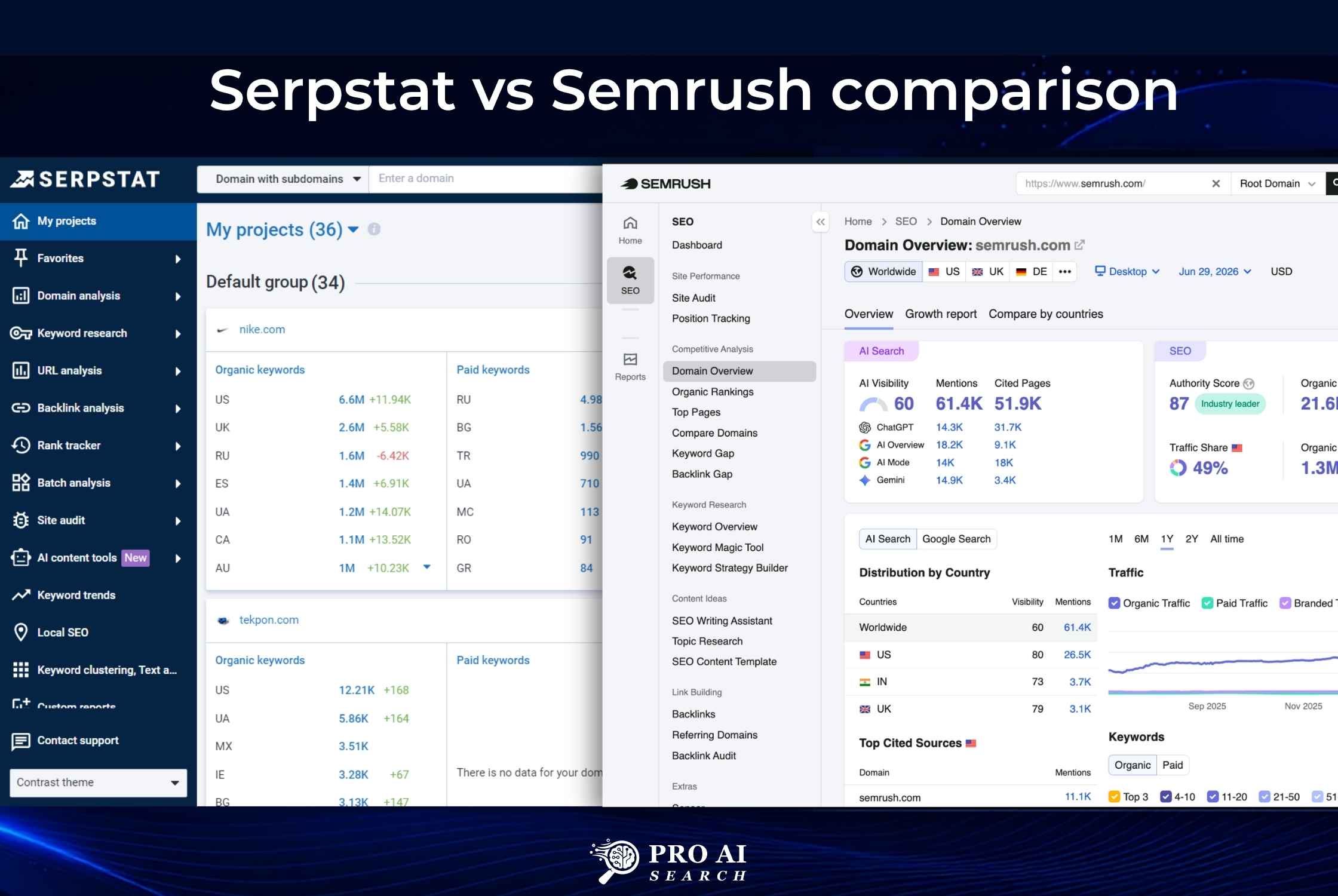
The serpstat vs semrush question comes up on almost every client onboarding call at Pro AI Search. Both are real platforms doing real SEO work. Both have meaningful gaps. I have run Serpstat on FinLecture.in and tested Semrush across multiple client sites, including B2B SaaS work through VEGA AI. This is my honest comparison, not a feature-by-feature list padded to seem thorough.
If you understand why AI search behaves differently than traditional search, you already know why the tool you choose in 2026 matters more than it did two years ago. The short version: Serpstat wins on price and API value. Semrush wins on data depth and AI search visibility tracking. Here is the breakdown.
Quick Verdict: Serpstat vs Semrush at a Glance
Neither tool is the right answer for everyone. The right answer depends on your budget, your team size, and whether AI search tracking is part of what you need to deliver. Here is the comparison at a glance:
| Feature | Serpstat | Semrush |
|---|---|---|
| Starting price (annual) | ~$50/month | $139.95/month |
| Keyword database | 7 billion+ | 25 billion+ |
| Backlink index | Smaller, solid for monitoring | 43 trillion+ backlinks |
| AI Overview tracking | Basic detection in reports | Full AI Visibility Toolkit ($99/mo add-on) |
| Google AI Mode tracking | Not available | Available in Position Tracking (2026) |
| ChatGPT / Gemini tracking | LLM Brand Monitor (separate product) | Included in AI Visibility Toolkit |
| API access | From $100/month (Team) | From $499.95/month (Business) |
| Best for | Solo SEOs, lean teams, budget agencies | AI SEO agencies, multi-client programs |
If AI search tracking is not yet part of your client deliverables, Serpstat is the better value at almost every price tier. If you are doing serious AI SEO work or need to show clients where they appear in AI-generated responses, Semrush has the infrastructure and Serpstat does not yet.
Pricing: The Real Cost After You Scale
The entry-level price gap is real and should be your first filter. For FinLecture.in, I run Serpstat at the Individual plan. At around $50 per month on an annual commitment, it covers keyword research, competitor analysis, rank tracking, and site audits without becoming the most expensive tool in my stack. Semrush Pro starts at $139.95 per month. For a content site where AI search tracking is not the priority right now, that gap funds two months of content budget.
The gap widens when you look at the AI tracking layer. Our AI search statistics show AI Overviews now appear in roughly 27 to 32% of all tracked SERPs, which means ignoring AI search tracking is increasingly a business risk. Semrush’s AI Visibility Toolkit costs an additional $99 per month on top of your base plan. Serpstat includes basic AI Overview detection without an add-on, but the feature depth is not comparable.
| Plan tier | Serpstat (annual) | Semrush |
|---|---|---|
| Entry | ~$50/month (Individual) | $139.95/month (Pro) |
| Mid-tier | ~$100/month (Team) | $249.95/month (Guru) |
| Agency | ~$410/month (Agency) | $499.95/month (Business) |
| AI search tracking add-on | Included at basic level | +$99/month (AI Visibility Toolkit) |
| API access | Included from Team (~$100/mo) | Business plan only ($499.95/mo) |
One point most pricing comparisons miss: Serpstat includes API access from the Team plan at $100 per month. Semrush restricts API access to the Business plan at $499.95 per month. If your workflow involves pulling keyword or ranking data programmatically, that is not a minor difference. It is a $400 per month difference.
Core Features: Where Each Tool Actually Wins
For the core SEO loop (keyword research, rank tracking, backlink analysis, site audit), both tools deliver. The difference is in data depth and the workflows built around that data. Here is where each one actually leads.
Keyword Research
Semrush’s Keyword Magic Tool generates large keyword lists with intent signals. For planning content optimized for AI search, the ability to filter by question format and search intent directly in the tool speeds up planning. Serpstat handles keyword research well for most workflows: enter a seed keyword, pull volume and difficulty, and move to execution. The database is smaller (7 billion vs 25 billion+ keywords), which starts to matter most on niche B2B queries where long-tail coverage is thin. Understanding how GEO and SEO differ in 2026 also informs which keyword signals actually matter for your specific goals.
Rank Tracking
Both tools support rank tracking down to city level, which matters for location-specific visibility. I covered the detail of tracking rankings by location for AI search in a separate guide. Semrush updates daily and includes SERP feature tracking built into Position Tracking campaigns, including AI Overview detection. Serpstat tracks ranking changes with flexible scheduling and shows SERP feature flags, though the AI-specific filtering is more limited.
Backlink Analysis
Semrush claims 43 trillion backlinks in its index with continuous crawling. For competitive link gap analysis, that coverage matters: you find more referring domains, fresher link data, and more complete anchor profiles. Serpstat’s backlink database is useful for monitoring and spot-checking, but is smaller. If active link building or toxic link auditing is core to your work, Semrush leads on this one.
Site Audit
Semrush’s Site Audit tool checks 140+ issue types across crawlability, indexing, Core Web Vitals, and content. Serpstat’s audit includes strong crawl controls and supports JavaScript rendering, which matters for modern JavaScript-heavy sites. For acting on what audits surface, our full technical GEO audit checklist goes through the AI search layer that neither tool covers out of the box. That includes checking how your robots.txt affects AI crawlers and whether llms.txt helps SEO for your specific setup.
AI Overview and AI Search Tracking: The 2026 Differentiator
This is where the tools diverge most sharply, and where most comparison articles miss the story entirely.
At LearnQ.ai, I started noticing a pattern in Google Search Console: clicks for certain test prep queries were falling even though our rankings held steady at position one. The cause was AI Overviews. When Google displays an AI Overview for a query, the user often gets their answer from the AI summary and never clicks through to an organic result. Learning how to appear in Google AI Overviews became urgent, but first I needed to know which of our keywords were actually triggering them. That is where Serpstat and Semrush give you very different answers.
What Serpstat Offers for AI Search Tracking
Serpstat detects AI Overview presence in its rank tracking and keyword research modules, marking AIO-triggered keywords with a robot icon. The platform has done real research work here: their research across 30 million SERPs found AIO adoption, volatility, and sourcing patterns at scale. They also launched LLM Brand Monitor as a separate product for tracking brand mentions in AI responses.
The limitation: Serpstat tells you that an AI Overview appeared for a keyword. It does not tell you whether your content is being cited inside that AI Overview, how your brand is performing across ChatGPT or Gemini, or what prompts trigger your competitors to appear in AI responses. For a full picture of how AI search engines work and where your site fits in the citation ecosystem, that level of detail matters. Serpstat is building toward it but is not there yet.
What Semrush Offers for AI Search Tracking
Semrush built AI search tracking faster than any other major SEO platform. Their AI Visibility Toolkit ($99 per month add-on) tracks brand presence across ChatGPT, Google AI Overviews, Perplexity, and Gemini. You can configure custom prompts (25 to 200 depending on your plan), track daily visibility scores, and see exactly which domains are cited in your target queries. This directly informs a GEO strategy focused on earning AI citations, not just organic rankings.
Semrush also added Google AI Mode tracking to Position Tracking in 2026. When your content is cited in a Google AI Overview, it counts as a number one ranking in your tracking campaign, linking AI visibility directly to the workflow SEOs already use. This is also why setting up GA4 AI search tracking alongside your Semrush data gives you the most complete picture of how AI search affects your actual traffic.
The verdict on AI tracking: Semrush is the clear leader, and the gap is not small. If AI search visibility is part of what you need to measure and report on, Serpstat’s current offering is not a substitute. Whether you’re trying to understand ChatGPT vs Perplexity as citation sources, or want to know why your competitor ranks in AI answers while you do not, Semrush answers those questions and Serpstat does not.
Who Should Use Which Tool
Based on running Pro AI Search as an agency and using both tools across client verticals, here is how I actually map the decision.
Choose Serpstat if: you are a solo blogger, freelance SEO, or small team where the core research loop (keywords, competitor analysis, rank tracking, audit) covers 90% of your work. The entry price is realistic, the API is included at a fraction of Semrush’s gating threshold, and you are not yet delivering AI search visibility reports to clients. The difference between a 7 billion and 25 billion keyword database matters less than most comparisons suggest for standard use cases. Check whether rich snippets help SEO for your vertical before deciding how much SERP feature tracking you actually need.
Choose Semrush if: you run a multi-client agency, you work on AI search optimization deliverables, or your clients are asking where their brand appears in ChatGPT and Google AI Overviews. At VEGA AI, when B2B SaaS clients started asking whether AI search engines were recommending their product in category queries, Serpstat could not answer the question. Semrush could. Understanding how AEO and traditional SEO differ is also part of this shift: clients increasingly want answer engine optimization coverage alongside standard SEO, and Semrush’s toolkit is built for both.
The budget-constrained agency case: if you manage 3 to 5 clients and need both core SEO research and AI search tracking, consider running Serpstat for keyword and competitor work and adding a dedicated AI visibility platform on top. The best GEO tools for AI search guide covers what is available outside of Semrush for that layer. For Perplexity AI alternatives and other AI search platforms you may need to track, the platform landscape is still evolving quickly.
My Honest Verdict
Serpstat and Semrush are not competing for the same customer anymore, at least not in 2026. Serpstat is a solid, affordable core SEO platform for teams doing keyword research, competitive analysis, and rank tracking without needing enterprise data infrastructure or AI search visibility tracking. Semrush is the right tool when AI search tracking is part of what you deliver, when you need the deepest backlink and keyword data available, or when you run multi-client programs that need repeatable reporting workflows.
My current stack: Serpstat for budget-sensitive client accounts and personal projects where the core SEO loop is sufficient. Semrush’s AI Visibility Toolkit when a client needs to see where their brand appears in AI-generated responses. There is no Serpstat substitute for that workflow right now. Understanding how to rank in ChatGPT or how to rank in Perplexity starts with knowing whether you appear at all, and Semrush tells you that. Serpstat does not yet.
The wrong move is paying for a more expensive tool and not using the features that justify the cost. Start with our AI search optimization checklist to identify where your actual gaps are before choosing a platform. If you want a team to run the full AI search stack for you, explore our AI search optimization services.
Frequently Asked Questions
Is Serpstat as good as Semrush for SEO?
For core SEO tasks (keyword research, rank tracking, backlink monitoring, site audit), Serpstat covers most of what Semrush offers at a significantly lower price. The main gaps are database size (7 billion vs 25 billion+ keywords), backlink index depth, and AI search tracking capability. Semrush is materially stronger on data depth, and its AI Visibility Toolkit has no direct equivalent in Serpstat’s current product lineup.
Why is Serpstat cheaper than Semrush?
Serpstat focuses on a tighter set of core SEO features with a smaller keyword and backlink database. It was built to be accessible for solo operators and small teams, while Semrush expanded into a broader marketing platform with larger data infrastructure and AI tracking tools. Serpstat also includes API access starting at the Team plan (~$100/month), while Semrush gates API access behind the $499.95/month Business plan.
Does Serpstat track Google AI Overviews?
Yes, at a basic level. Serpstat detects when AI Overviews appear for tracked keywords and marks them in its reports. They have published substantial research on AIO trends based on 30 million SERPs. For tracking whether your specific content is cited inside those AI Overviews, or monitoring AI search visibility across ChatGPT, Gemini, and Perplexity, Serpstat does not have a tool comparable to Semrush’s AI Visibility Toolkit.
Does Semrush have an AI search tracker?
Yes. Semrush’s AI Visibility Toolkit ($99 per month add-on) tracks brand presence in ChatGPT, Google AI Overviews, Perplexity, and Gemini. You configure custom prompts, track daily visibility scores, and see which competitors appear where you do not. Semrush also added Google AI Mode to its Position Tracking tool in 2026, counting AI Overview citations as number one rankings in your campaign.
Which is better for small agencies: Serpstat or Semrush?
Serpstat is the better choice for agencies doing traditional SEO at a manageable cost. Semrush is the better choice if your clients are asking about their presence in Google AI Overviews, ChatGPT, or Gemini, because Serpstat cannot answer those questions at the same depth. The deciding question is whether AI search visibility is part of your client deliverables. If it is, Semrush’s AI Visibility Toolkit is the most direct solution available right now.
Can I use both Serpstat and Semrush together?
Yes, and some agencies run exactly this split: Serpstat for keyword research and competitive analysis on budget-sensitive accounts, Semrush for AI search tracking on accounts where that visibility matters. The combined cost is significant, so this only makes sense at a certain client volume. A more cost-efficient alternative is Serpstat for core SEO research plus a dedicated AI visibility platform for the AI tracking layer, which is what the best GEO tools guide covers in detail.