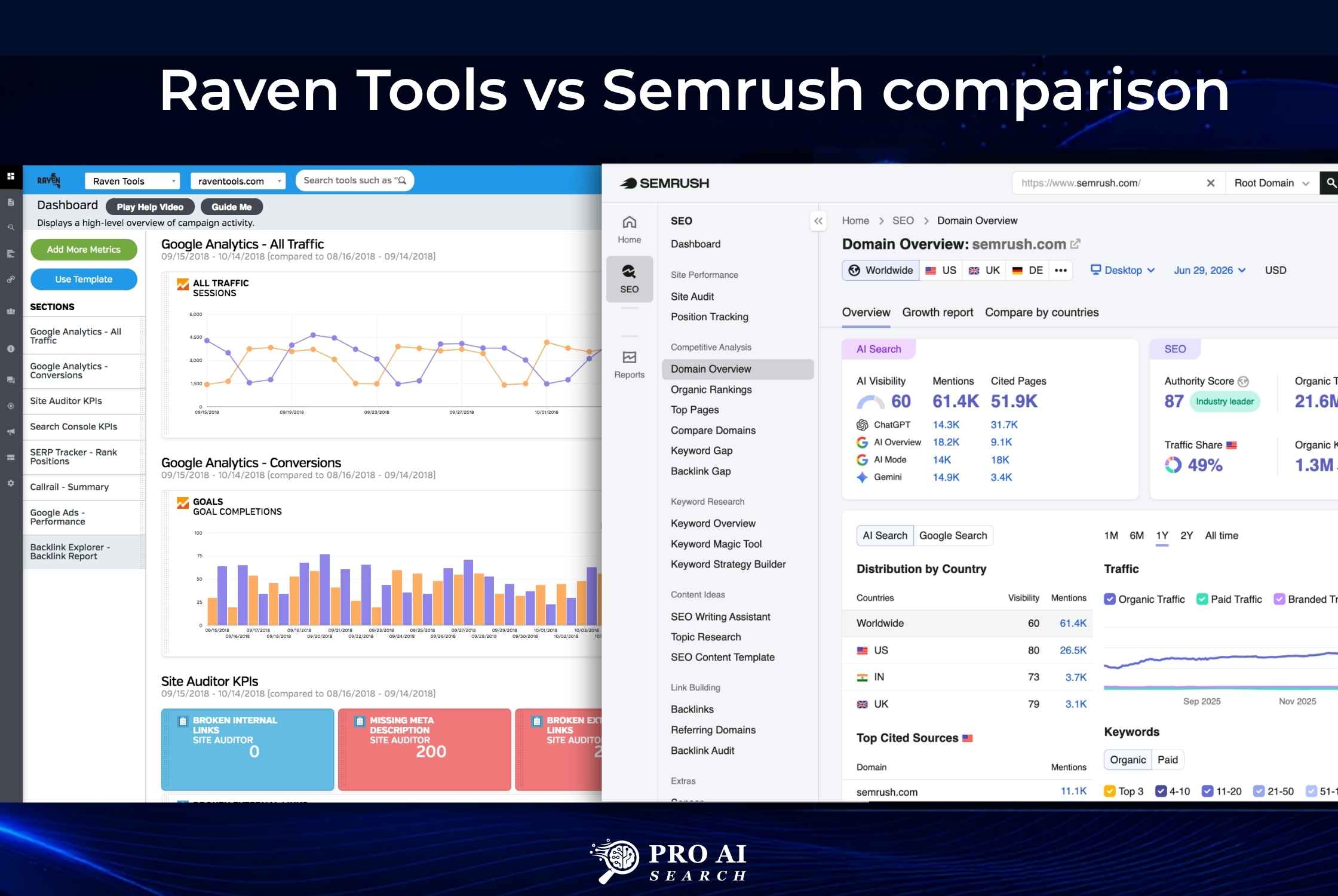
The raven tools vs semrush question comes up regularly on agency onboarding calls at Pro AI Search, and the honest answer is not what most comparison articles give you. These two platforms are not competing for the same workflow. Raven Tools is built around multi-source client reporting. Semrush is built around deep SEO research. Understanding where those priorities diverge is what this comparison is actually about.
At Pro AI Search, our agency tool decisions come down to three questions: how deep does the data need to be, how many people need access, and whether AI search tracking is on the scope. In 2026, that third question is what separates the two tools most sharply. Let me show you exactly why.
Quick Verdict: What Each Tool Is Actually Built For
Raven Tools is a reporting platform with SEO features built in. Semrush is a research platform with reporting capabilities added on top. That distinction changes which tool fits your agency depending on what your clients are actually asking for.
| Feature | Raven Tools | Semrush |
|---|---|---|
| Starting price (annual) | $39/month | $139.95/month |
| Users included | 2 to 40 (plan-dependent) | 1 per plan (add-ons for more) |
| Keyword database | 1.25 billion (via Moz) | 26.3 billion (own crawler) |
| Backlink data | Via Majestic | 43 trillion+ (own index) |
| White-label reports | All plans, multi-source data | Limited on lower tiers, SEO data only |
| AI Overview tracking | None | Full AI Visibility Toolkit ($99/mo add-on) |
| Google AI Mode tracking | None | Available in Position Tracking (2026) |
| ChatGPT / Gemini monitoring | None | Included in AI Visibility Toolkit |
| Best for | Traditional agencies, reporting-heavy workflows, multi-user teams | AI SEO agencies, deep research, AI search visibility |
If your clients want comprehensive monthly reports pulling from GA4, Search Console, Google Ads, and backlinks in one branded document, Raven Tools handles that better than Semrush and at a fraction of the cost per user. If your clients are asking where they appear in Google AI Overviews or ChatGPT, Raven Tools cannot answer that question at all.
Pricing Per Seat: The Agency Math No One Shows You
Every comparison article focuses on Raven Tools’ lower starting price. The more important number for agencies is cost per seat. At VEGA AI, I managed a team of five SEO specialists who all needed daily access to the same platform. That changes the pricing calculation entirely.
| Plan | Raven Tools (annual) | Users included | Domains |
|---|---|---|---|
| Small Biz | $39/month | 2 | 2 |
| Start | $79/month | 4 | 20 |
| Grow | $139/month | 8 | 80 |
| Thrive | $249/month | 20 | 160 |
| Lead | $399/month | 40 | 320 |
Semrush Pro at $139.95 per month gives you one user seat and five projects. For a team of five at VEGA AI, five Semrush Pro subscriptions would run $700 per month. Raven Tools’ Grow plan at $139 per month gives eight user seats and 80 domains. That is not a marginal pricing difference: it is a structurally different business model. Every Raven Tools plan includes all features, which means no team member is ever locked out of a tool because of plan tier.
For agencies that need rank tracking across multiple client domains, the domain limit matters as much as the user count. Raven’s Lead plan handles 320 domains at $399 per month with 40 users. Semrush Business at $499.95 per month handles 5 projects natively (expandable, but at additional cost) for one user. The right comparison is not plan vs plan: it is total team cost vs total team cost.
White-Label Reporting: Raven Tools’ Clearest Advantage
White-label client reports are where Raven Tools genuinely leads the category. Every plan includes branded reporting, and the data sources Raven pulls from go beyond what Semrush consolidates: Google Analytics 4, Google Search Console, Google Ads, Facebook Ads, Twitter, Majestic backlinks, and Moz metrics all feed into a single report. That kind of multi-channel aggregation is the core reason agencies adopt Raven Tools and stay with it.
At Pro AI Search, client reporting requirements typically include traffic data from GA4, ranking data, backlink changes, and ad performance in one monthly document. Raven Tools handles all of that in one workflow, with custom branding and scheduled delivery. Semrush’s reporting covers SEO metrics well, but building a comparable multi-channel report requires pulling from GA4 separately and assembling it manually or through an integration. For teams doing content optimization for AI search, the reporting layer matters as much as the research layer.
One important note: Raven Tools white-label reporting does not include AI search visibility data, because Raven has no AI tracking features. If your client report needs to show AI Overview citations, ChatGPT mentions, or Gemini visibility alongside traditional SEO metrics, Raven cannot provide that. Understanding how AI search engines work and why citation tracking matters in 2026 is the gap Raven Tools has not addressed.
SEO Data Depth: Where Semrush Has No Real Competition
Semrush runs its own crawler and maintains its own keyword database of 26.3 billion keywords, updated continuously. Raven Tools sources its keyword data from Moz (1.25 billion keywords) and its backlink data from Majestic. That sourcing arrangement creates two practical limitations for serious SEO research.
Keyword Coverage
The 20x keyword database gap between Semrush and Raven starts to matter on niche B2B queries where long-tail coverage is thin. At VEGA AI, when I was building out keyword research for clients in specialized SaaS verticals, Semrush consistently found relevant long-tail variations that Raven’s Moz-sourced data did not surface. For standard informational and commercial queries, both tools cover the ground adequately. For niche verticals, Semrush’s depth gives you more to work with.
Data Freshness
Raven’s data is only as fresh as Moz and Majestic make it. Semrush refreshes its own data on a daily to weekly schedule depending on the metric type. For tracking SERP features like rich snippets or monitoring backlink changes in near real-time, Semrush’s own infrastructure is more responsive. This is less of an issue for monthly reporting workflows where Raven excels, and more of an issue for active competitive monitoring or technical SEO work.
Site Audit
Semrush’s Site Audit checks 140+ issue types and includes progress tracking across crawls. Raven Tools’ audit is solid for surface-level technical checks but lighter in diagnostic depth. For agencies running full technical audits, our technical GEO audit checklist extends what either tool surfaces into the AI search layer, including checking how your robots.txt affects AI crawlers and whether llms.txt is helping your AI search visibility.
AI Search Tracking in 2026: Only One Tool Can Answer This
Raven Tools has no AI search tracking features. No AI Overview detection. No monitoring for ChatGPT, Gemini, or Perplexity citations. No Google AI Mode tracking. This is not a minor feature gap: it is an absence of an entire capability category that is now central to what serious AI SEO work requires.
At LearnQ.ai, when AI Overviews began appearing for test prep queries, our organic clicks dropped on keywords where we held position one. The AI Overview was absorbing the clicks before users reached our result. I needed to see which keywords were triggering AI Overviews and whether our pages were being cited as sources inside those summaries. Understanding how to appear in Google AI Overviews started with knowing whether we appeared at all. Raven Tools offered no answer to that question. Semrush did.
Our AI search statistics show AI Overviews now appear in roughly 27 to 32% of all tracked SERPs, and that share is growing. For any agency whose clients are asking about AI search visibility, Raven Tools is not a viable primary platform in 2026. The difference between GEO and traditional SEO is increasingly what separates agencies that can answer AI-era questions from those that cannot.
What Semrush Offers for AI Search
Semrush’s AI Visibility Toolkit ($99 per month add-on) tracks your brand presence in ChatGPT, Google AI Overviews, Perplexity, and Gemini. You configure custom prompts, monitor daily visibility scores, and identify the topics where competitors appear in AI-generated answers but you do not. This directly informs a GEO strategy built around earning AI citations, not just organic rankings. Semrush also added Google AI Mode to Position Tracking in 2026, so AI Overview citations count as number one rankings in your campaign. Setting up GA4 AI search tracking alongside Semrush data gives you the most complete picture of how AI search affects actual traffic.
If you need to monitor across individual platforms, our guides on ranking in ChatGPT and understanding ChatGPT vs Perplexity as citation sources cover the strategy. The tools question is simpler: for AI search visibility tracking, Semrush is the only mainstream SEO platform with the infrastructure to support it right now.
Who Should Choose Which Tool
After running Pro AI Search as an AI SEO agency and using both tools in real client work, here is the actual decision framework.
Choose Raven Tools if: your agency’s core deliverable is multi-channel client reporting, you need multiple team members sharing access without paying per seat, and your clients are not yet asking about AI search visibility. The combination of white-label reports, multi-source data aggregation, and generous user seats makes Raven Tools a strong choice for traditional SEO agencies running 10 to 40 client accounts. Understanding how AEO differs from traditional SEO may help you assess whether your current client base is moving toward AI-era questions or staying in traditional search territory.
Choose Semrush if: you are doing AI search optimization for clients, you need the deepest keyword and backlink data available, or your clients are asking about their presence in Google AI Overviews, ChatGPT, or Gemini. For agencies navigating the AI search era, Semrush’s research depth and AI Visibility Toolkit together cover both the traditional and AI-era deliverables. Check our best GEO tools guide if you want to see how other AI-specific tools compare alongside Semrush.
The hybrid case: some agencies run Raven Tools for client reporting and add Semrush for specific accounts where AI search research and deeper data are required. The total cost is higher, but for agencies at a certain client volume it makes more sense than paying Semrush per-seat rates for a team of ten. Our AI search optimization checklist can help you scope which client accounts genuinely need the Semrush layer and which are fine with Raven’s core stack.
My Honest Verdict
Raven Tools and Semrush are less direct competitors than most comparison articles suggest. Raven Tools is a reporting-first platform that happens to include core SEO research features. Semrush is a research-first platform that has added reporting over time. Most agencies need both things, which is why choosing between them requires being honest about which half of the job is harder for your team.
For traditional agency workflows in 2026, Raven Tools is still a strong choice: the per-seat pricing, the multi-source reporting, and the white-label flexibility are genuinely better than what Semrush offers at comparable cost. For any agency moving into AI search optimization, Raven Tools is a gap you will hit immediately. There is no Raven feature that shows you where your client appears in AI Overviews, ChatGPT, or Gemini, and in 2026, that question is not going away.
If you are not sure whether AI search visibility belongs in your current scope, the AI search optimization checklist is a useful starting point. Or if you want a team already set up for both traditional and AI search work, take a look at our AI search optimization services.
Frequently Asked Questions
Is Raven Tools still worth using in 2026?
Yes, for traditional agency reporting workflows. Raven Tools’ white-label multi-source reporting, multi-user seats at every price tier, and competitive pricing make it a practical choice for agencies that deliver monthly client reports combining GA4, Search Console, Google Ads, and backlink data. The platform has slowed on new feature development since its TapClicks acquisition, and it has no AI search tracking features, which is a real limitation for agencies moving into AI SEO work.
Why does Raven Tools include so many more user seats than Semrush?
Raven Tools was built as an agency platform from the start. The business model includes multi-user seats at every plan tier because agency teams need shared access. Semrush was built as a research tool and charges per additional user seat. At the agency level, this difference makes Raven Tools dramatically more affordable for teams of five or more, even when Semrush appears cheaper on a per-plan basis.
Does Raven Tools have white-label reporting?
Yes, on all plans. Raven Tools white-label reports pull data from GA4, Google Search Console, Google Ads, Facebook Ads, Majestic backlinks, and Moz keyword data into a single branded document. Custom report templates, scheduled delivery, and client branding are available starting from the $39 per month Small Biz plan. This is one of Raven Tools’ strongest advantages over Semrush, which limits white-label options on lower plan tiers.
Does Raven Tools track Google AI Overviews or AI search?
No. Raven Tools has no AI search tracking features as of 2026. It does not track AI Overview appearances, does not monitor citations in ChatGPT or Gemini, and does not include Google AI Mode data in its rank tracking. For AI search visibility tracking, Semrush’s AI Visibility Toolkit ($99 per month add-on) is currently the main option among mainstream SEO platforms. If you want to understand what AI Overview coverage looks like for your niche, our guide on how to appear in Google AI Overviews covers the strategy side.
Which is better for agencies: Raven Tools or Semrush?
It depends on what your agency delivers. Raven Tools is better for multi-user teams doing traditional SEO reporting with multi-source data in client deliverables. Semrush is better for agencies doing AI search optimization, competitive keyword research at scale, or clients who want AI search visibility data. For agencies doing both, some teams run Raven for reporting and Semrush for research on specific accounts. Check the best GEO tools for AI search if you need a broader view of what is available for the AI visibility layer.
Can I use Raven Tools and Semrush together?
Yes. The most practical split is using Raven Tools for client reporting (multi-source reports, white-label delivery, team access) and Semrush for deep keyword and backlink research on accounts where data depth matters. The combined cost is higher, but for a team of eight or more working across 20+ client accounts, the per-seat savings on Raven plus the research depth of Semrush can justify both. For AI search platform alternatives beyond Semrush’s AI Visibility Toolkit, there are standalone options worth evaluating depending on your tracking needs.